First things first — I owe you an apology. The ESTC releases are behind and here’s exactly why.
Since the conference ended, some friends and I were putting in 12-16 hour days, 7 days a week, moving everything into the new shop before the lease ran out on the old one. When that was finally done, I took a couple days to catch my breath and got out of town.
A friend and I were on our way up to the hills to pick huckleberries when I got the news — Spokane was burning and my home was in an evacuation zone.
Fair warning: I apologize ahead of time, but partway through this I have to vent about some Spokane politics that won’t apply to most of you reading this. But it’s very related to these fires — how this disaster could have been prevented, and who dropped the ball at every level. Bear with me — or skip ahead to the donation section, because that part matters no matter where you live.
Three Fires, One Triangle — My Home Inside It
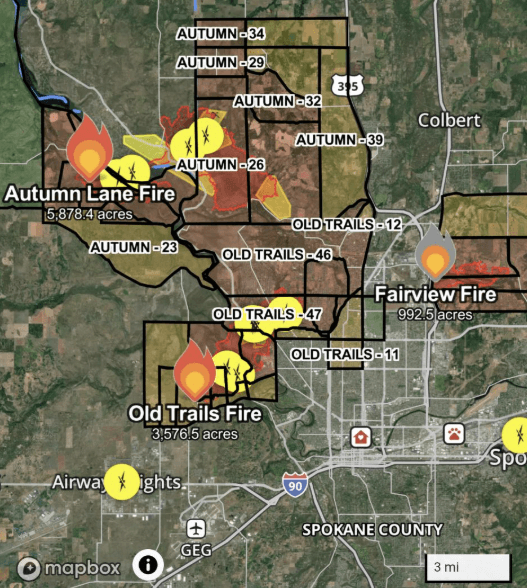
Three major fires broke out around Spokane in one afternoon — the Old Trails Fire, the Autumn Lane Fire and the Fairview Fire. Look at them on a map and they form a triangle around the north side of the city. My home sits at the south-central part of that triangle — closest to Old Trails, the big one that jumped the Spokane River and burned straight into the city.

From the Watch Duty app — I live in the Old Trails fire section.
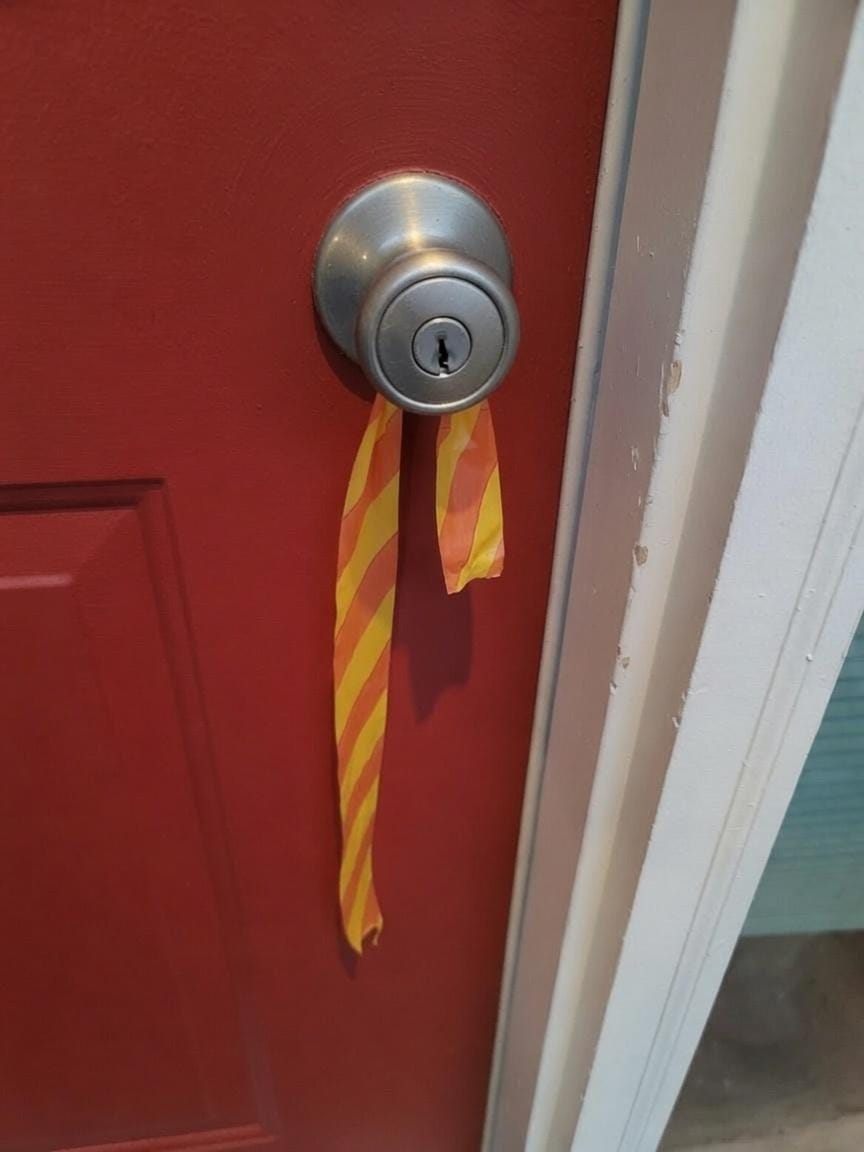
We were too far out for me to go back to his place and grab my truck, so my friend drove me straight to my home as fast as he could. This is what was waiting for me on my front door:

That ribbon is what crews leave on the door when they sweep an evacuation zone. Seeing one tied to your own doorknob puts a chill through you.
I talked to some of my neighbors — they were packing as fast as they could to evacuate. That’s when it really hit me. That’s when things got real. My friend and I packed the most valuable things into one of my cars and his, and we took off.
The next day I went back alone for everything I couldn’t take the first trip. Before I left, I took a picture of my home — because it might have been the last time I ever saw it.
Thankfully, I Had a Home to Come Back To
I got back home for good a couple days ago. So many were not so fortunate.
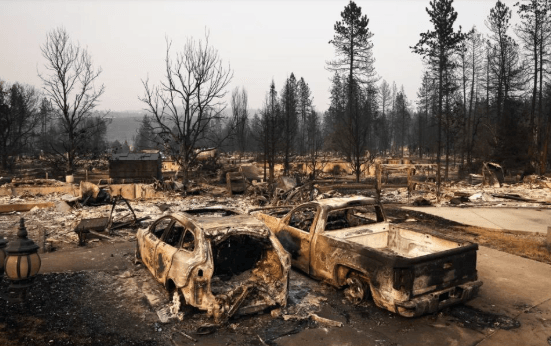
Just a couple minutes from my home is a disaster area. Entire neighborhoods burned to the ground. Somewhere between 700 and 1,100 homes and structures are gone — the most destructive fire in Washington state history. A few people I know had damage to their homes. Others lost their homes completely.

Image from a local news broadcast — used under fair use (17 U.S.C. § 107) for purposes of news reporting and commentary.
And before anyone asks why some trees are still standing — in Boy Scouts, I boiled an egg in a paper cup set right in a campfire. Seriously, go try it on a campfire or in a BBQ grill. You can boil an egg in boiling water in a paper cup and the paper doesn’t burn — for the SAME EXACT reason those trees are still standing that aren’t carbonized. The cup is full of water. Living trees are full of water. Kiln-dried homes are not. Simple physics. The trees that DID burn are obviously carbonized — different trees, different results. And no, there were no laser beams from space. I know there are a vast amount of conspiracies in play and have known for most of my life — they’re real and they’re not “theories.” But this isn’t one of them. If anyone starts posting laser beam photos from Spokane, they’re all fake.
What it actually was: a lunatic. A man with a prior manslaughter conviction was arrested and charged with first-degree arson for starting the Old Trails Fire — the fire that nearly took my home and DID take hundreds of others. At MINIMUM he should be sentenced to life.
The Buck Stops Where?
And here’s the part that should make your blood boil. According to court records and law enforcement’s own statements: this man killed his father in Arizona, shot himself, did his prison time, and then got discharged from probation WITHOUT ever completing his court-ordered mental health evaluation or treatment — with multiple reprimands from his own probation officer on the record. Discharged anyway. Then last year, Spokane law enforcement contacted him about an arson call in July AND a wildfire in Riverside State Park in August — the SAME park the Old Trails Fire just burned through. And on the day of THIS fire, a witness saw him crouching in the grass right at the origin point, police found him 1.5 miles away carrying waterproof matches and a butane lighter — and they questioned him and let him go while the city burned. The courts, the probation system, the mental health system and the police ALL had their chances with this guy, more than once, and every single one of them dropped the ball. 700+ families are paying for it. When the trial is over, the reckoning shouldn’t stop with him.
And let me be crystal clear about something: I support our firefighters and police 100%. The men and women on those fire lines and running those evacuations did their jobs and then some — some of them worked 30-40 hour shifts straight while this city burned. My problem is not with them. My problem is with the POLICIES and the people at the top who set them. That starts with Mayor Lisa Brown and city hall. On the very night the city was burning, a city official was on the record asking people not to turn on their sprinklers because water pressure had been affected — quote: “We’re already running into water issues in some of our water towers and our pumping capabilities.” Read that again. The night half the north side was on fire, the city’s water system was straining. And here’s some history for you: the Great Spokane Fire that burned down this entire city happened on August 4, 1889 — and the reason it couldn’t be stopped was a pump station failure that left NO water pressure in the hydrants. That was 137 years ago almost TO THE DAY. So the after-action review better answer some questions, in public: Why was water pressure affected? Do the city’s water pump stations have backup generators, and did every single one of them work? What has the city done about fuel management on city land along the bluffs where this fire climbed into our neighborhoods? These are city systems — the mayor’s systems — and this city’s complacent, soft-on-everything leadership doesn’t get a pass because the person who lit the match was a lunatic. And the mayor doesn’t run this city alone. The city council holds the budget and the oversight power, and today that council is a 6-1 progressive supermajority governing hand-in-hand with Mayor Brown: Council President Betsy Wilkerson, Zack Zappone, Paul Dillon and Kitty Klitzke have been setting this city’s priorities and budgets for years, and Kate Telis and Sarah Dixit joined that same bloc within the last year. (Michael Cathcart is the lone exception on that council.) Whatever each of them did or didn’t vote for before the fire, every single one of them owns what happens NOW: the after-action review, the answers about the water system, the fuel management on city land, and what actually gets funded so this never happens again. If they demand those answers in public and fix what failed, give them credit. If they close ranks, deflect, and go back to business as usual — remember ALL of these names the next time they’re on a ballot.
You Want a REAL Conspiracy?
Now, if you want a REAL conspiracy — forget lasers, look at the data centers they want to put around here. County Commissioner Al French spent over a YEAR in undisclosed talks with a data center developer and Avista about a massive project on the West Plains — one that could eventually suck up more electricity than every home and business in this county COMBINED, plus industrial amounts of water for hydrogen production. In a county in its fourth straight year of drought. We only found out because of a records request. And wouldn’t you know it — the county’s vote on a data center moratorium got delayed right when the story broke. Nobody lit these fires for a data center — a lunatic did that. But keep your eyes open for what gets quietly rammed through while this whole community is distracted digging out of the ashes. That’s how these things actually work. If you live in Spokane County, pay attention to when that moratorium vote gets rescheduled — and show up. Public comment at the commissioners’ meetings goes on the record. That’s where this fight actually happens.
The one miracle in all of this: as of this writing, not one single life has been lost. More than 60,000 people got out. But thousands of families lost everything they own and their recovery is going to take years.
To everyone who sent me messages of concern — thank you, sincerely. I’m OK. My home is OK. And I know exactly how lucky that makes me, because so many people just minutes from my door can’t say the same.
Where Donations ACTUALLY Reach the Families
If you want to help, I did the homework on where the money actually gets to fire victims instead of getting eaten up by overhead and executive salaries. Two organizations made the cut:
1. Innovia Foundation — Spokane Complex Wildfire Response Fund (Best Option)
Innovia is our regional community foundation. They ran the relief funds after the 2023 fires here and they have a proven track record of getting the money directly to affected families and the local groups doing the real work. Low overhead, local board, local accountability. This fund raised $1.55 million from this region in its first day.
Even better — your donation gets DOUBLED right now. STCU, a local credit union, is matching all donations up to $100,000 total, and every dollar flows straight into Innovia’s wildfire fund. Anyone can donate through this page — you don’t need to be a member and you don’t need to be in Washington:
Donate with the 2x match: STCU Here for Good Foundation — Disaster Relief
Or donate to Innovia directly: goinnovia.org/spokane-complex-wildfire
Rather mail a check? Payable to Innovia Foundation, memo line “Spokane Complex Wildfire Response Fund”:
Innovia Foundation, attn: Spokane Complex Wildfire Response Fund, 818 W. Riverside Ave., Spokane, WA 99201
2. The Salvation Army Spokane
The Salvation Army runs one of the leanest operations of any major charity — their national commander earns a tiny fraction of what the big-charity CEOs take home. The local Spokane corps is on the ground right now running mobile kitchens, feeding first responders on the fire lines, and providing case managers who personally walk fire victims through recovery.
Donate to their Spokane Fire Response 2026 fund: Salvation Army — Spokane Fire Response 2026
By phone: 509-325-6810, ext. 2015
By mail: Check payable to “The Salvation Army Spokane,” memo line “Spokane Fire Response,” to:
The Salvation Army Spokane, 222 E. Indiana Ave., Spokane, WA 99207
(Gifts stay local unless you tell them otherwise.)
Bonus: if your employer matches charitable donations, submit this one — both are 501(c)(3)s, and an employer match stacked on top of the STCU match can TRIPLE your impact.
One Warning
Scammers are already working this disaster — the county prosecutor put out a public warning about them. Use ONLY the links above, typed or clicked directly. Do not donate through links in unsolicited texts, emails or social media posts.
About the ESTC Releases
They’re coming. Between the shop move and the fires, everything slid a couple weeks. I appreciate your patience more than you know — and given what this community just went through, I’ll gladly take being behind schedule with a home still standing.
Every dollar helps a real family here start over. Thank you.
— Aaron