
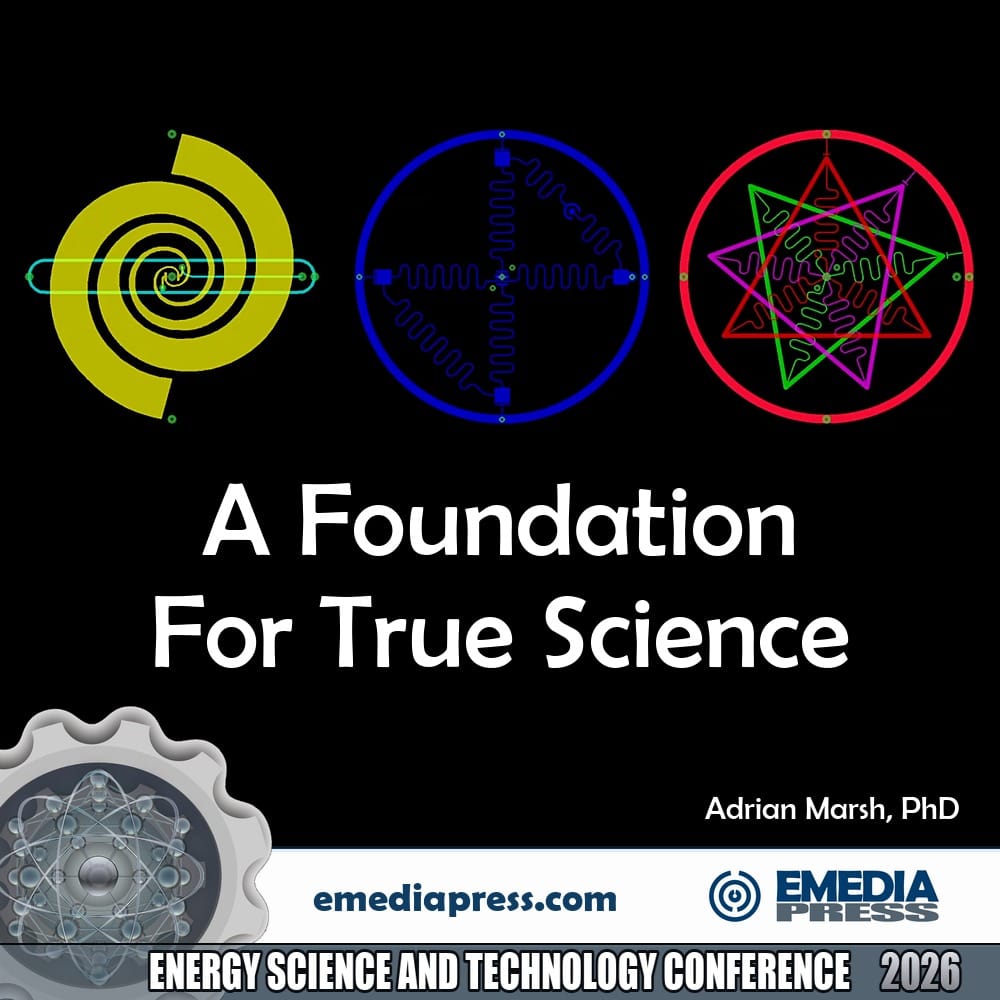
Description
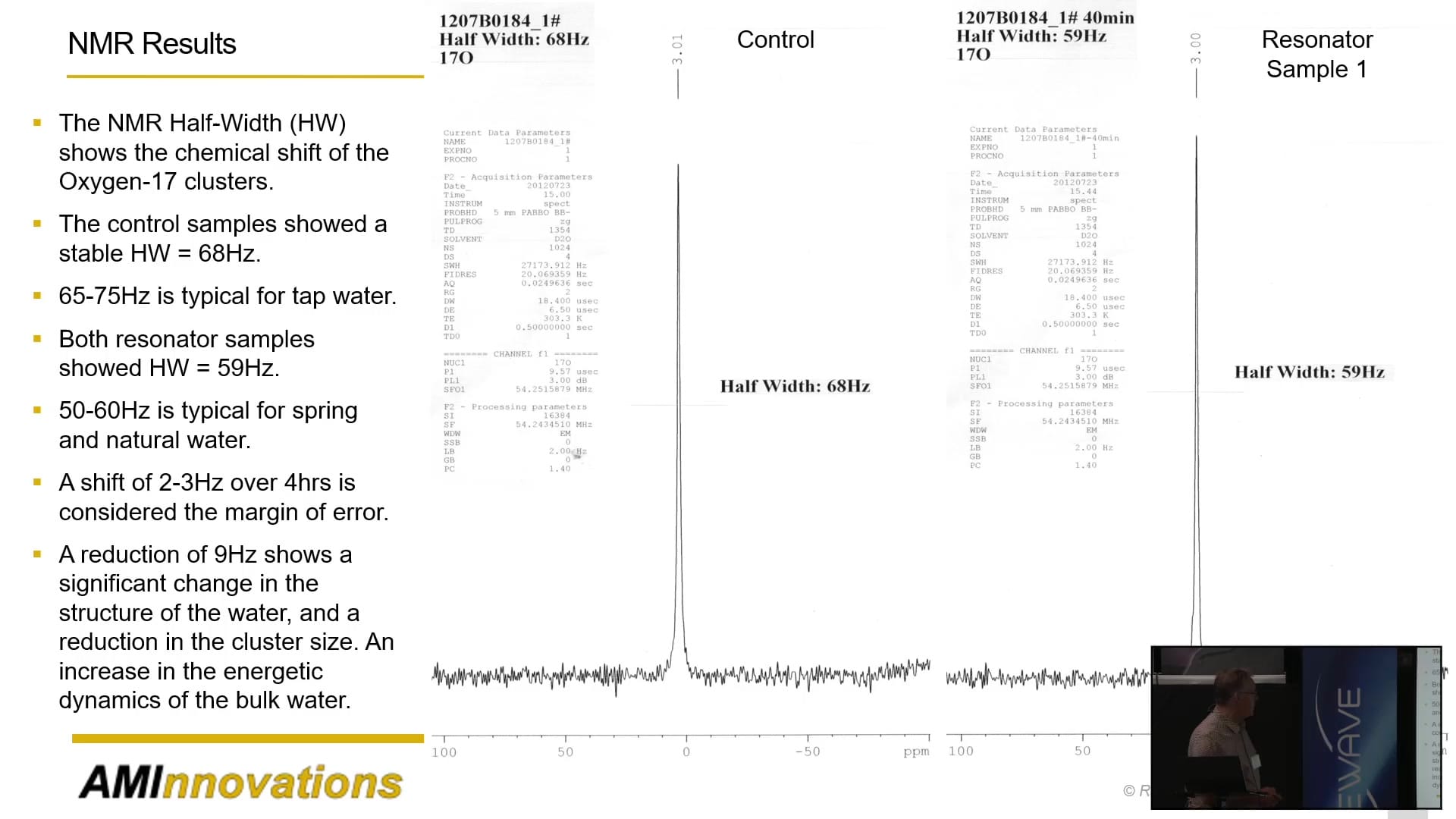
Tap water measured at 68 Hz. On the resonator, 59 Hz. The margin of error was 2 to 3.
Adrian Marsh PhD’s full 141-minute presentation on why over-unity is so hard to replicate, and the first public disclosure of his etheric resonator, recorded live at the 2026 Energy Science & Technology Conference.
Marsh runs an oxygen-17 NMR comparison on ordinary tap water from the research facility. The control sample reads a stable cluster at 68 Hz, inside the 65 to 75 range he gives as typical for tap water. Two samples exposed to the resonator both read 59 Hz, inside the 50 to 60 range he gives for spring and natural water. The experiment takes about four hours, and he states 2 to 3 Hz of drift over that time as the margin of error. A 9 Hz shift, he says, “shows a significant change in the structure of water and a reduction in the cluster size.”
The preview carries the words FIRST TIME DISCLOSED. What is disclosed is a device: Marsh’s etheric resonator, shown in full in the presentation and then put on the test bench. It is a design and a set of measurements, not a claim of an over-unity machine, and the page keeps the two apart the way Marsh does.
Marsh holds a PhD in Physics from the Cavendish Laboratory at Cambridge University, has been part of this conference’s research team since 2019, built the five-kilowatt golden ratio discharge system he showed here in 2023, and has spent 30 years on the two journeys he describes here, the scientific and engineering one and the esoteric one. He set out years ago to replicate Eric Dollard’s experiments as accurately as he could, in his words to “get a sense of his intent, of what he was trying to explore about Tesla.” This talk is where he puts the two journeys together and then puts the result on a spectrum analyzer.
He is careful about what he claims. The resonator, he says, is “a research in itself,” with many aspects “as yet unknown and unexplored.” What he shows is the instrument readings, the test setups and the controls, and he tells you which results he considers strong and which need more work.
What you get: the full 141-minute presentation as an MP4 video download, recorded live at the 2026 Energy Science & Technology Conference. Download it and keep your copy.
Regular price $37. Introductory price $27.75. 25% off at the introductory price through November 6, 2026. No coupon required. The discount is already applied on this page.
Why over-unity is so hard to replicate
Marsh opens by polling the room: who has witnessed an over-unity machine working, who has seen the plans, who has replicated one. Then the question the whole talk answers: “So why does free energy in over-unity remain so elusive? We have experience, we’ve seen it, but why is it still so elusive?” His answer is not a missing component value. It is what the builder brings to the bench. “If you want to replicate someone’s over-unity machine, you need to align the same intent. Because when you align the same intent, it’s going to work.” He spends the first hour building the framework that makes that sentence a method rather than a slogan, then spends the second hour testing a device built by it.
WHAT YOU’LL SEE IN THE FULL PRESENTATION
- The replication question, asked straight: Marsh’s poll of the room, his account of why so many people fail to reproduce other people’s results, and what he says they leave out.
- The first disclosure: Marsh announces “a first-time disclosure” of his etheric resonator, a device he says resonates in both the electromagnetic spectrum and what he calls the etheric spectrum. The full design and its current equivalent circuit are shown in the presentation.
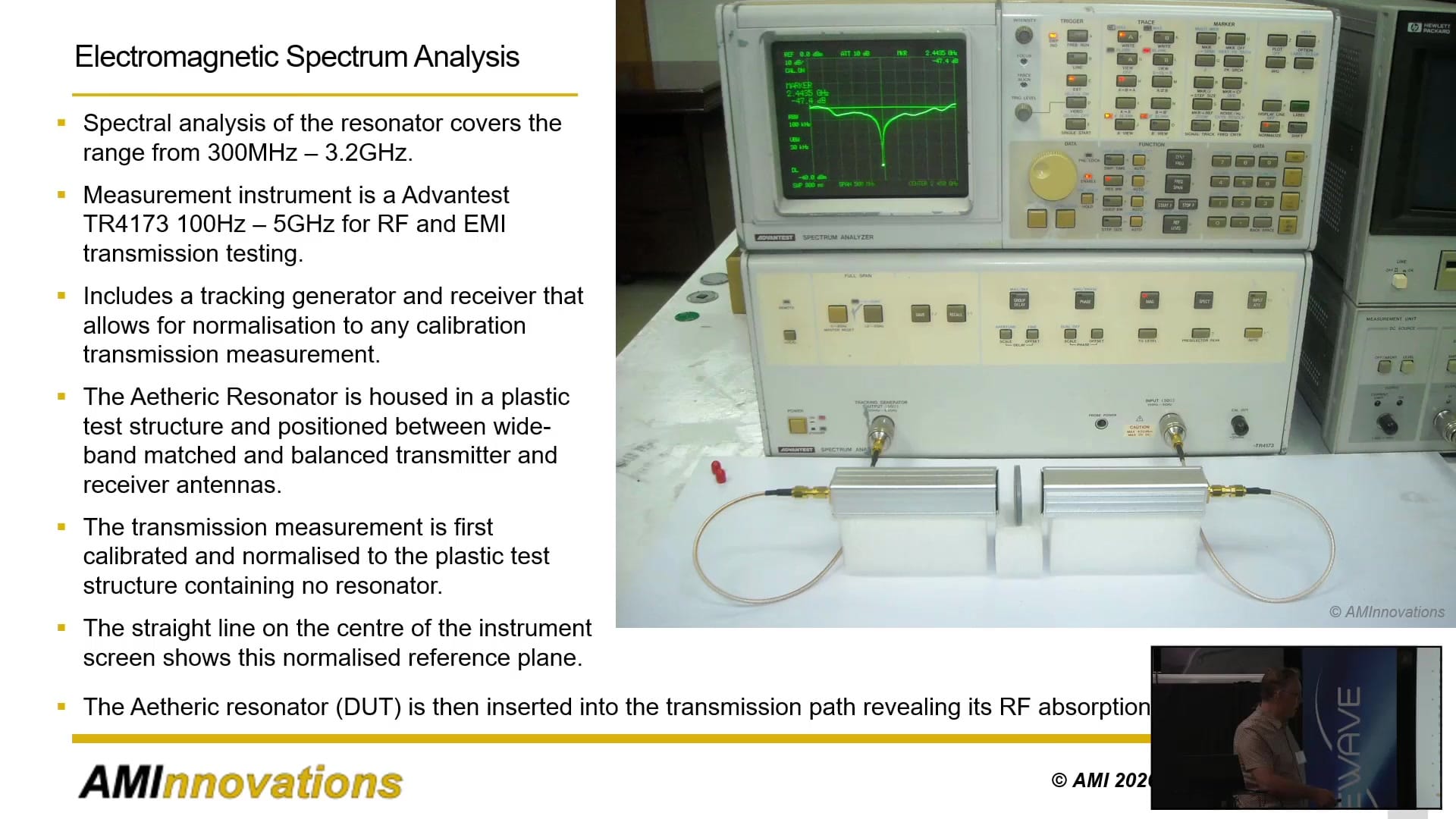
- The spectrum sweep, 300 megacycles to 3.2 gigacycles: an Advantest TR4173 with tracking generator and receiver, first calibrated flat to the empty plastic test structure, then the resonator inserted between matched and balanced wideband antennas. The upper spectrum shows a major component at 2.45 gigacycles. “You might recognize that frequency.”
- Absorbed, not reflected: the resonator “appears at first like a notch filter,” so Marsh explains the two ways you could get that result and why the measurement says the energy is being consumed rather than sent back to the generator. “It’s a matched condition.”
- 49 dB: the transmission signal attenuation at that harmonic frequency against the normalized calibration without a resonator. “It’s consuming quite a lot of the power that’s actually going into it.”
- The mid and lower spectrum: major components at 1.3 and 1.4 gigacycles, which he places at the OH band and the hydrogen line and says are particularly sensitive to nearby water and humidity, a minor component at 1.54, and the lower components at 375.6 and 780 with minors near 780 and 920.
- The cell phone test: the resonator mounted on a phone in an EMI test receiver setup with spectrum analyzer and low-noise preamplifier, and an overall attenuation of 33.5% across peaks 1 and 2. The phone’s 906 GSM frequency sits close to the resonator’s 920 minor resonance. “We didn’t design this.”
- Oxygen-17 NMR on water: control 68 Hz, both resonator samples 59 Hz, margin of error 2 to 3 Hz over the four-hour run.
- Dissolved oxygen without agitation: from about 54 to 55 up to 65 after 15 minutes on the resonator, 67 at 30 minutes, and very close to natural spring water after 60 minutes, run with a Wi-Fi background at 2.45.
- The plant test: two plants near a router, one watered from the resonator and one not, shown after 12 days of normal growing, then repeated with cress.
- Where the power comes from: his account of the ambient microwave background in the upper UHF and L-band as the source at this device scale, and why he says 10 to 100 nanowatts is enough.
- The Q&A: whether linear sine wave, sideband heterodyning and disruptive discharge methods are equal (the second and third, he says, produce a much stronger effect, “particularly the non-linear”), a follow-up on displacement current, and his capacitor-discharge explanation, demonstrable “with high voltages, with capacitors, inductors, and disruptive circuits. So spark gaps.”
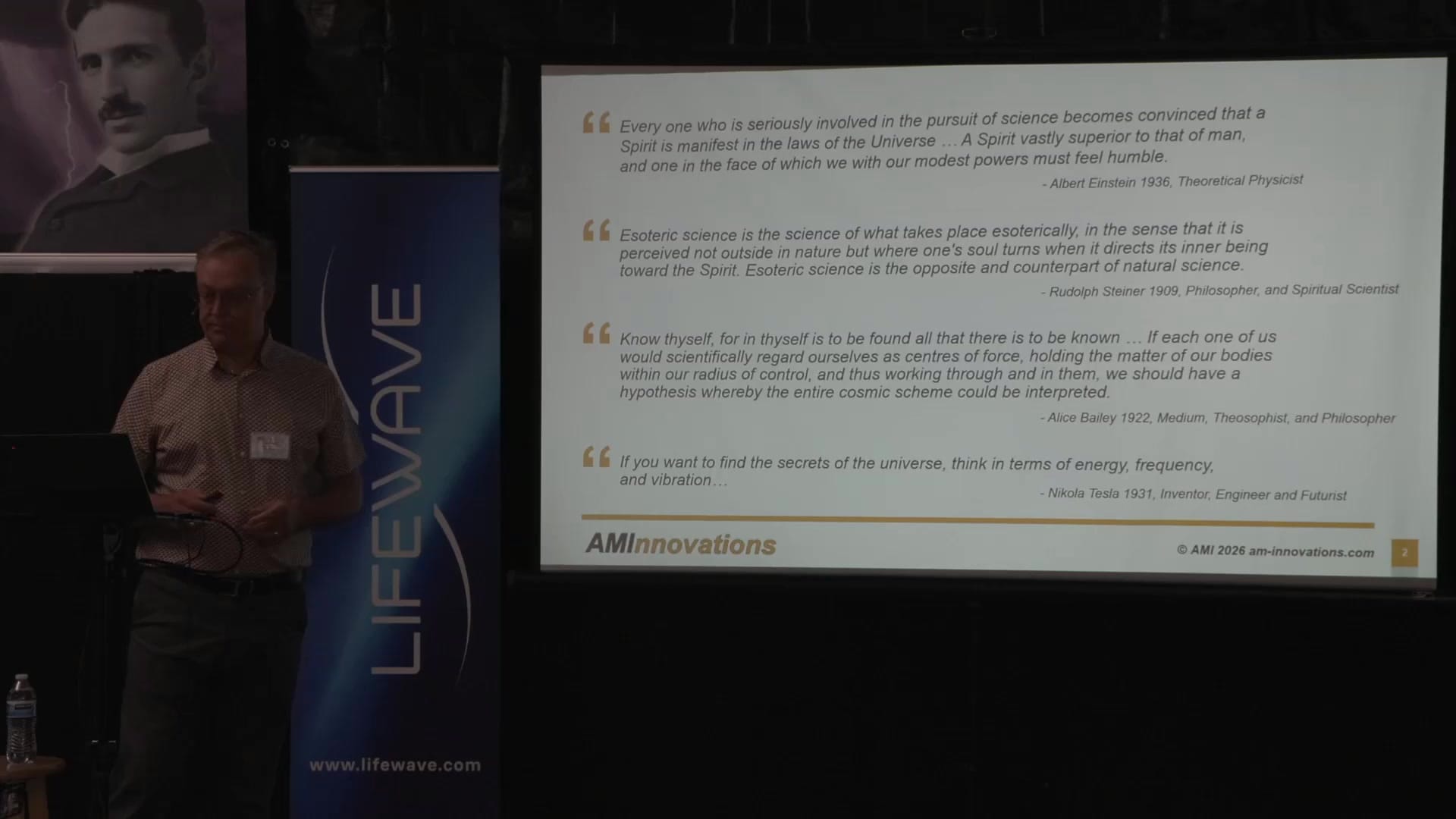
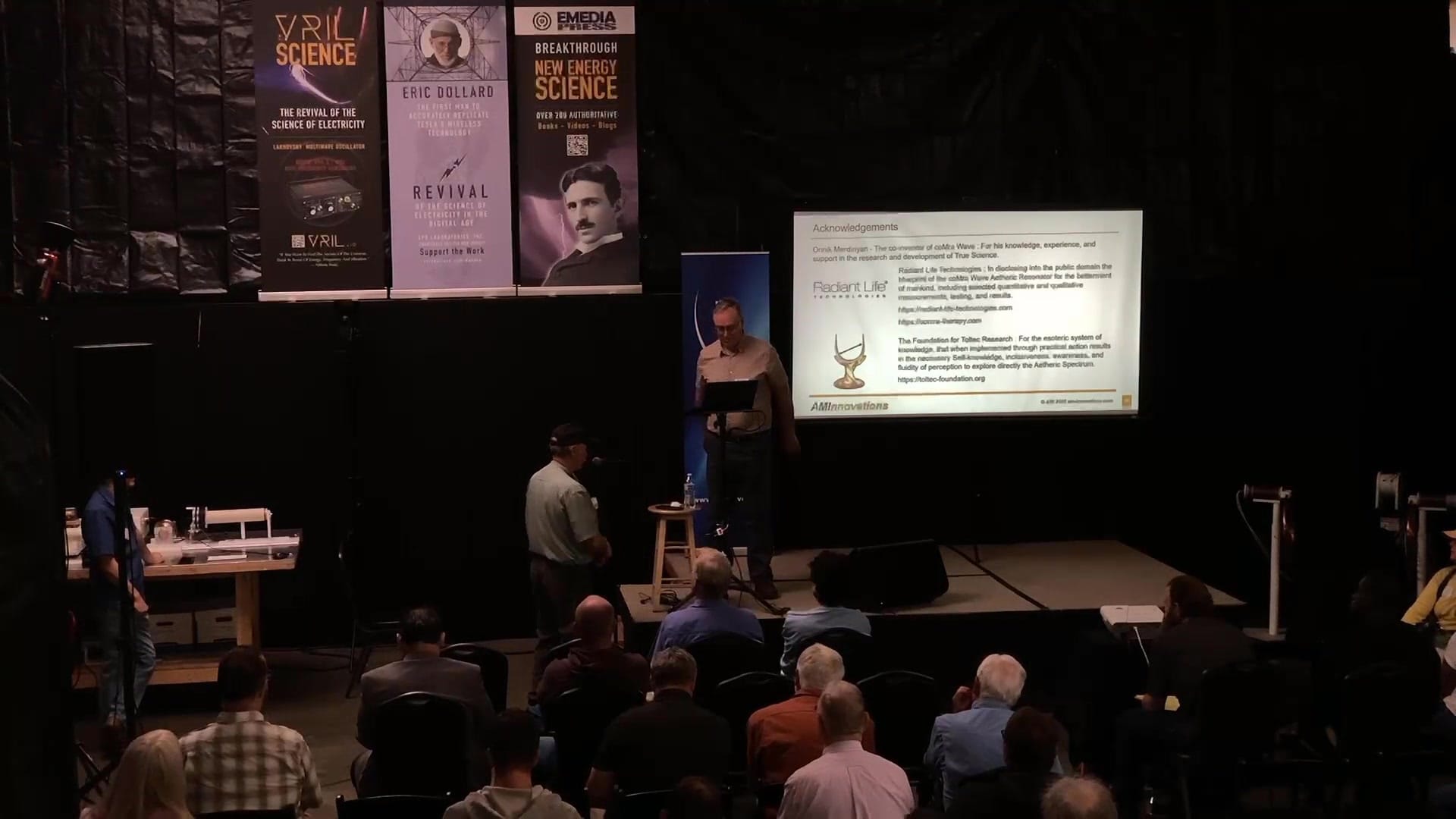
From a framework to an instrument reading
The first hour is the foundation the title promises. Marsh lays out how he thinks discovery works, from intent to a materialized device, and why he believes the usual replication failures come from copying the hardware without the rest. He is frank that part of this comes from an esoteric tradition, and he keeps the two threads separate so you can weigh each one. Then he does what most speakers on this subject never do: he puts the device between two antennas and sweeps it.
49 dB measured transmission attenuation
At the 2.45 gigacycle harmonic, Marsh shows a transmission signal attenuation of 49 dB compared with the normalized calibration without a resonator, and says the energy is being absorbed by the resonator and its crystal structure rather than reflected back to the tracking generator. He presents it as a measurement of what the device does to an RF beam, with the setup, the calibration and the control level on screen, and nothing more than that.
“It’s not being reflected back to the generator. It’s a matched condition.”
Adrian Marsh, ESTC 2026
Water gives him a second test bed
The RF results say the device absorbs power. The water results are where Marsh looks for an effect of that absorption. The oxygen-17 NMR half-width is his measure of cluster size, and the 68 to 59 Hz shift is the number he leans on hardest, because he can state the margin of error beside it. The dissolved-oxygen readings and the twelve-day plant comparison follow. He shows the sequence, the controls and the readings, and leaves the interpretation to you.
“Many aspects of the etheric resonator remain as yet unknown and unexplored. It is a research in itself.”
Adrian Marsh, ESTC 2026
“So as such, I would maintain there’s no free energy in the universe or etheric spectrum. All additional energy is induced through the process of inspiration based on our current level of inner knowledge.”
Adrian Marsh, ESTC 2026
Who this is for
The experimenter who built a published free-energy circuit to the letter and got nothing, and wants to hear a Cambridge physicist’s account of why. The Tesla and Dollard researcher who wants to see how Marsh connects the replication work to a device of his own. The engineer who will not accept a claim without a sweep, a calibration and a control, and wants to see all three on screen. The person who has heard the word ether used loosely for years and wants to see what happens when someone tries to measure it.
You do not need the physics to follow it. The first hour is argument and history, in plain language, and the second hour is test setups you can see: the analyzer, the antennas, the phone, the water samples, the two plants. Is it just theory: the second half is readings, with the margin of error stated. Why 141 minutes: a full framework, a first disclosure, four separate test methods and a Q&A that gets into disruptive discharge and displacement current. The MP4 is yours to keep.
Download the full 141-minute presentation now.
Regular price $37. Introductory price $27.75. 25% off at the introductory price through November 6, 2026. No coupon required. The discount is already applied on this page.
After this presentation you will understand what Marsh thinks is missing from most replication attempts, what his resonator measures as on a spectrum analyzer, and why a 9 Hz shift in an NMR half-width is the number he asks you to look at first.



Reviews
There are no reviews yet.