
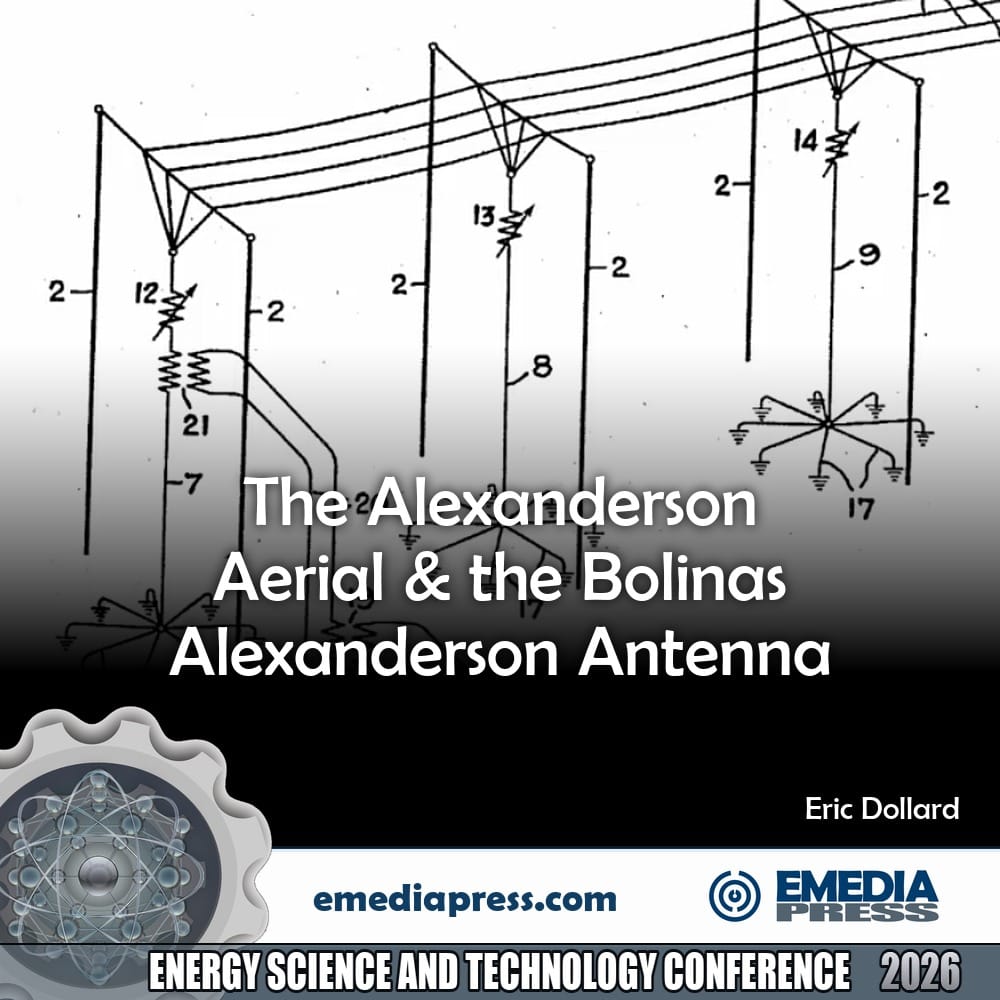
Description
54 poles, 2.1 miles, and a radio telescope pointed into the Earth.
Eric Dollard’s full 223-minute presentation on the Alexanderson Aerial and the Bolinas antenna, recorded live at the 2026 Energy Science & Technology Conference.
At 14, Dollard walked into the RCA transmitting station at Bolinas, California on a marine biology project. By 16 he had the keys. He held the original Marconi blueprints while still in high school, learned the station from men who had worked for Marconi, General Electric and RCA, later inherited the station records and diagrams, lived in the powerhouse and in the antenna field, and dug the Marconi, GE and RCA dumps along the cliffs for the insulators that told him what had really been built there.
What had been built was not what RCA taught him. Dollard’s conclusion from the blueprints, the station records and what he dug out of the ground is that the Alexanderson Aerial at Bolinas was a space scalar antenna: the phase of the current is invariant along its whole length. In his words, “There’s no delay and there’s no advance. Everything operates in unison.” When he ran the numbers, the electrostatic power flow was orders of magnitude larger than the electromagnetic. In his analysis the Aerial is electric, not electronic, and not an electromagnetic antenna at all, whatever the patent implies.
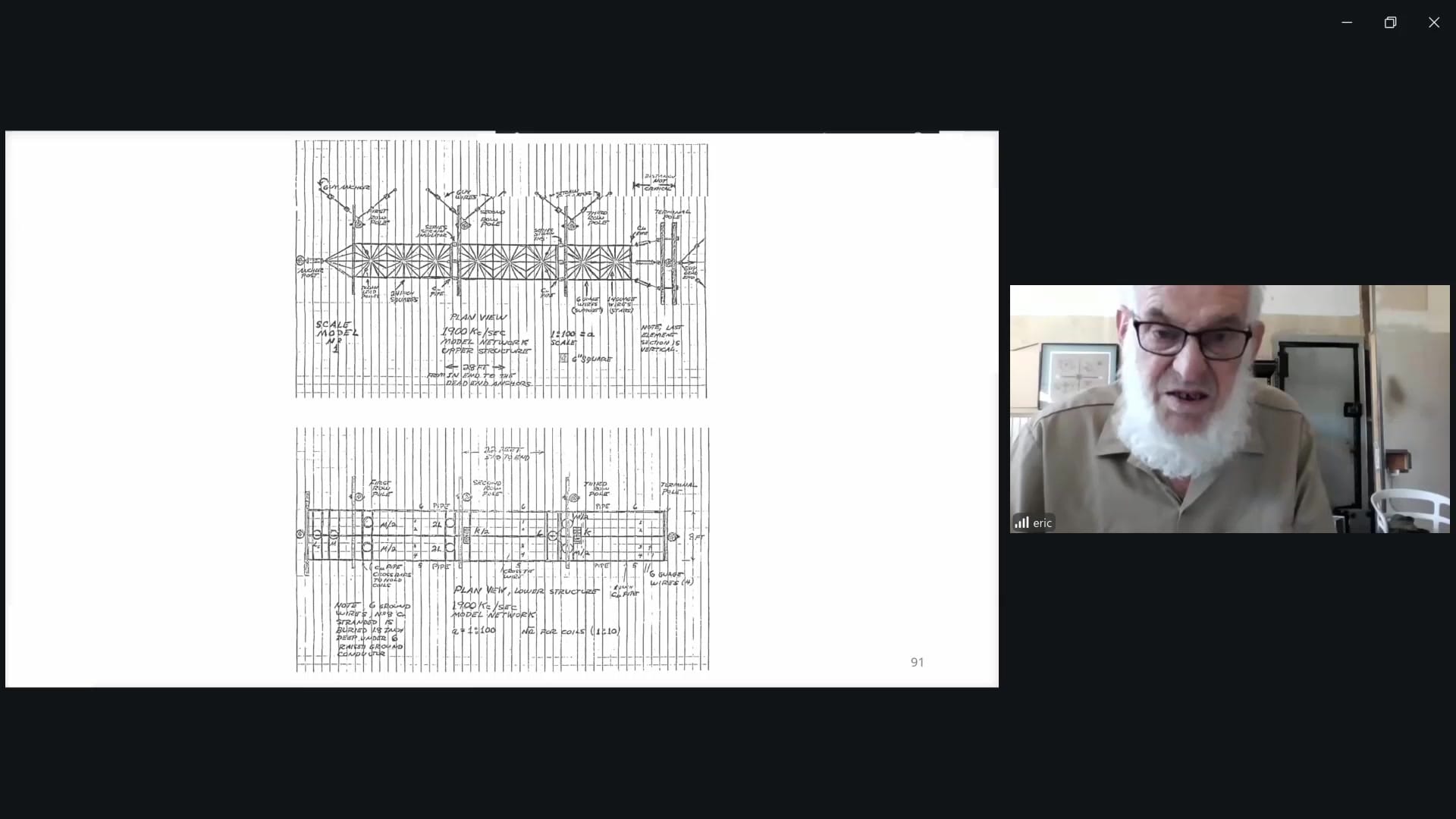
This is the first-hand account of the Alexanderson Aerial, from someone who held the drawings, dug up the hardware, built a receiving version at Landers and listened to it for ten years, and is now building it again at full scale in Tonopah, Nevada. The history and the mathematics come first, derived step by step in Steinmetz’s units. Then Dollard walks the Tonopah line, pole by pole, as it stands today.
What you get: the full 223-minute presentation as an MP4 video download, recorded live at the 2026 Energy Science & Technology Conference. Download it and keep your copy.
Regular price $47. Introductory price $35.25. 25% off at the introductory price through November 6, 2026. No coupon required. The discount is already applied on this page.
WHAT YOU’LL SEE IN THE FULL PRESENTATION
- Bolinas from the inside: the 1913 Marconi powerhouse on its circular ground plane with a six-pointed star of ground wires, earth electrodes run out to the Pacific, the Navy pushing Marconi out, and Steinmetz handing the antenna to his protege Ernst Alexanderson.
- The lineage of the electric wireless: Franklin’s kite, Loomis’s two kites and a galvanometer, Tesla’s elevated capacity and buried roots, Hertz’s plates, Marconi’s Righi gap and coherer, and why the AM broadcast station is the last thing on the air that still resembles Tesla’s work.
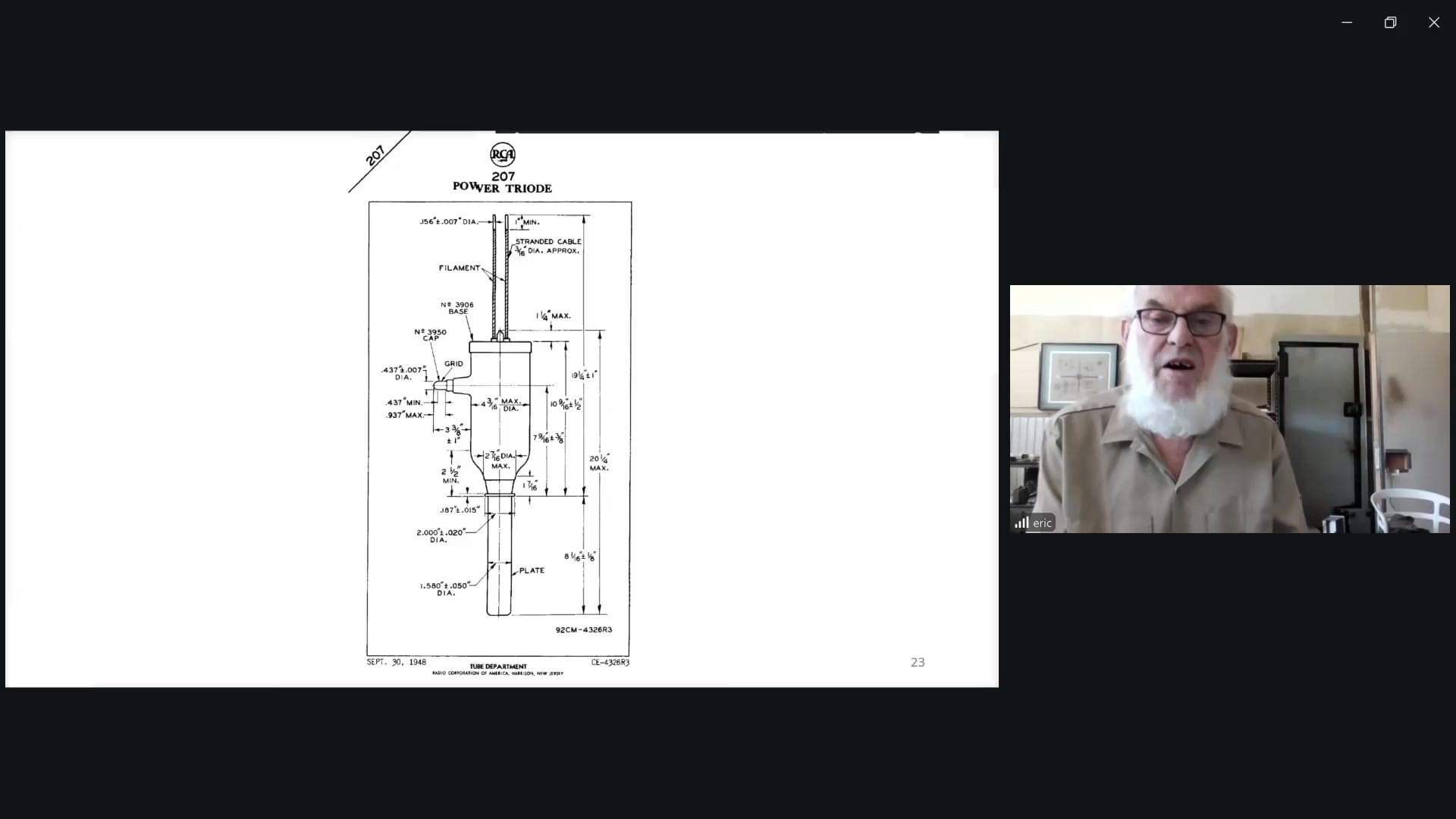
- The RCA-207 water-cooled power triode: 22 volts at 55 amps on the filament, a 15,000-volt maximum plate rating, four of them for 50 kilowatts continuous, and the lights dimming in Bolinas every time the key went down.
- The units, rebuilt from scratch: why the work has to be done in CGS, the picofarad and the kilocycle as the natural units of very low frequencies, the Planck as the quantity of electricity, and the reciprocal of the farad that Dollard calls the Tesla.
- The Steinmetz-Heaviside power equation: active and reactive power in quadrature, the power factor and induction factor as a versor operator, and the magnification factor as their ratio, the quantity Tesla named and radio engineers buried under the letter Q.
- Loading, from the undersea telegraph cable to the Aerial: the one-mile analog network, the Heaviside condition LG equals RC stated as two time constants that must match, and why loading raises impedance and cuts attenuation at once.
- The space scalar condition: lag networks and lead networks, velocity and contravelocity, half sections in tandem, and the relationship that makes the advance of one cancel the delay of the other so the whole structure acts as one.
- The Marconi aerial by the numbers: 3,000 feet long, 600 feet wide, 300 feet up, 44.77 kilocycles, 50,000 picofarads to ground, 1,540 amperes at 100,000 volts, a magnification factor of 513, and Dollard’s estimate that about 11 percent of its activity did useful work. “It rang like a bell.”
- The hardware from the dumps: the porcelain inserts from the series coil with the corona burns still on them, and the eight-saddle shunt-coil insulator Dollard spent a week breaking out of Navy concrete, the remains of what he calls the ultimate Tesla coil.
- The scale model: 2,700 feet becomes 27 feet, 19 kilocycles becomes 1,900 kilocycles in the 160-meter amateur band, 15 millihenries becomes 150 microhenries, and the reactance stays at 1,800 ohms.
- Landers: a 900-foot Alexanderson antenna under an 1,800-foot beverage antenna, ground rods driven into greasewood roots because the granite would not take them, 300 cycles to 30 kilocycles, inside and outside of the Earth on left and right speakers.
- The Q&A: the working Alexanderson station in Sweden, why Dollard trusts an audio oscillator, a scope and a Simpson 260 over a vector network analyzer, the impedance-admittance ratio nobody takes, and displacement current versus conduction current in one answer.
Electric, not electronic
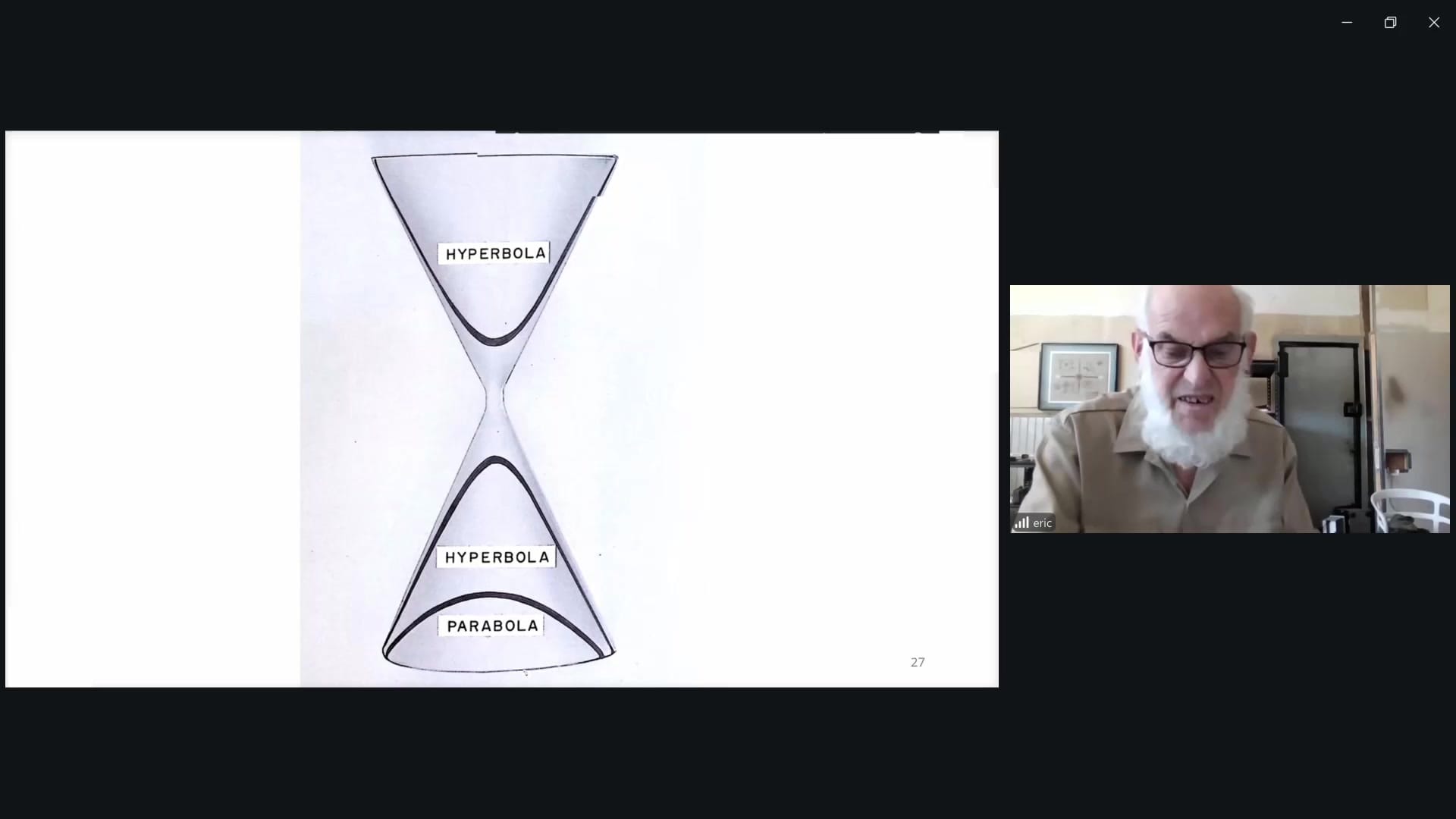
The Alexanderson Aerial belongs to the age of the electric wireless, the line from Franklin through Loomis and Tesla, and Dollard’s case is that it was abandoned not because it failed but because the water-cooled triode and the shortwave rush arrived within a few years of it. Nobody thought to put the tubes under the Aerial. The alternator went into a blast bunker, and the mathematics that described it, Helmholtz’s, never got the Heaviside that Maxwell’s did. So Dollard rebuilds the units in centimeters, grams and seconds and derives the antenna from the two coordinate systems it joins: the electrostatic above ground and the electromagnetic below it.
“This thing is a radio telescope to listen to the interior of Earth.”
Eric Dollard, ESTC 2026
What goes up must go down
Tesla did not build a radial ground. He built a massive set of metallic roots. Landers showed Dollard why: set a resonator on a radio-station ground plane and the plane acts as a capacitor plate, pulling the lines of force off the elevated capacity and shorting them back through the transformer neutral. Each Alexanderson loading network wants its own spot of ground, and if you tie the grounds together you short the antenna. At Tonopah the ground is fused volcanic ash, so the earth connections will be made electrostatically: Dollard’s plan is 30-foot boreholes with coil electrodes insulated from the rock.
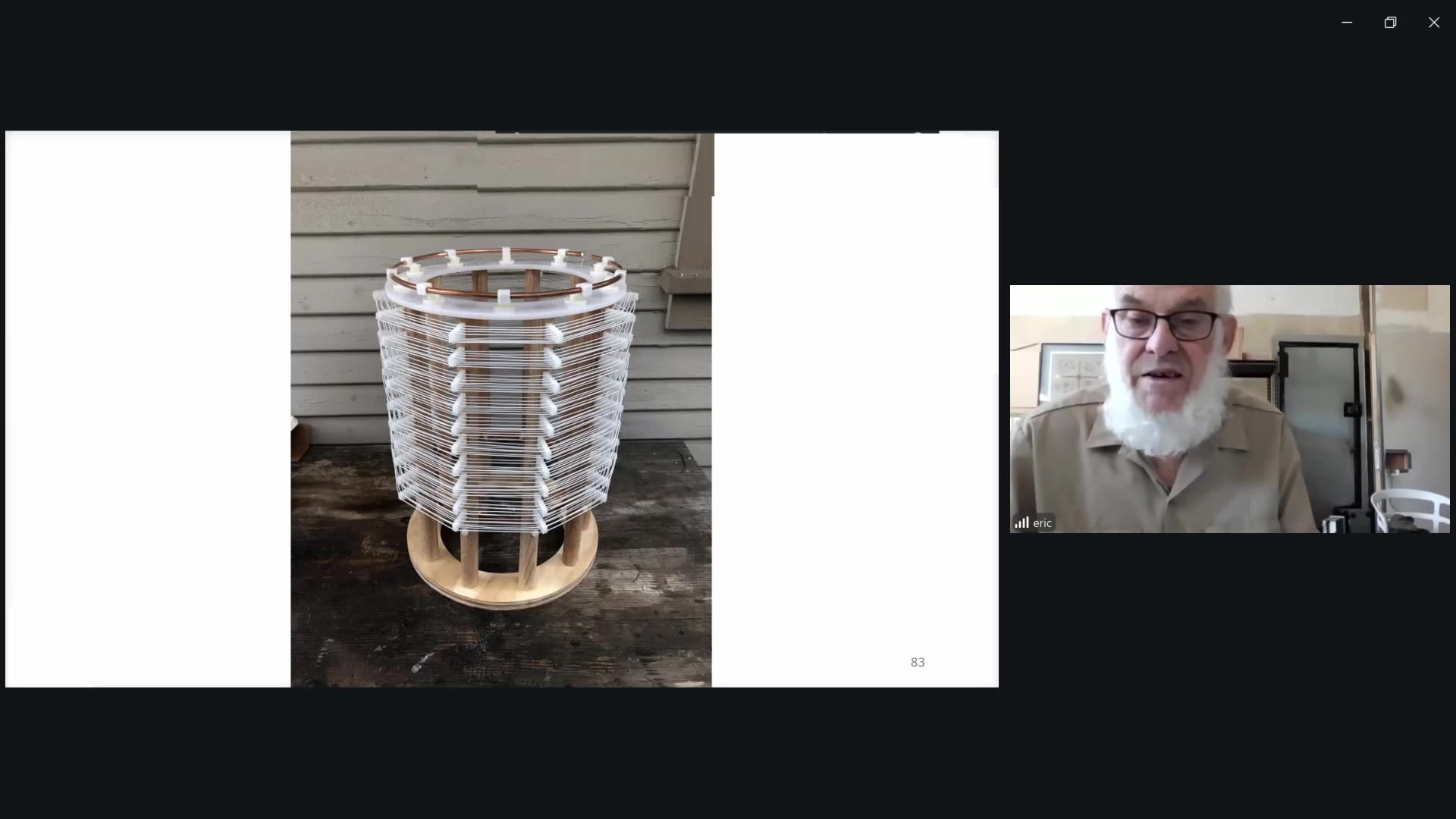
“And what I heard there and measured was absolutely stunning.”
Eric Dollard, ESTC 2026
The Tonopah line, pole by pole
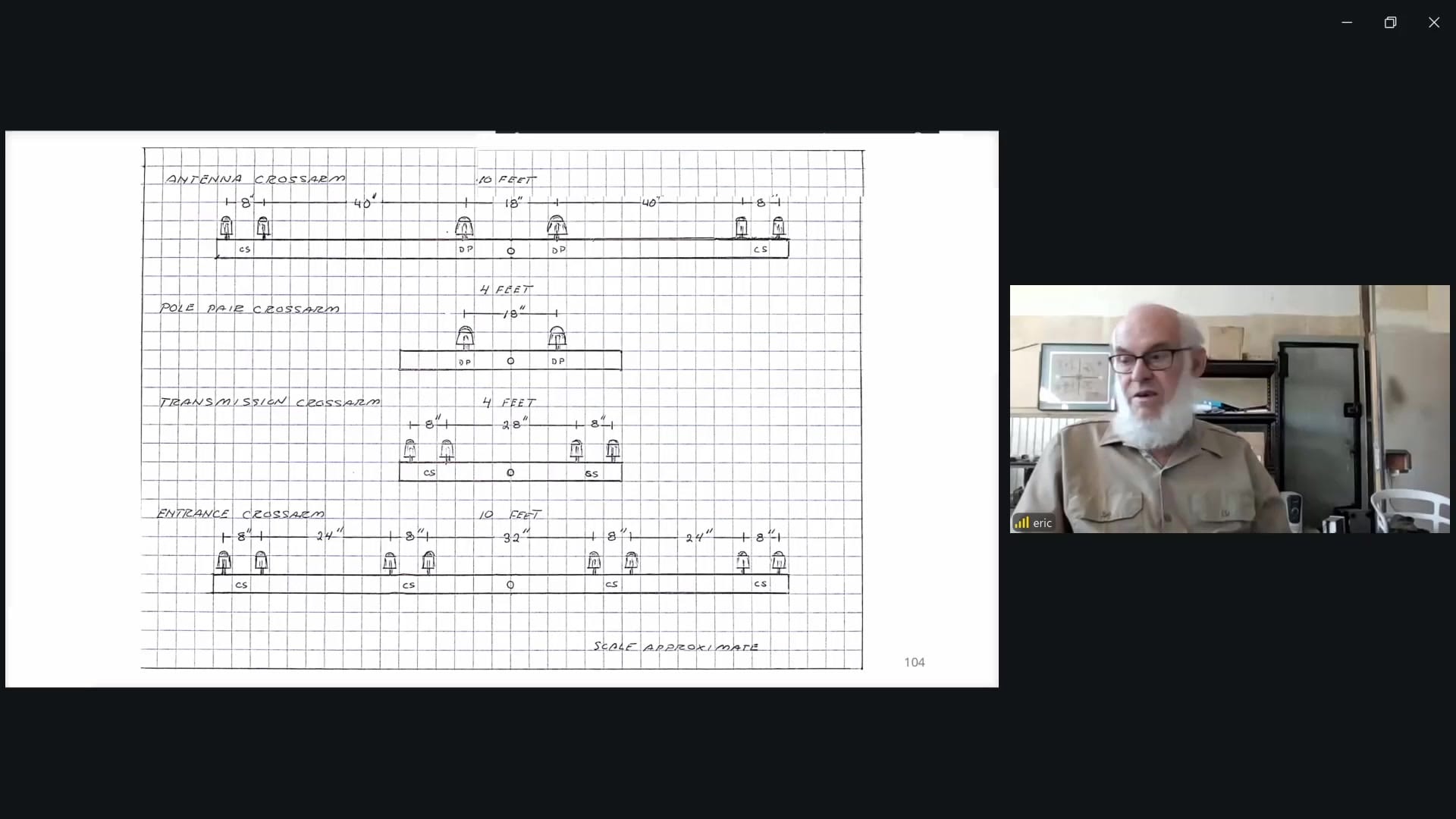
The last part leaves the equations and walks the right of way. Fifty-four poles over about 2.1 miles, built to Bell System open-wire standards from hardware harvested out of the Mojave and the Great Basin. The completed Aerial section runs 4,800 feet, pole 49 to pole 26, with the Alexanderson pair in the center and the outer pairs transposed so they cannot talk to it. Dollard shows the loading points, the 120-year-old pole on a 45-degree slope that nobody wants to climb, the corner where jumpers equalize the wire lengths, the guying that stops one broken pole from pulling the whole antenna down, and the Bell carrier repeater cabinet in the ravine where what the Aerial captures, which is not electromagnetic, is converted into an electromagnetic analog an open-wire line can carry. Two grounds: static, aluminum buried in magnesium sulfate, and signal, rods driven into plant roots. The signal comes out of an E37B transmission test set at 0 dBm, the level you can hear in a telephone receiver. Still to come: the carrier pairs to the mine, its three seismic transducers, and the public display Dollard calls the musical seismograph, stereo audio of the seismic waves inside the Earth.
“I’m going to hang a sign on the door that says no software allowed past this point.”
Eric Dollard, ESTC 2026
Why this matters now
Dollard builds with open-wire line, vacuum tubes and no software because the analog services he relies on are being switched off. On March 26, 2026, the FCC adopted an order easing the retirement of copper telephone networks, removing filing requirements and letting carriers stop offering legacy copper voice and low-speed data to new customers. By June 2026 the FCC had approved AT&T to shut down more than 30% of its wire centers, and California’s utilities commission had gone to court over the rules. In Canada, Weatheradio ended service on March 16, 2026; the government page now directs listeners to the website and the WeatherCAN app. Dollard says it from the other side: the telephone pairs he needs to carry the Aerial signal into town may vanish before he can use them, and a receiver that has to make a blue spark at the far end cannot run on a digital analog of itself.
The equipment was real, and he was there
Nothing here is a simulation. The Marconi figures are Dollard’s own calculations from the constants of the Marconi setup, and he says which ones still need verifying. The Bolinas equivalent circuit was checked with long conductors run out from station ground and confirmed by what came out of the dirt: mica in the soil and the drain wires of the capacitor cabinets, which told him the Aerial had series condensers nobody had drawn. The Landers account is a decade of listening. The Tonopah figures are footages on a line that has wire on it today.
“Everything you see here is basically a museum.”
Eric Dollard, ESTC 2026
Who this is for
The ham or VLF listener who has watched a service go off the air and wants to know what the old open-wire plant could still do. The engineer who was taught an antenna is a delayed traveling-wave structure and has never seen one treated as operating in unison. The reader of Wireless Giant of the Pacific who wants Bolinas from someone who slept in the powerhouse. The builder of a telluric or seismic receiver who needs to know why the grounds must stay separate. The researcher following Tesla, Steinmetz and Dollard who wants the derivation and the 2.1-mile experiment in one sitting.
You do not need to be an engineer. The opening is history and people: Franklin, Loomis, the Navy and Marconi, the dumps along the cliffs, the real-estate scam that put bulldozers through twenty years of work at Landers. The mathematics is simple algebra with the units defined before they are used. The last part is photographs and pole numbers. Why 223 minutes: Dollard says half of the presentation is the electricity itself, and the rest is the history, the installation and the Q&A, and nobody else has the material. The MP4 is yours to keep.
Download the full 223-minute presentation now.
Regular price $47. Introductory price $35.25. 25% off at the introductory price through November 6, 2026. No coupon required. The discount is already applied on this page.
After this presentation you will know what the Alexanderson Aerial actually was, why a structure with no delay along its length is not an ordinary antenna, what Dollard heard at Landers, and what is standing on 54 poles outside Tonopah right now.




Reviews
There are no reviews yet.