
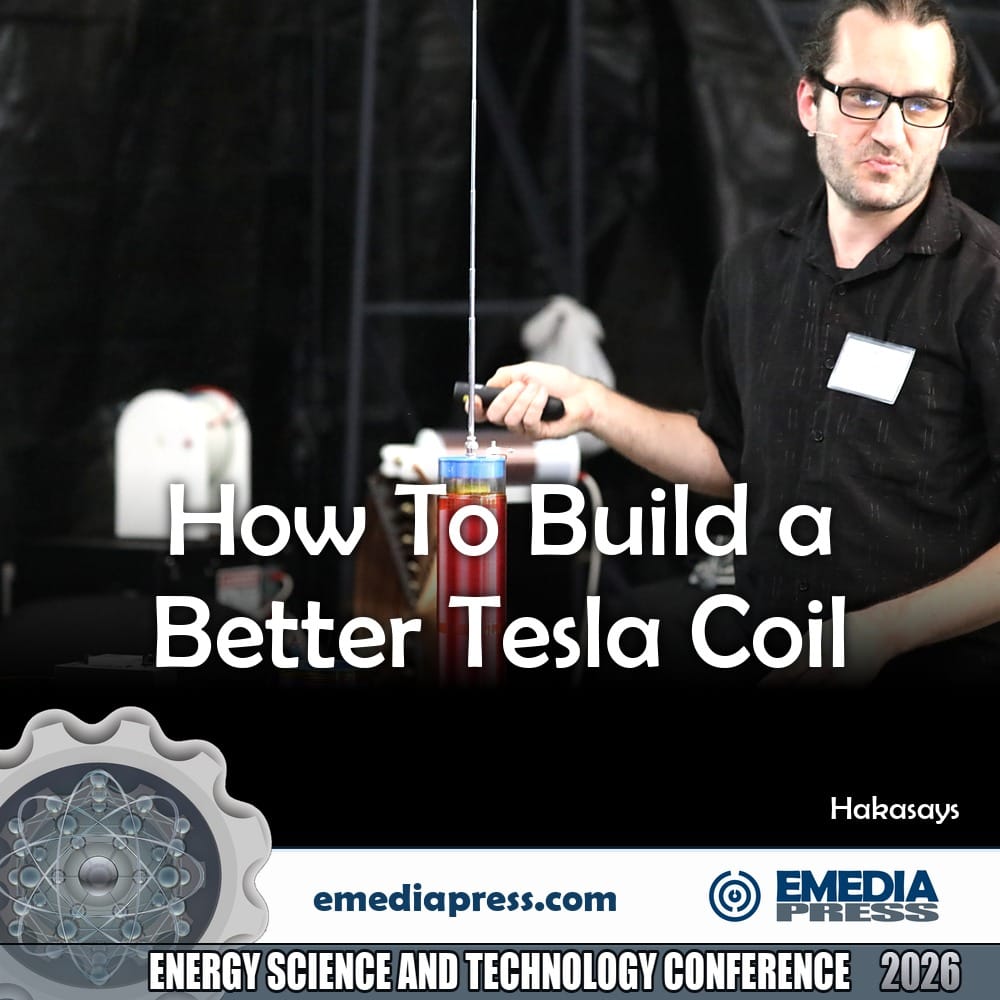
Description
Seven watts lit the bulb. Then he cut the input to a third of a watt, and the bulb stayed lit.
Hakasays’ full 137-minute presentation on building a Tesla coil the way Tesla built it, recorded live at the 2026 Energy Science & Technology Conference.
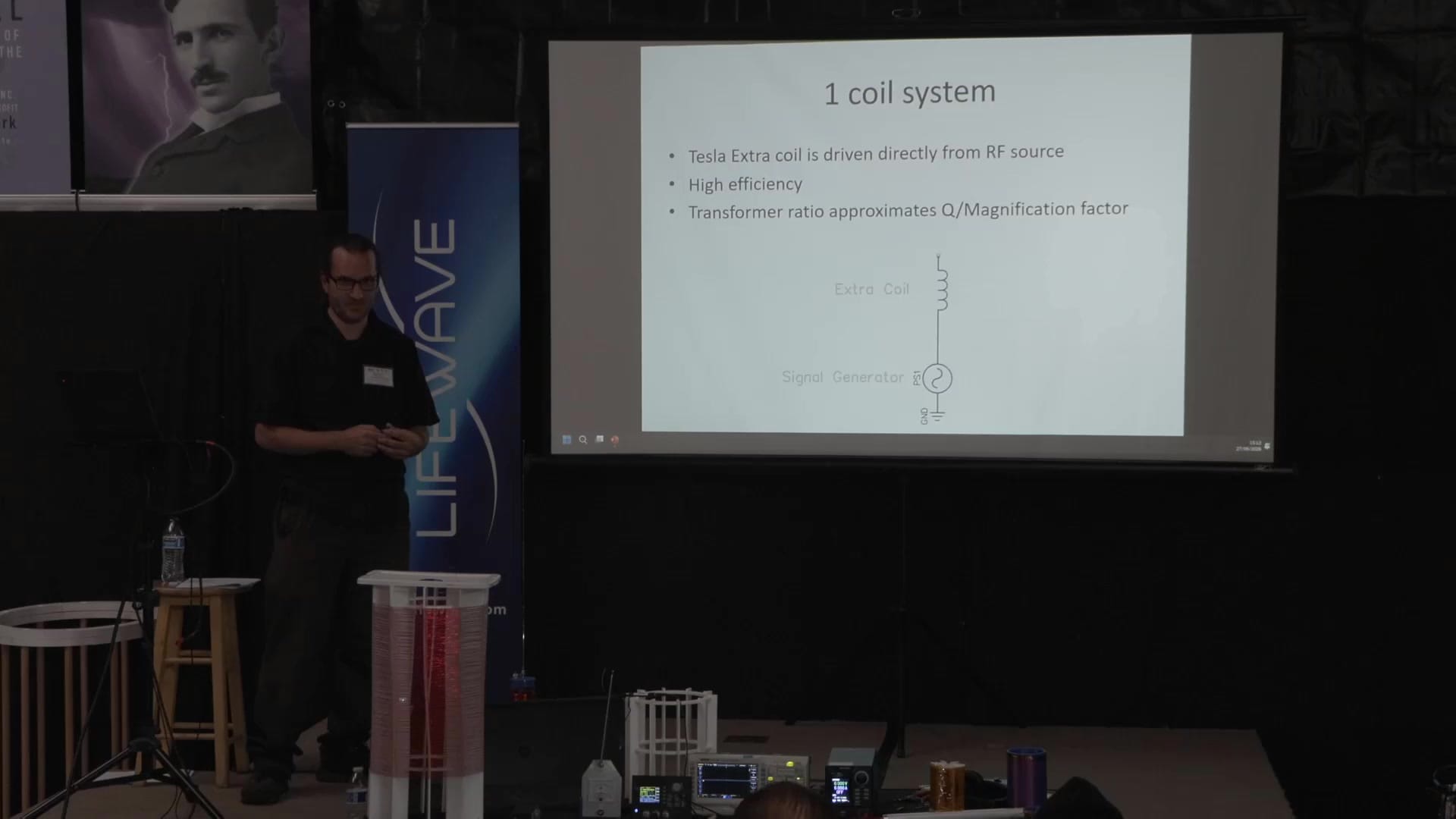
NOT THE COIL TESLA BUILT. The two-coil spark gap machine everyone calls a Tesla coil is not the three-coil arrangement Tesla ran at Colorado Springs. Hakasays shows the difference, then proves the point on the bench. He starts with the circuit most people buy online, a self-oscillating exciter, lighting a bulb at “about seven, seven and a half watts.” Then he takes it apart one piece at a time. The feedback winding goes. The primary goes. The driver circuit goes. What is left is a hobby signal generator and one coil, and the bulb is still lit, at a distance. He measured those generators with a proper RF meter before the previous conference: “those generators all put out between a quarter and a third of a watt.” His summary from the stage: “So I think we’ve made a better Tesla coil. We’ve done the same output with almost no power.”
Hakasays has been building coils for years alongside the EPD Laboratories work, including the telluric transmission platform. What set him on this path was the 2019 conference presentation of a 20-to-1 scale replica of Tesla’s Colorado Springs system, a matched pair of three-coil transmitters built by Eric Dollard and Bruce Gavin. He tried to copy it himself and, in his words, was driven mad by it. This talk is what he learned when he stopped copying and started measuring: why a faithful spark gap coil shows a quality factor around 30 to 60 while the coils his group winds come in “over 200 and often higher than that,” and what a builder has to change to get there.
The coil on the bench was wound at the conference itself, in the first day and a half, from wire and plastic he packed in his luggage. He did not know its frequency when he started. He finds it live, on stage, with a signal generator, a scope and a field strength meter, in front of the room.
What you get: the full 137-minute presentation as an MP4 video download, recorded live at the 2026 Energy Science & Technology Conference. Download it and keep your copy.
Regular price $37. Introductory price $27.75. 25% off at the introductory price through November 6, 2026. No coupon required. The discount is already applied on this page.
For builders: what the talk shows you how to do
He ends the formal talk with one line: “Go forth and build.” The hour before it is the how. The dimensions, turn counts and wire tables are on his slides in the video; here is what they cover.
- Frame material, ranked by loss: he goes through the plastics builders wind on and puts numbers to each. “Probably 95, very close to 100%” of modern builders wind on PVC from the hardware store, and “The PVC is one of the worst materials that you could use to wind a Tesla coil on.” His line: “You’d be better off winding a coil around a tree.”
- 3D printing a frame: why dark filaments are a trap (the pigment is usually carbon, and carbon acts like a resistor) and what to print with instead.
- Wire, conductor and spacing: his wire selection slide, the trade-off between gauge, cost and weight, the turn spacing rule he uses and why spacing changes what the coil is.
- What killed a telluric coil: unpolished copper tubing oxidized in the air, “copper oxide has really horrible properties so it ruined the coil right away,” and the fix.
- Finding resonance with three instruments: signal generator, oscilloscope and field strength meter, sweeping from a starting frequency up to the coil’s quarter-wave resonance, done live.
- Measuring Q from bandwidth: the method, worked on a previous coil: 1470 and 1463 kilocycles, 7 kilocycles of bandwidth, “we divide that, the 1466 by 7, and we get a 209 quality factor, magnification factor.”
- Matching the drive: Bruce Gavin’s method of setting the primary-to-extra-coil distance so a 50-ohm ham radio sees a match, “set it and forget it,” and the Armstrong oscillator and radio-plus-amplifier drives he describes for higher power.
WHAT YOU’LL SEE IN THE FULL PRESENTATION
- Three coils that are not the same machine: the modern two-coil spark gap coil, the older Oudin-type induction coil, and Tesla’s three-coil Colorado Springs arrangement, where “the coil is the building.”
- A Tesla coil is a transformer: the water analogy, tuning forks and bells he uses instead of the heavy formulas, and why he says those formulas “often disguise” the simple relationships underneath.
- The side-by-side from 2022: a well-known online builder’s fresh coil at 20 volts and 1 amp lighting a small fluorescent bulb at about six inches, against Hakasays lighting a full fluorescent tube at a much larger distance the same week on far less power.
- Demo 1, 2 and 3 on stage: the exciter circuit at about seven watts, the same coil driven at a fixed frequency at 6.3 watts and reaching further into the room, then the stripped-down version on a quarter to a third of a watt.
- The striations in the tube: visible bands in the lit fluorescent tube, which he attributes to “where the fields have nodes.”
- Walking the field across the room: the field strength meter pegged beside the coil, then 50, 40, 15, about 10, about 5 as he backs away, “nowhere near the coil.” “Everything around here, myself and the front row members included, are part of the capacitor storing energy inside this system.”
- The conference coil’s resonance found live: starting at 100 kilocycles and sweeping up until the meter and scope agree on the quarter-wave resonance.
- Why Tesla ran low: his account of the Colorado Springs coil operating between 50 and 100 kilocycles, “almost the audio spectrum,” and what that means for a coil you can build.
- The telluric platform: the 50-ohm ham radios against a platform near 10 ohms, the matching transformer, and the impedance chart that shows why volts climb as impedance rises.
- Single-wire power, from his earlier talk: one three-coil system transmitting to another through one wire, lighting 400 watts at the far end, and his finding that “the connection to the substation ground had absolutely no effect on the current being carried between the two systems.”
- Other builders: Griffin, who taught himself glass blowing to reproduce Tesla’s bulbs, and a YouTuber who reproduced two identical polyethylene coils and is sending power between them over a single wire.
- The Q&A: can a lossy frame be rescued with high-dielectric paint (“It’s still a cheat”), the wood-and-polyethylene frame EPD uses as a cost balance, and whether wire material matters. Plus the Cliff Young ultramarathon story he closes the talk with.
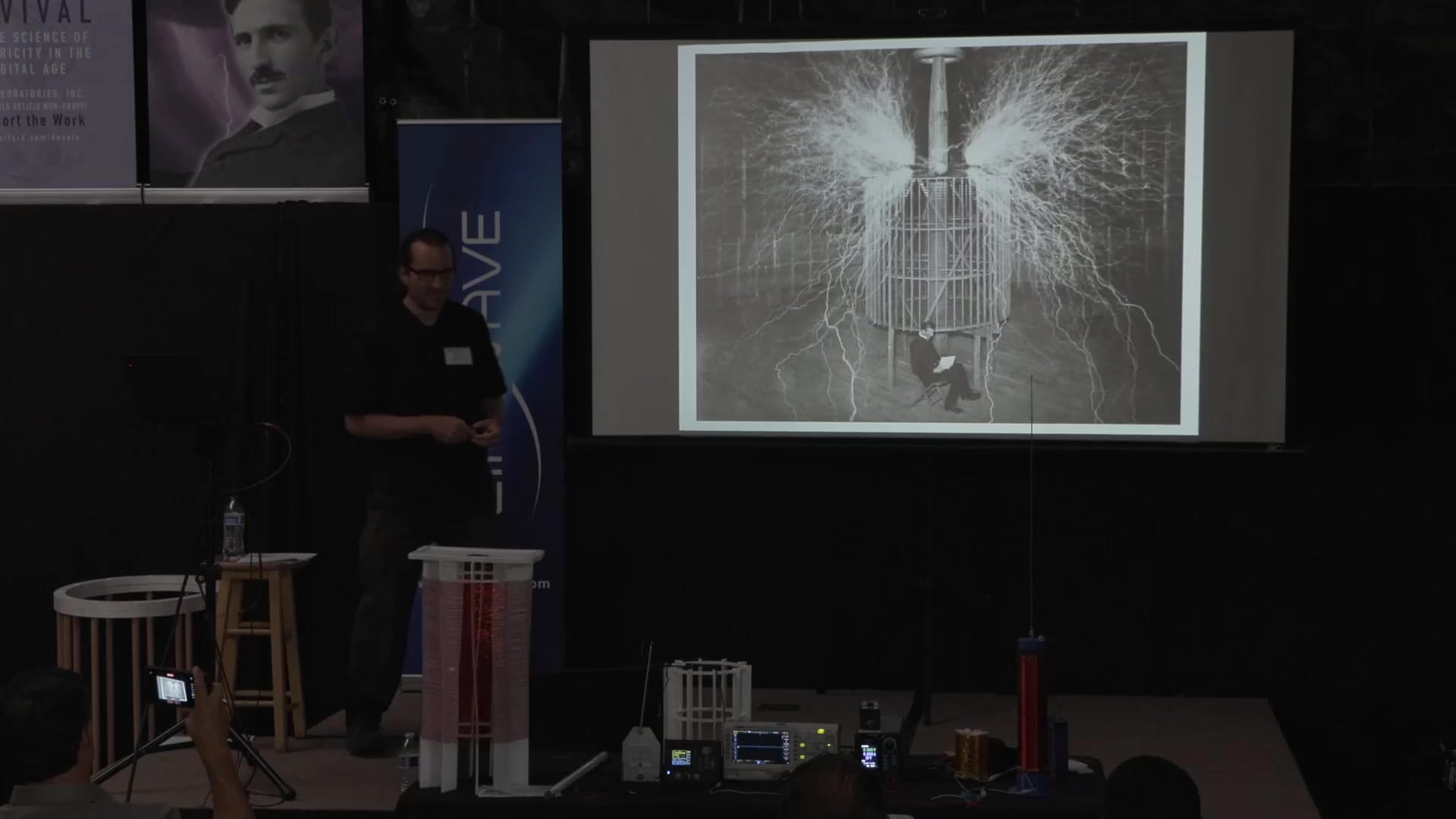
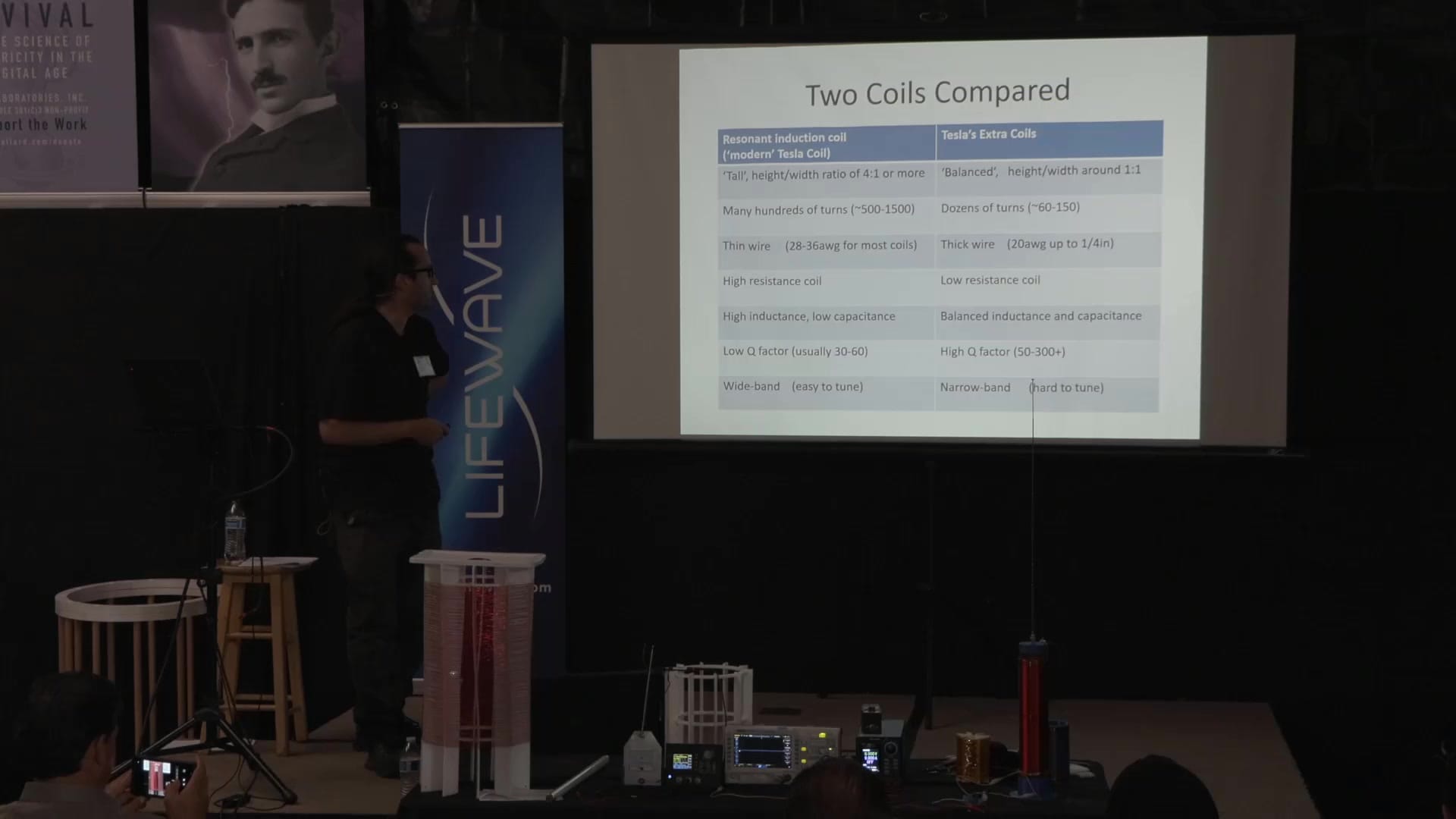
Same bulb lit, from seven watts down to a third of a watt
The exciter circuit lights the bulb at about seven watts. Driven at a fixed frequency from a signal generator the same coil does it at 6.3 watts and reaches further. With the feedback winding, the primary and the driver circuit removed, a single coil on the signal generator’s quarter-to-a-third-watt output still lights it. He presents it as what it is: the bulb still lit on a small fraction of the input, with the meter readings on screen. He shows the change in arrangement and the readings; he does not call it a controlled efficiency test, and neither does this page.
“So I think we’ve made a better Tesla coil. We’ve done the same output with almost no power.”
Hakasays, ESTC 2026
Measured, not judged by the sparks
The second half is the bench. He takes the coil he wound at the conference, finds its resonance, walks the field across the room and shows you the readings as he goes. Then he shows the Q method on a previous coil and gets 209 against the 30 to 60 he says a faithful spark gap replica returns. The point he keeps returning to is that a coil’s quality is in its electrical response, not in how long the spark is, and that you can measure it with instruments a hobbyist can afford. “And you can see for yourself. You don’t have to trust me for this.”
“For breakthroughs, like the first flight, or a device that leads to a type one civilization, you don’t fight academia, you prove them wrong, on the bench and in the field.”
Hakasays, ESTC 2026
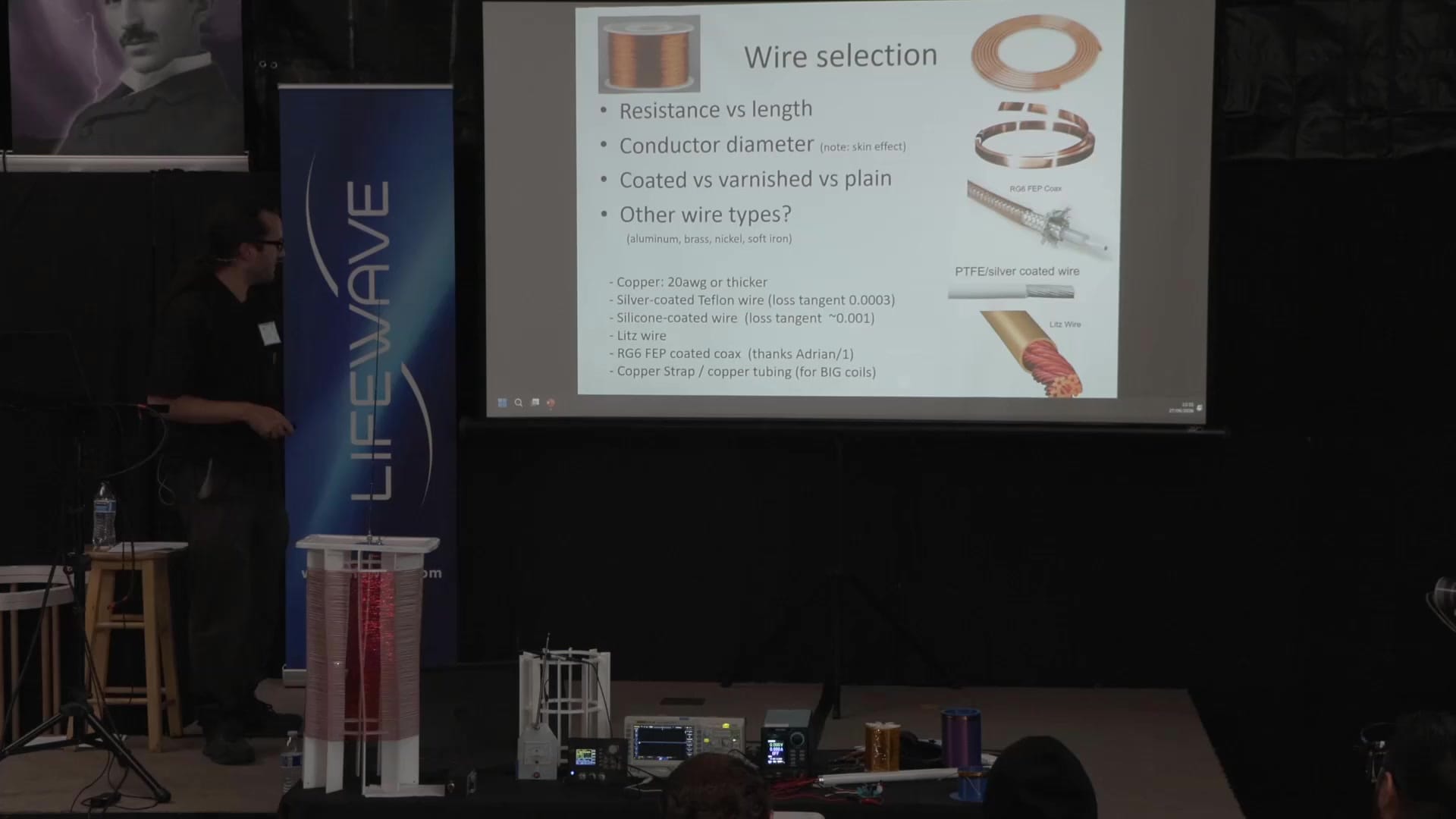
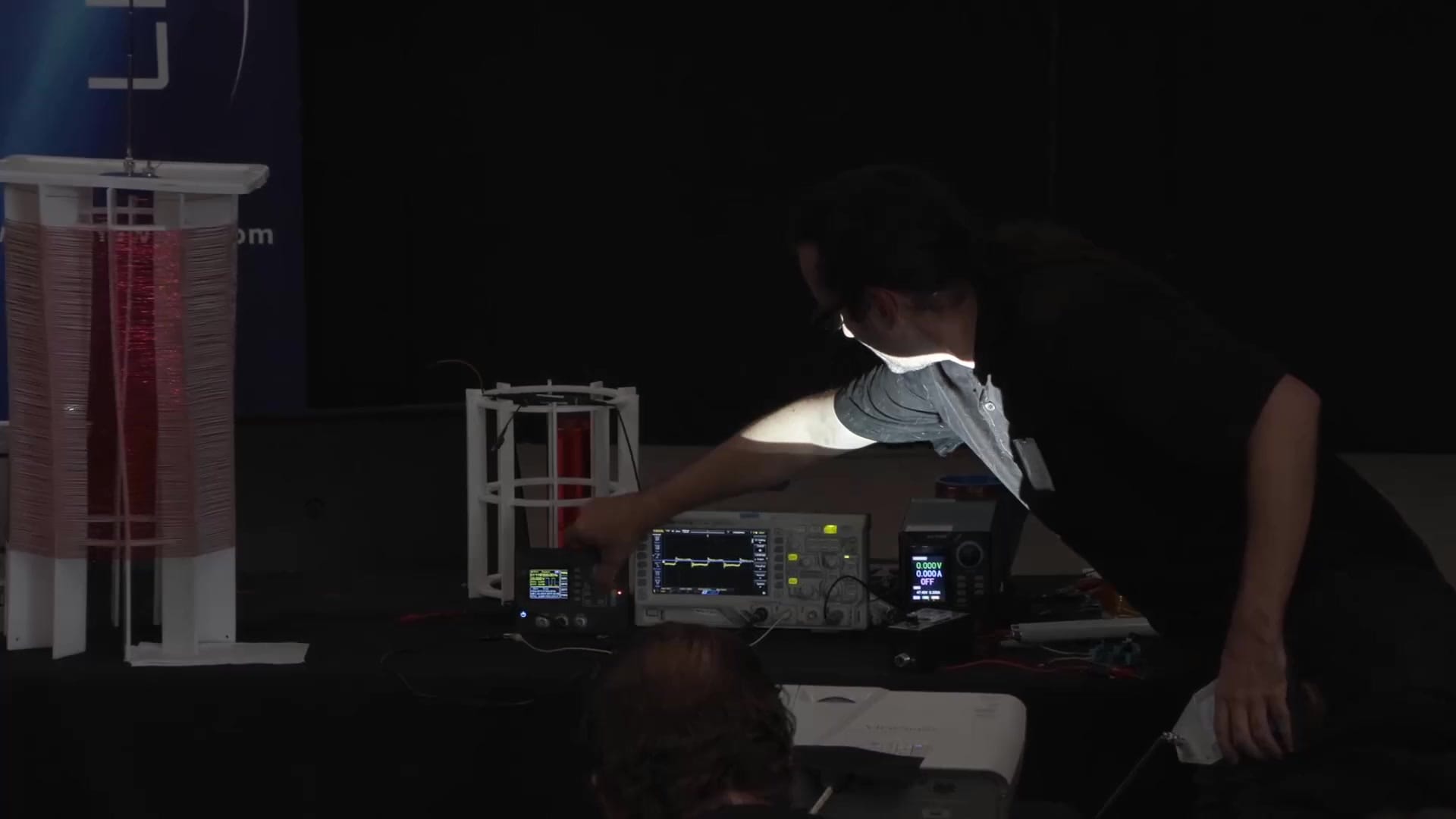
“So with that, I have one request or one imperative. Go forth and build.”
Hakasays, ESTC 2026
Who this is for
The builder who wound a coil on a PVC pipe, got sparks, and wants to know why the coil rings like a dead bell. The experimenter who tried to copy the Colorado Springs replica and gave up. The ham radio operator who already owns the signal generator and the scope and did not know they were enough. The Dollard and EPD follower who wants the telluric platform’s coil explained by the man who wound it. The person who buys the kits online and wants to know what the kit is hiding.
You do not need to be an engineer. The formulas are on the slides, but he explains everything with water pressure and flow, and every claim is followed by a meter reading you can watch. Is it just theory: three demonstrations on stage, a resonance found live, a Q worked out on screen. Why 137 minutes: the history, three demos, the materials lesson, the bench session, the telluric platform and the Q&A. The MP4 is yours to keep.
Download the full 137-minute presentation now.
Regular price $37. Introductory price $27.75. 25% off at the introductory price through November 6, 2026. No coupon required. The discount is already applied on this page.
After this presentation you will understand why the frame matters as much as the wire, how to find a coil’s resonance and measure its Q with three instruments, and why the same bulb can be lit on a third of a watt once the coil is built the way Tesla built it.



Reviews
There are no reviews yet.