
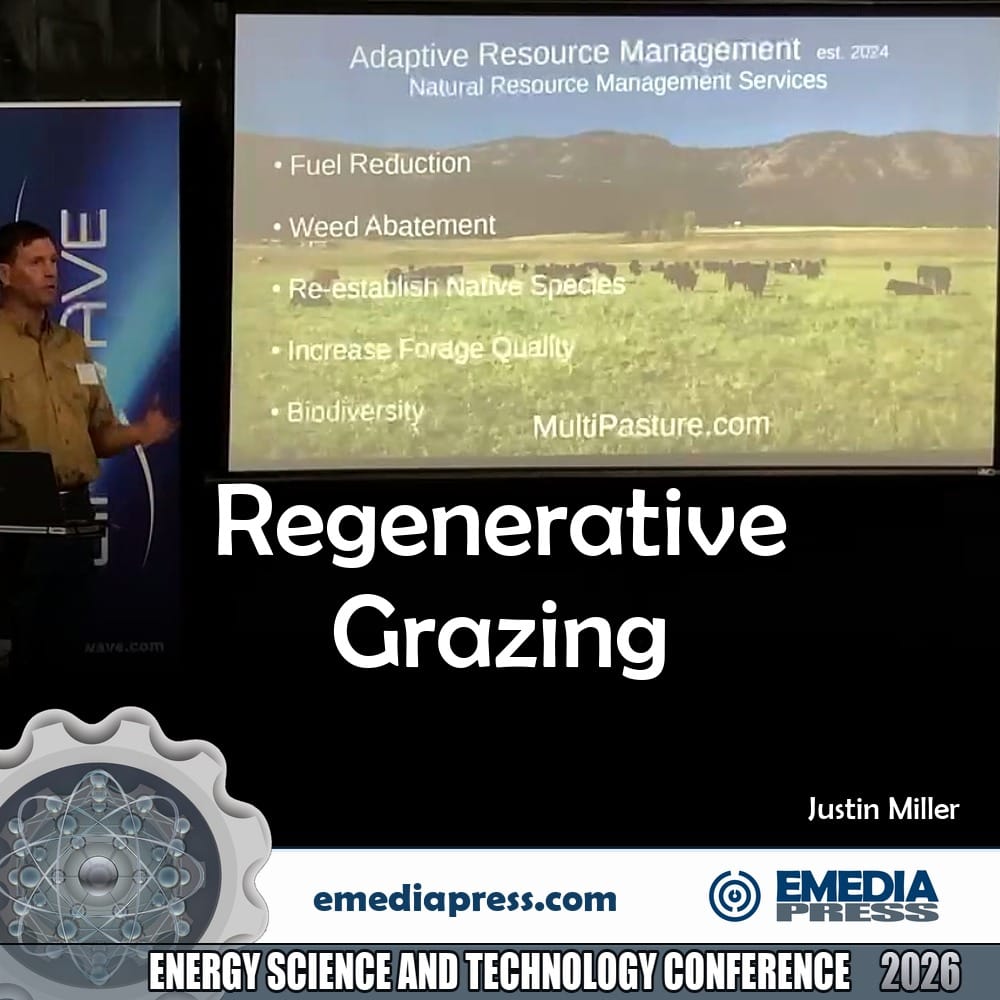
Description
One man on foot, upwards of a hundred head, and the cows come to him.
Justin Miller’s full 64-minute presentation on regenerative grazing and low-stress livestock handling, recorded live at the 2026 Energy Science & Technology Conference.
In his own footage, Miller moves upwards of a hundred head with “no horse, no dogs on the ground.” The herd walks toward him, not away. “These cows are coming to me because they’ve been trained to do that.” They know, he says, that “following along with me is their meal ticket, that they’re going to get turned on to the next paddock of green grass.” In another clip a herd moves onto a paddock of regrowth: “It’s been at least 30 days. We’re bringing them back through the same landscape. We’re getting multiple grazes.”
Miller calls himself a first-generation rancher: his family had been off the land for several generations. He has worked on an organic biodynamic farm, on a conventional industrial operation, and from 2012 on an 1,100-acre preserve whose owners had banned livestock and torn out every cross fence. There the management was, in his words, “a hundred percent mechanical,” and the mower was his office. A 2014 conference introduced him to stockmanship and to the idea that “as beef producers, we’re actually grass farmers.” He now works in northeast Oregon.
What you get: the full 64-minute presentation as an MP4 video download, recorded live at the 2026 Energy Science & Technology Conference. Download it and keep your copy.
Regular price $17. Introductory price $12.75. 25% off at the introductory price through November 6, 2026. No coupon required. The discount is already applied on this page.
WHAT YOU’LL SEE IN THE FULL PRESENTATION
- The preserve that banned livestock: 1,100 acres kept open by machine alone, “many hundreds of hours mowing,” and the hemlock, coyote brush, poison oak and blackberry that came back between mowings anyway.
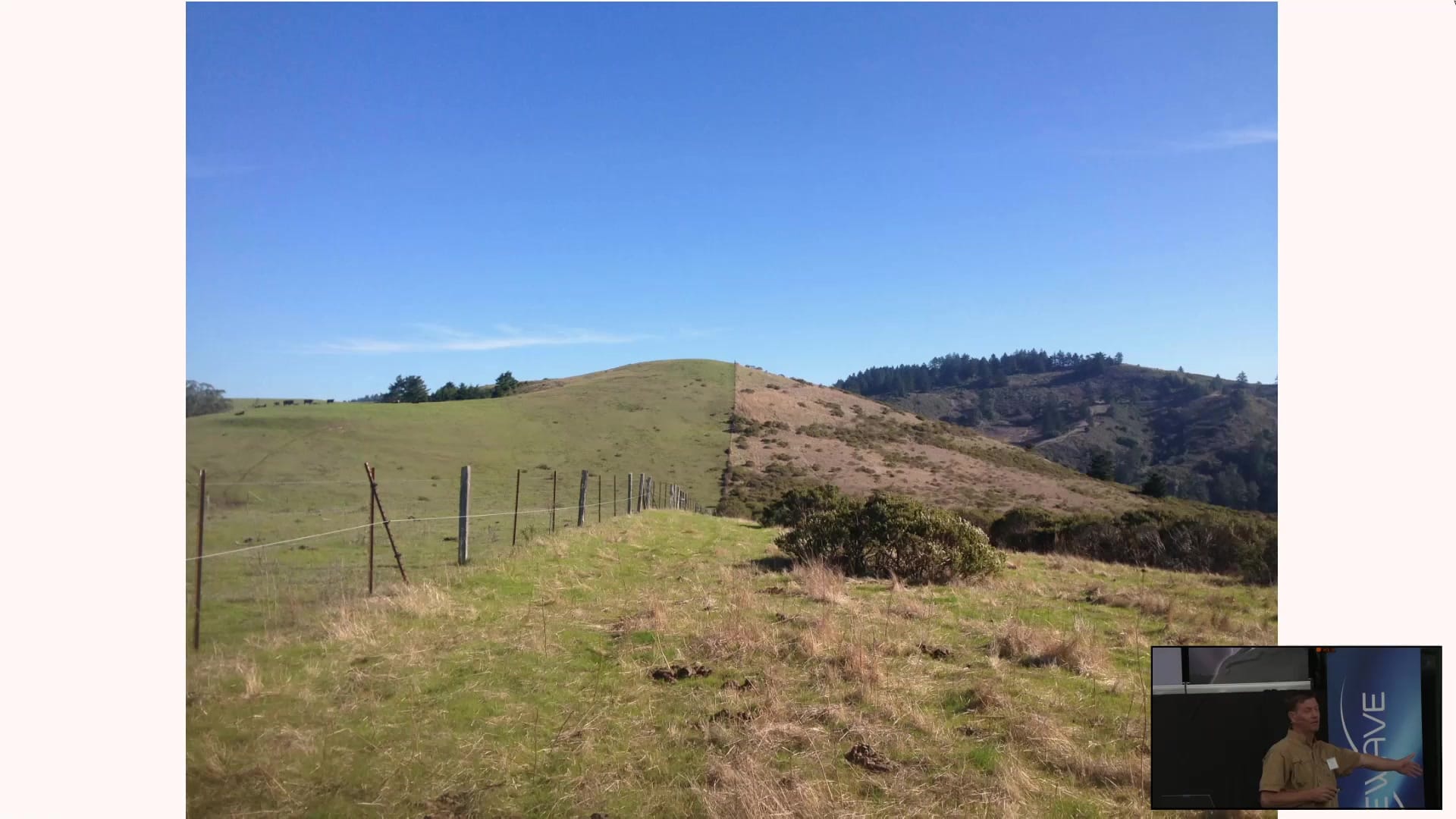
- Overgrazed and understocked at the same time: a fence-line slide where a few head left on one side all season “have negatively impacted the carrying capacity of this land,” while the other side stands uneaten.
- The stock density slide: a principle he reads from a slide he credits to Understanding Ag, one cow on 10 acres all season against a large herd on the same paddock for a single day. It is a principle, not a herd he ran, and he presents it that way.
- One or two days, then rest: how long he leaves a herd in a paddock, why 60 to 90 days of recovery was the target on the California coast, and why in northeast Oregon he found he “could return in 30 days.”
- Single-wire paddocks: poly wire on reels and fiberglass posts set from a rig, with hard fencing only on the perimeter, and why it works on cattle but “Goats don’t respect it.”
- The cold-wire move into poison oak: a single unenergized wire dead-ended into a thicket “the cows have no interest at all to go into,” and how the herd went in anyway. “I got lucky, you might say, or these are some well-trained cows.”
- Where the wildflowers went: a Southern California preserve of about 30,000 acres that kept cattle out, lost its wildflowers, and brought grazing back “in a very specific and very targeted way.”
- Two sides of one road: the same mowing on both sides, cut material lying dry on the ungrazed side and regrowth on the grazed side, “totally due to the grazing.”
- Machines against cattle: his brush-crushing experiment with a crawler pulling an open disc, which “looked a lot like having a large herd of cattle come through” but missed the nutrient cycling, and why he says a dozer opening brush first is not a substitution for grazing.
- A herd you can walk among: how the troublemakers were culled until “we have a really nice, mellow herd of cows,” and footage of him “right in the midst of them, one man on the ground, no dogs.”
- The Q and A: what fencing costs (“the wire and the posts. It’s not cheap”), water as “one of the biggest challenges,” and the soil aggregation, water infiltration and plant sugar tests done with a refractometer. He names the tests; he gives no readings, and he says where his expertise stops.
Grazing is a tool, used for a day
Miller’s case is not cattle against no cattle. It is a few animals left on the ground all season against a herd that grazes a paddock hard for a day or two and then leaves it alone to recover. He gives his own definition of the goal, “a holistic land management approach focused on restoring soil health and biodiversity rather than sustaining existing conditions,” and says plainly that it is his definition, not the only one.
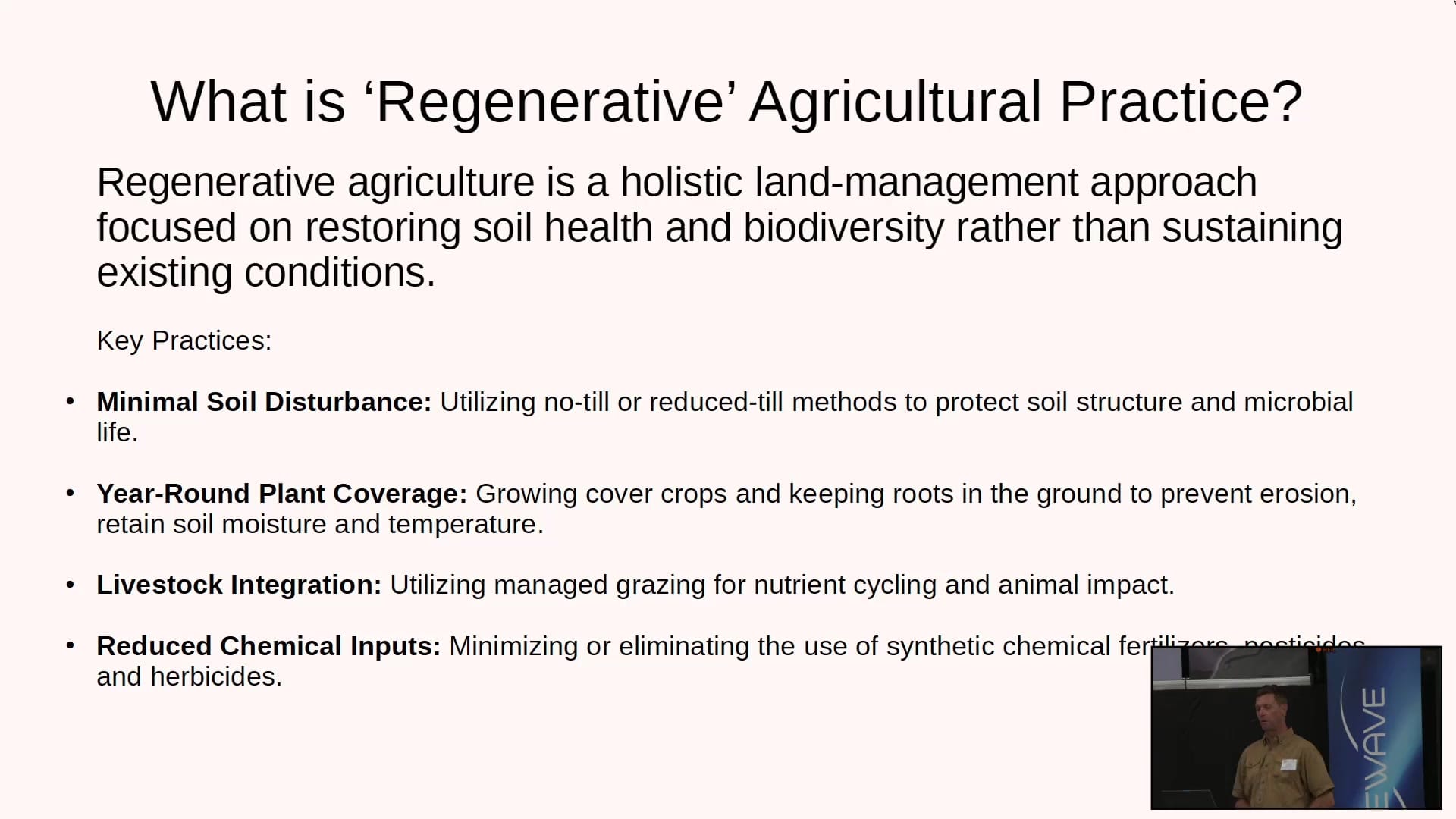
“Somebody said to me at one point, why do we want to sustain a broken system?”
Justin Miller, ESTC 2026
Same mowing. Different regrowth.
On a 30,000-acre preserve a road splits two landowners. Both sides get the same mowing. On the side that refuses grazing, the cut material lies there dry and not decomposing. The other side has regrowth. “So that was a big eye-opener for me.”
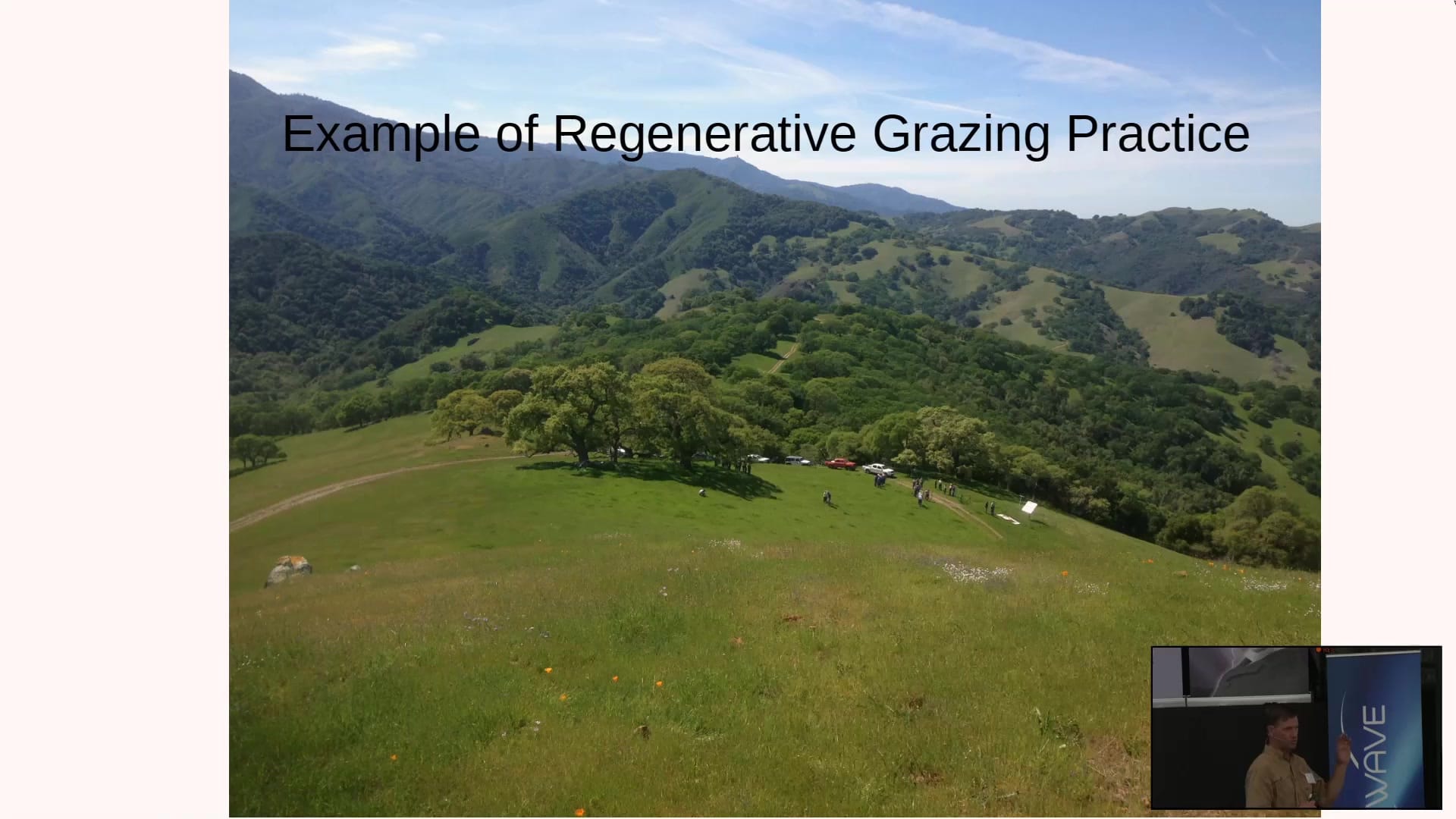
“Same exact mowing prescription on both sides of the road.”
Justin Miller, ESTC 2026
What a machine could not do
Where cattle were not allowed, he tried to get the effect another way, with a crawler pulling an open disc over standing brush. It looked like a herd had come through, but it was patchy, less thorough, and had none of the urine and manure cycling. Opening scrubbed-out brush with a dozer so cattle can graze it later works, he says, but it is expensive, with “no quick return on investment.”
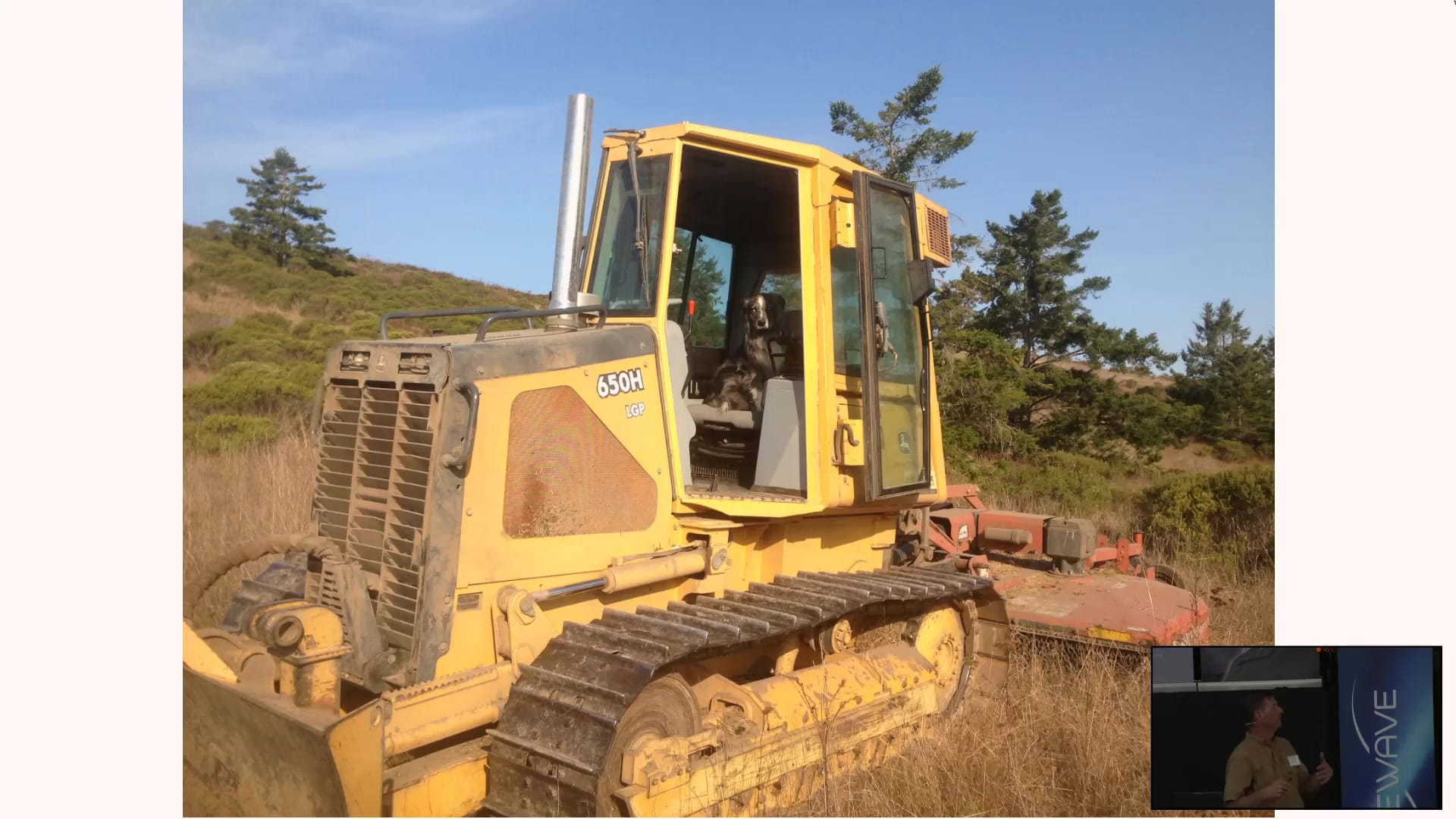
“I don’t fault machinery, but it’s in how you use it.”
Justin Miller, ESTC 2026
Back on the same ground in 30 days
On the northeast Oregon operation, his herd moves into a paddock of regrowth: “It’s been at least 30 days. We’re bringing them back through the same landscape. We’re getting multiple grazes.” On the coast, the same kind of paddock needed 60 to 90 days. He gives both numbers, and the climate behind each.
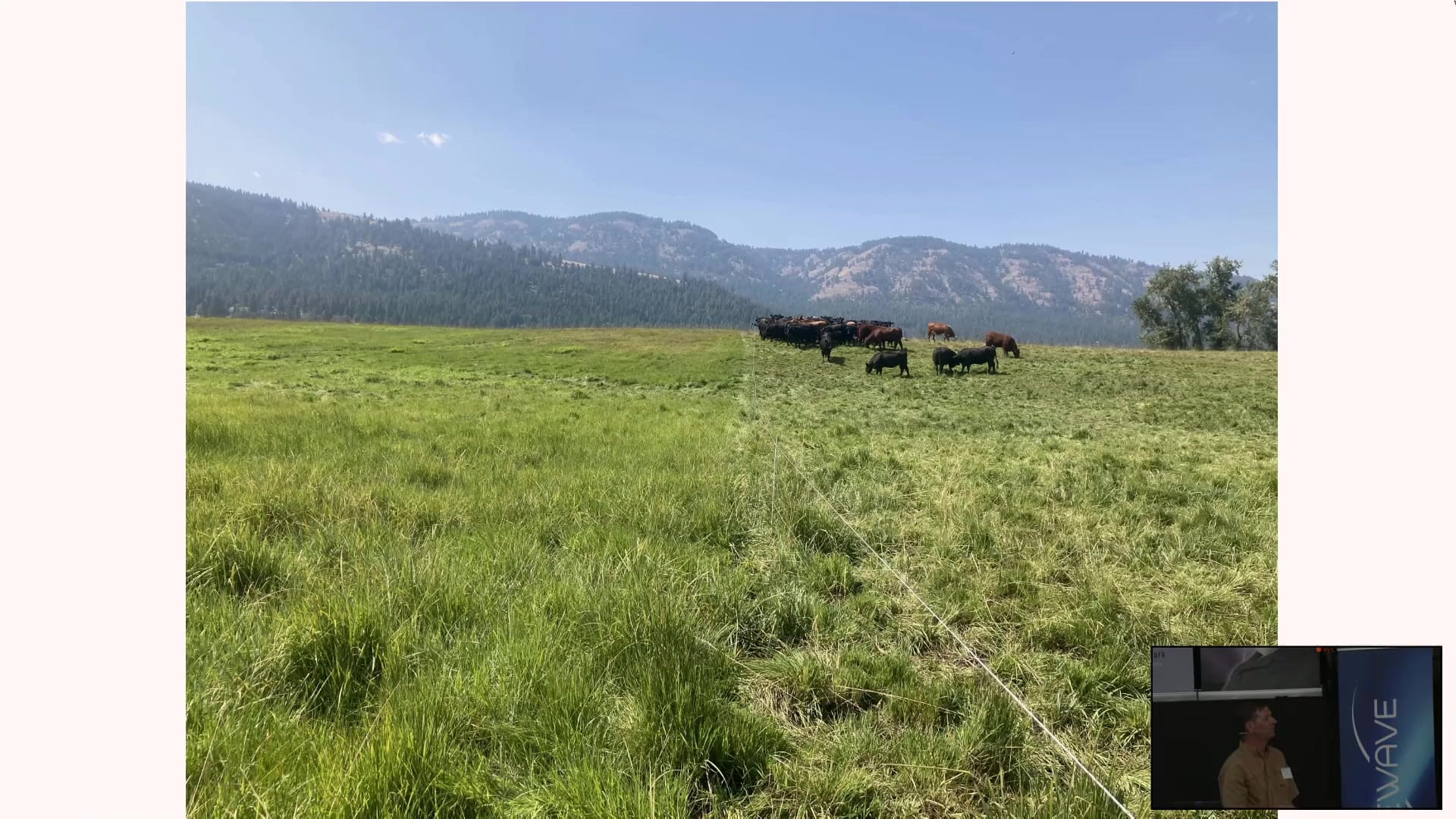
“They trust me. They’re not afraid of me.”
Justin Miller, ESTC 2026
For the land you manage
Watch the handling footage if moving cattle still means chasing them: “I don’t have to go chase these guys around.” Watch the fence footage if you want to see paddock lines set and moved with single wire instead of permanent cross fences. Watch the road and fence-line comparisons if you are deciding whether mowing alone is doing the job. And watch the Q and A if your real obstacles are water, keeping temporary wire hot, or paying for more fence.
This is a rancher’s report, not a promise. Animal impact can take weight off cattle, and he says so. Temporary fence has to be checked daily or “the cows won’t respect it anymore.” Water, in his words, is “one of the biggest challenges.” You get the trade-offs with the results, which is what makes them usable on your own ground.
Who this is for
The person mowing the same pasture every year and watching the brush come back. The rancher whose cattle sit on one pasture all season. The landowner told that livestock can only wear ground out. The stockman who still moves cattle with noise and pressure and wants to see a herd walk to one man on foot. No science degree needed: it is photographs and video from working ground, explained by the man who worked it. The MP4 is yours to keep and watch again.
Download the full 64-minute presentation now.
Regular price $17. Introductory price $12.75. 25% off at the introductory price through November 6, 2026. No coupon required. The discount is already applied on this page.
After this presentation you will understand why a few cattle left on one pasture can do more harm than a large herd moved through in a day, and what it takes to run cattle that way.






Reviews
There are no reviews yet.