
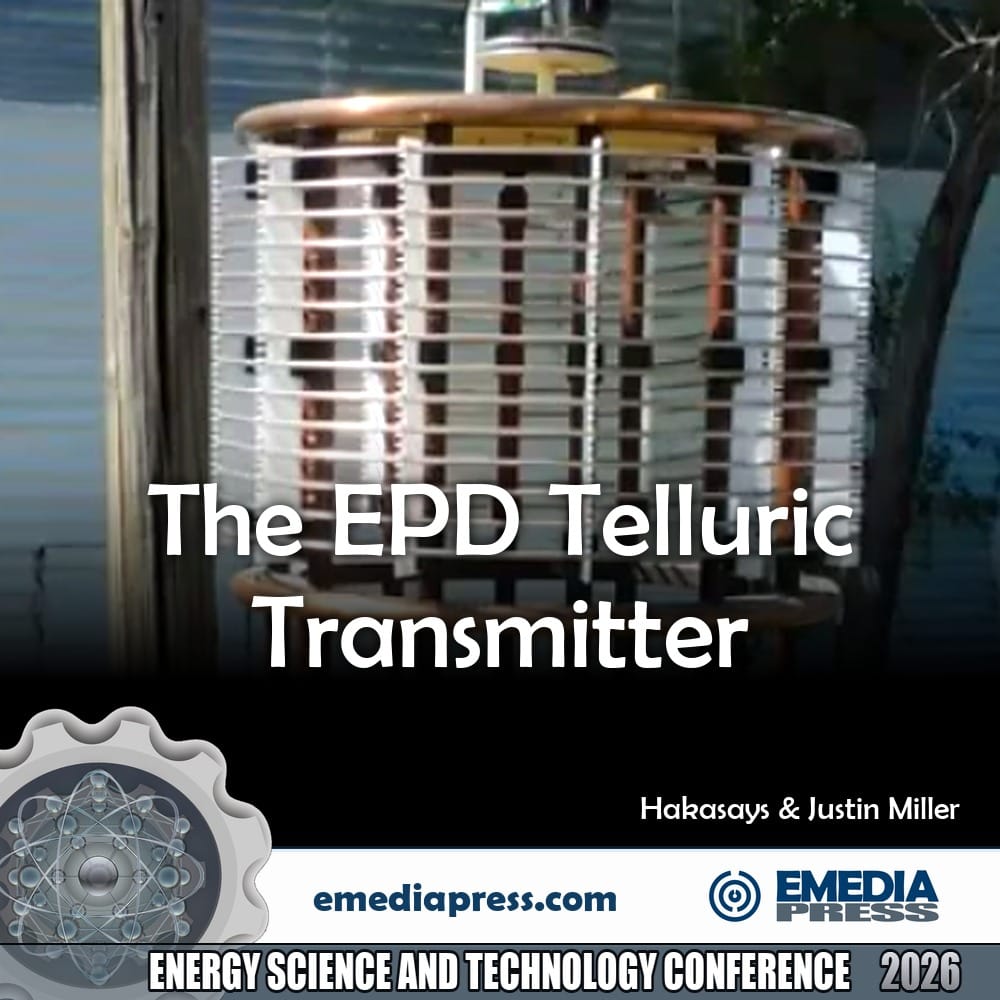
Description
They turned the transmitter down. The distant receiver kept hearing it.
At 5 watts, Steve McGreevy was still receiving the EPD signal clearly 115 miles away in Keeler, California. Hakasays describes the test as the team reduced power in stages, then used detuning to find where reception began to fall away. The result is a received radio signal and a documented field observation, not proof that the signal traveled exclusively through the earth.
What you get: the full 111-minute presentation as a downloadable MP4 video, recorded live at the 2026 Energy Science & Technology Conference. Download it and keep your copy. Hakasays and Justin Miller take you through the actual Tonopah apparatus, the work required to get it operating, their range tests and the measurements still missing.
Regular price $27. Introductory price $20.25. 25% off at the introductory price through November 6, 2026. No coupon required. The discount is already applied on this page.
Hakasays worked directly on the EPD Laboratories transmitter’s resonant platform, radio interface, tuning, measurements and beacon electronics. Justin Miller helped recover and prepare the EPD site, including the buried electrodes and transmission infrastructure, and participated in the field testing. They report the work in the sequence it developed, including the parts that did not behave as expected.
From Colorado Springs to a working Tonopah test site
The project starts with Tesla’s Colorado Springs objective and Eric Dollard’s 2019 demonstration using a pair of 20-to-1 scale-model resonant transformers. In that demonstration the transmission medium was a wire. Hakasays describes an earlier single-wire test powering a 500-watt load between the paired systems. That is not a claim that the Tonopah transmitter sent 500 watts through the earth. The scaled demonstration provides a physical reference for what the team wants to investigate at a larger site.
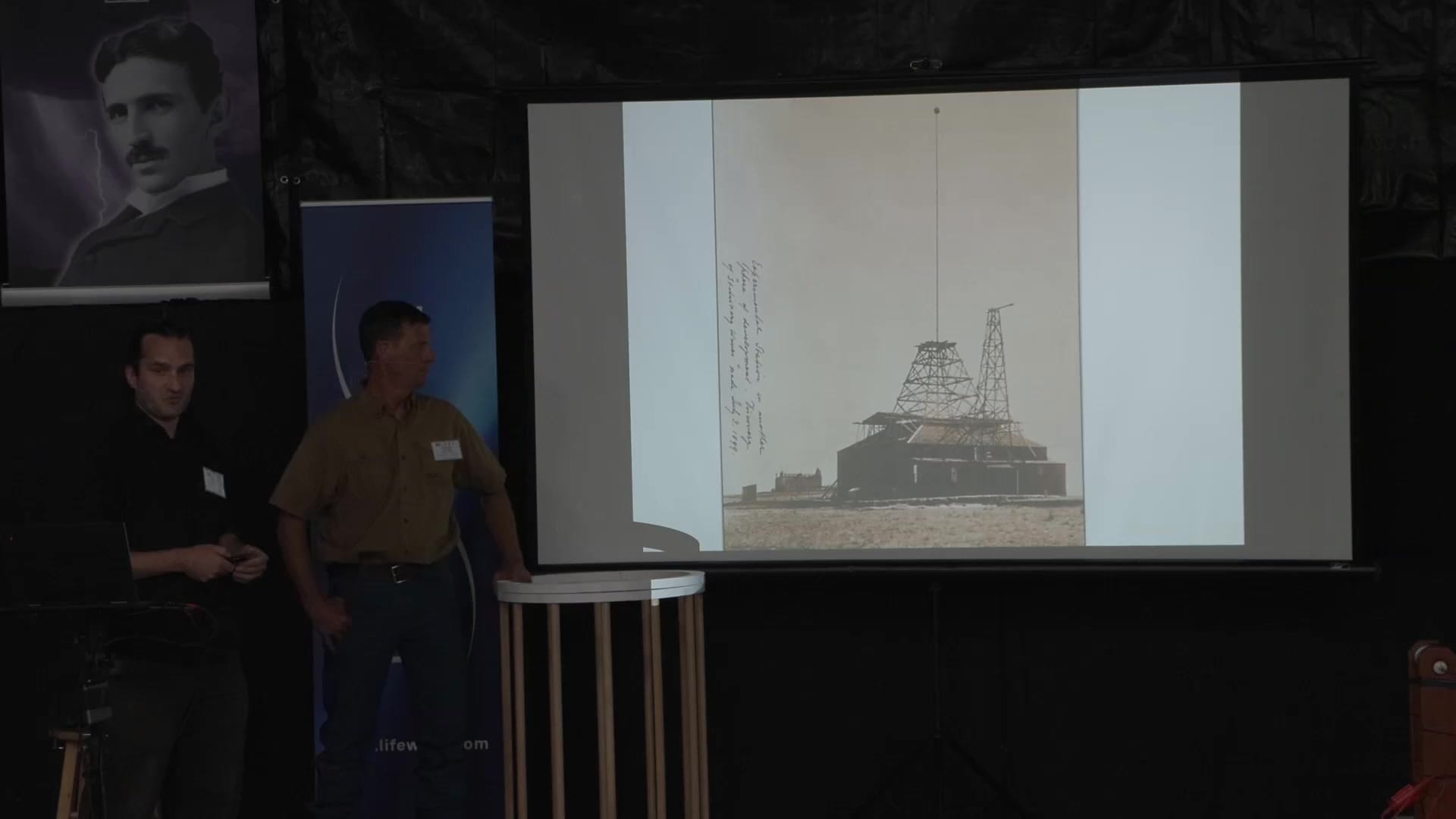
At Tonopah, the team has built and operated the transmitter side. The earth is the proposed transmission medium, but a complete matched transmitter-and-receiver system and decisive propagation measurements remain future work. Instead of beginning with a finished claim, the presentation shows what a field apparatus requires before a claim can be tested.
What the team built
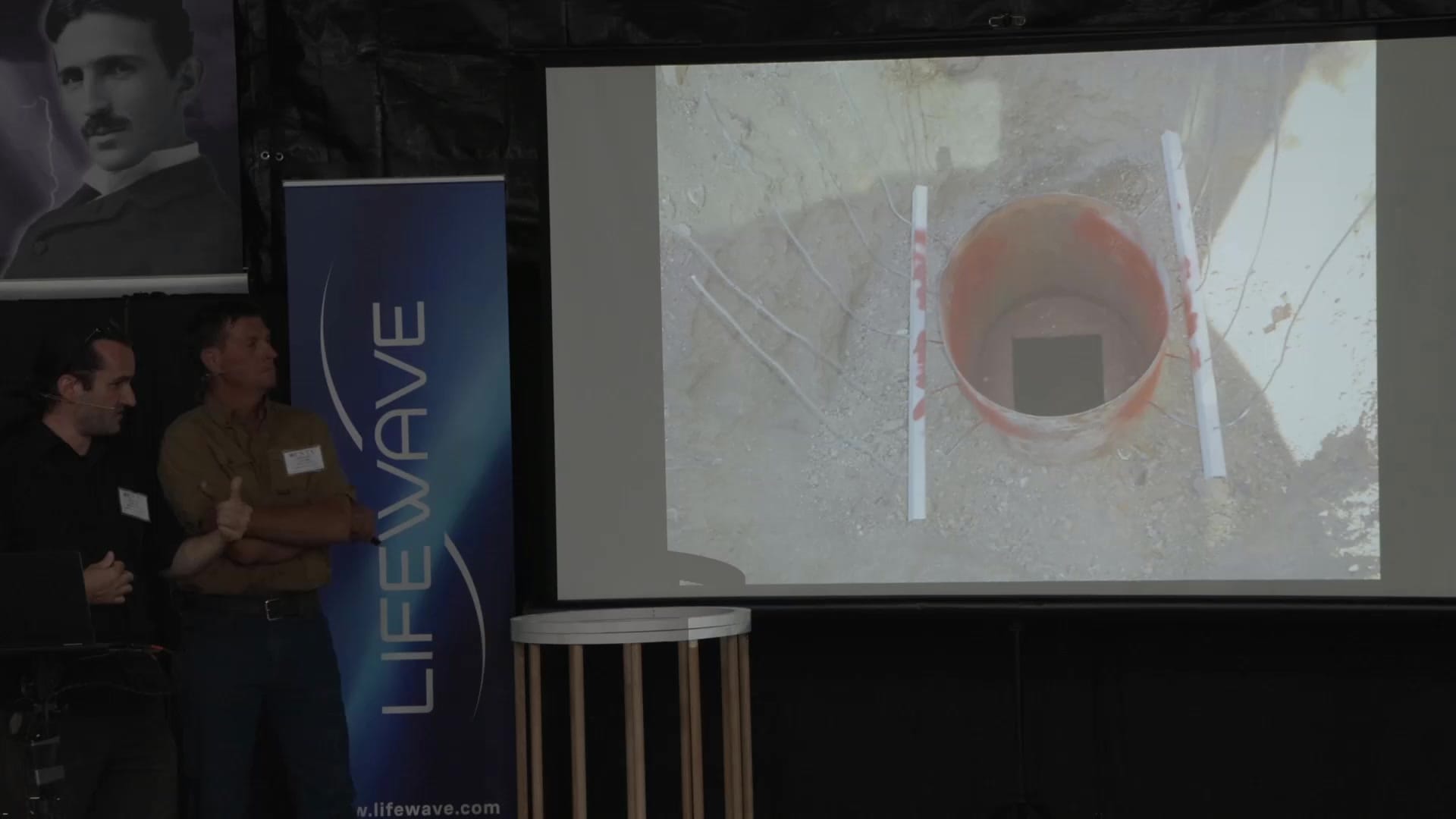
The site includes a resonant transmitter, its radio and matching arrangement, heavy ground connections and equipment for observing current and impedance. The most distinctive part was already buried beneath the EPD Laboratories property: two 10,000-gallon water tanks that the team adapted as a ground electrode. Justin shows the excavation, sealing, welding, backfilling, risers and lead connections that made the tanks usable. This was extensive site work before the experiments could begin.
Hakasays then explains why a Tesla-style earth-coupled experiment is approached differently from an ordinary radio antenna. Ground current is a central operating measurement for this group. He compares the behavior of the resonant apparatus on the outside deck with its behavior after moving it inside. The reported impedance went from about 10 ohms to about 18 ohms. That result changed how the team thought about the physical placement of the system.
What you will see in the full presentation
- The Colorado Springs model. See the paired resonant transformers used as the starting point and hear the clear distinction between a wire-linked model and the proposed earth-linked apparatus.
- The Tonopah ground system. Follow how two buried 10,000-gallon tanks were rehabilitated and connected to serve as the field platform’s electrode.
- The RF current measurements. Hakasays describes about 2.4 to 2.5 amps of current into the earth during a test using about 100 watts of input.
- The unexpected impedance change. Compare the deck and shop placements, with readings reported at about 10 ohms and about 18 ohms.
- The simple cross-check. See why Eric Dollard suggested illuminated automotive turn-signal bulbs as test loads when a vector network analyzer was not giving the team the answers it expected.
- The Keeler reception test. Follow the steps from 300 watts through lower settings until McGreevy was still receiving the signal at 5 watts, 115 miles away.
- The receiver that was actually used. Learn why Hakasays emphasizes that McGreevy used a radio receiver, not a matched resonant coil.
- The lower-power limit. Hear how detuning produced an estimated point of signal drop-off between about 1 and 2 watts. Hakasays says the exact number was not known.
- The car-based field test. Justin describes a daytime drive using small whip antennas, with a minimally discernible signal around 56 miles from town.
- The beacon hardware. See the CW keyer, its relay and protective circuits, and why sustaining an unattended signal presented practical engineering problems.
- The remaining measurement problem. Hear the proposal for synchronized timing at separated sites and why the team has not measured propagation speed or resolved the possible radio and ionospheric paths.
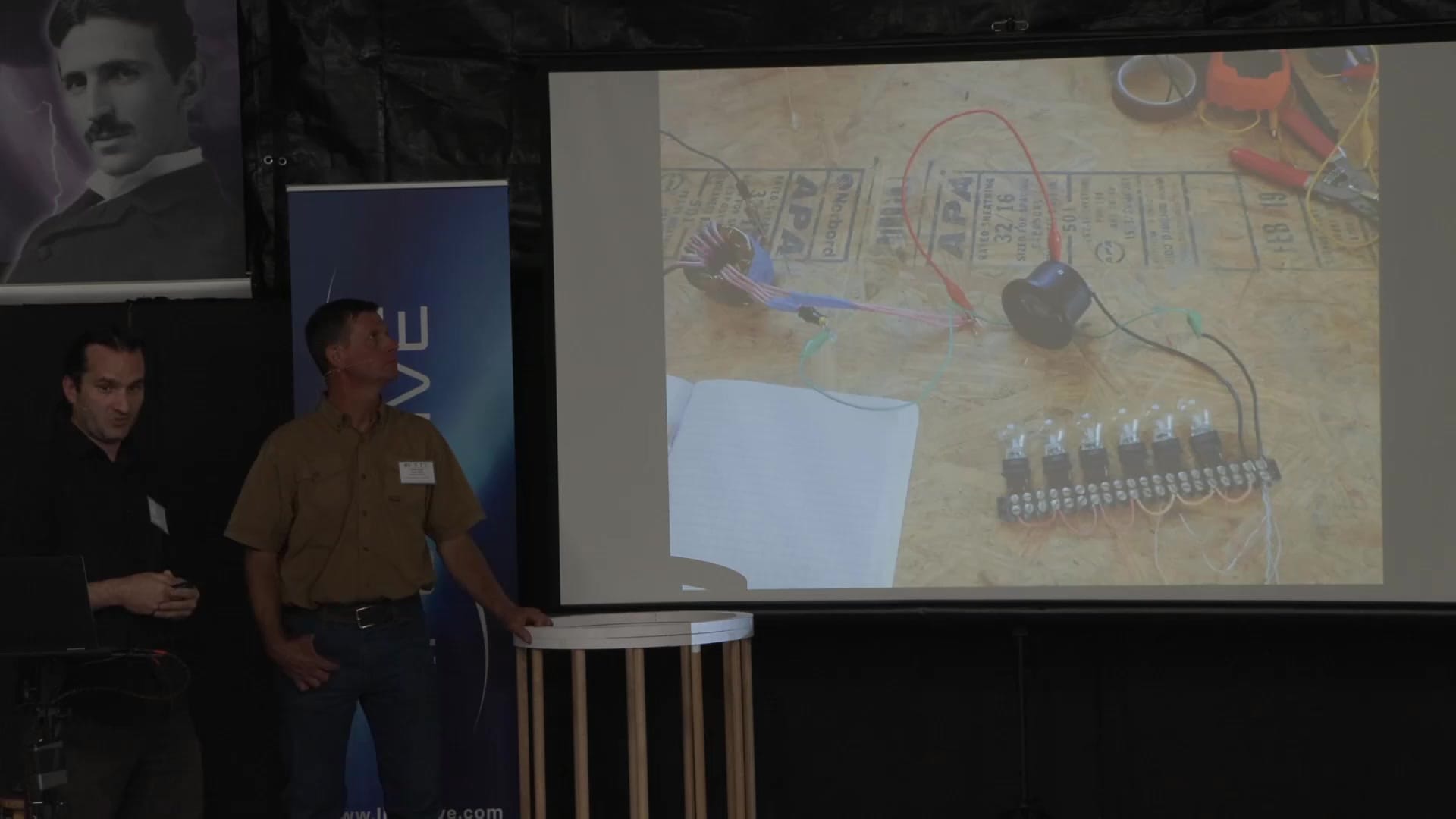
These are not isolated illustrations added to a theory lecture. The presentation moves among photographs, hardware, electrical readings, field-test sequences and questions from the audience. If you are trying to understand how an experimental result developed, the transitions matter. You see which adjustments were made before measurements, which variables remained uncontrolled and which ideas were only proposed for later testing.
“So the schematic of this is quite simple actually, but it’s one of those things where just because it’s simple doesn’t mean it’s easy.”
Hakasays, ESTC 2026
The range test, and the question it does not answer
Hakasays recounts the test with Steve McGreevy listening in Keeler. The transmitting team began at 300 watts after dark. The receiver continued to report a strong signal as power was reduced, first through the tube-amplifier arrangement and then from the HF radio. At the radio’s lowest setting, McGreevy still heard it clearly. Hakasays also points out that the receiving end did not have a purpose-matched coil.
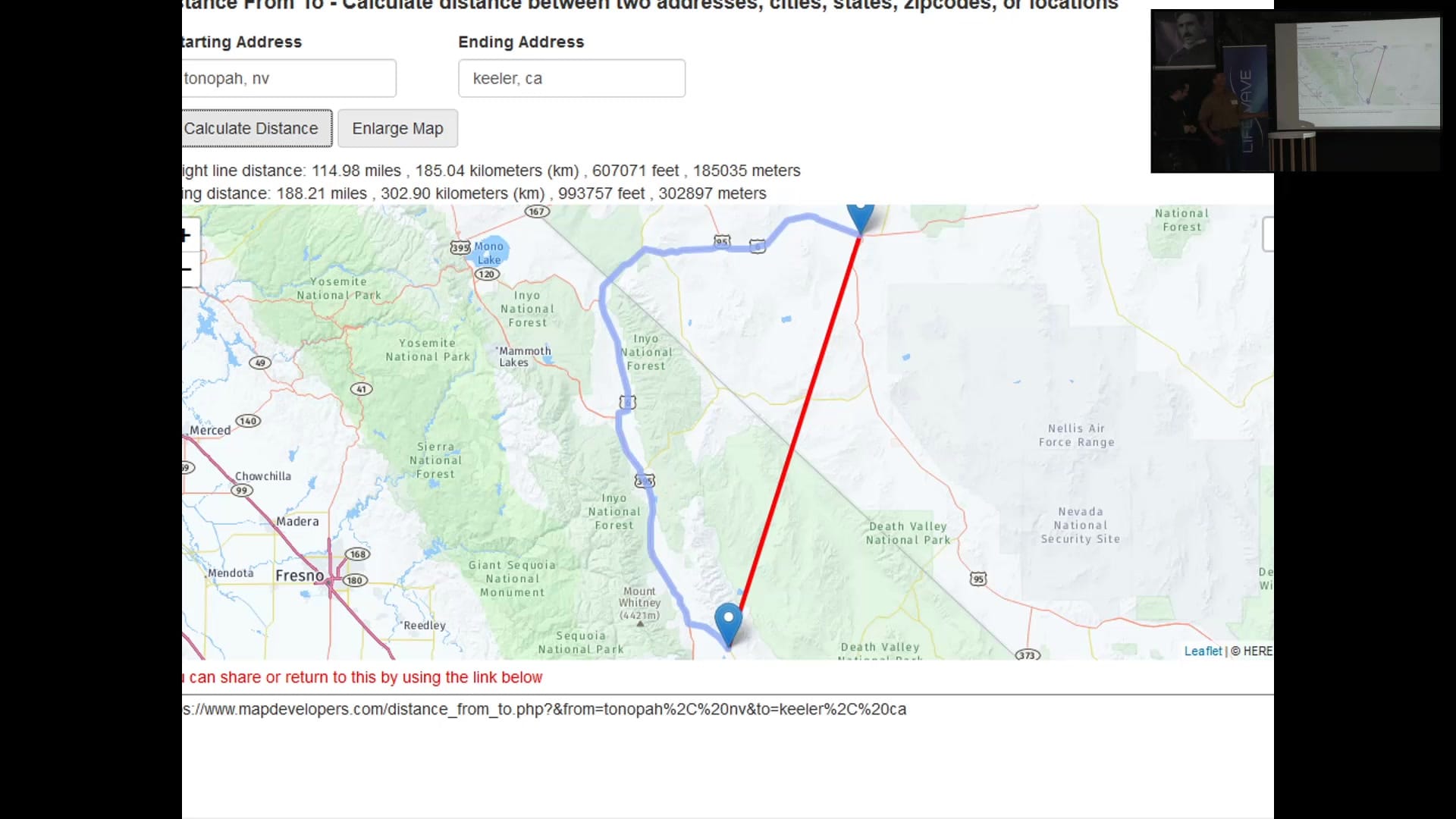
5 watts, 115 miles, received in Keeler
Hakasays reports that Steve McGreevy could still receive the signal using a radio receiver after the transmitter was turned down to 5 watts. This establishes the reported reception result. It does not, on its own, establish that the path was exclusively through the earth.
“And lo and behold, he was still picking it up, clear as day, 115 miles away.”
Hakasays, ESTC 2026
The distinction is central to the talk. Hakasays says the system has a radio component and a telluric component, and discusses the possibility that the ground and ionosphere may both influence what a distant receiver hears. He expressly says more measurements are needed. In response to an audience question about propagation speed, he states that the team cannot measure it yet and outlines a possible future time-of-flight comparison using GPS-disciplined timing equipment at two locations.
There is no need to accept an unmeasured transmission mechanism in order to find the field data worth studying. You can inspect the construction choices and read the reception report on their own terms. You can also follow the team’s proposed methods for distinguishing one explanation from another.
From a short field visit to sustained measurements
The speakers explain what has to change when a transmitter that works during attended experiments is expected to run for extended periods. Hakasays shows the beacon-keying electronics, built around a mercury-wetted relay because digital or MOSFET switching near a multi-hundred-watt transmitter risks surges “that would smoke the electronics.” Justin recounts the vehicle range test in daytime conditions, when they deliberately wanted a less favorable reception scenario. The talk also touches on remote listening stations and online receivers as possible tools for plotting results across different locations.
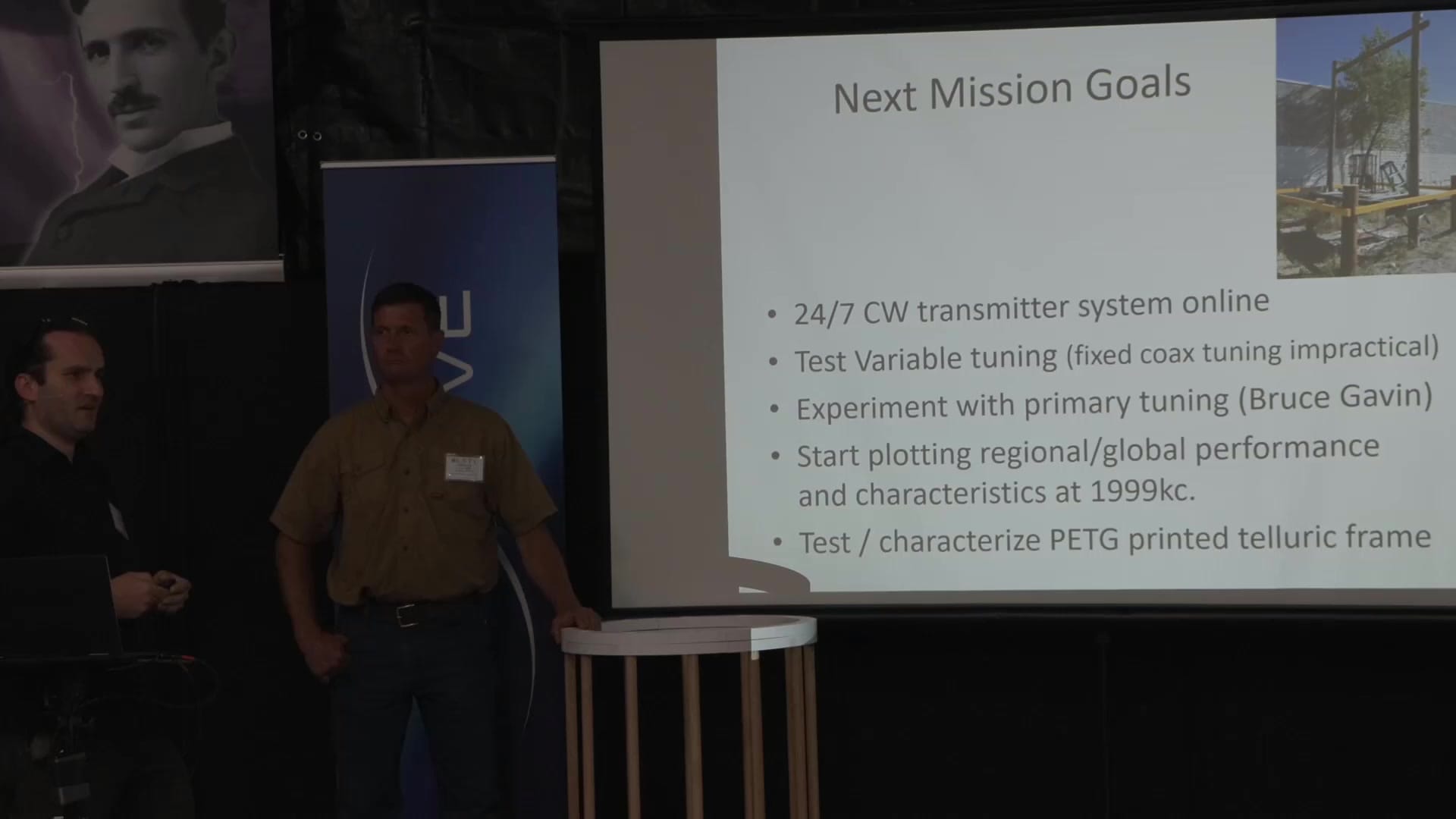
By the closing section, the next work is much clearer: keep the transmitter operating, record reception under changing conditions, compare receiving locations and design a credible timing experiment. It is a presentation about a research platform being built and improved, not a declaration that every unknown has been solved.
“This is why we’re all pushing it forward to get to this point that we can get the data and find out if this is a viable system or not.”
Hakasays, ESTC 2026
Who this is for
Watch when you want to evaluate a low-power long-distance reception report without assuming a mechanism before it has been tested. Watch when you are planning your own grounded-resonator experiment and need to see the practical constraints imposed by site work, electrode connections, equipment location and RF measurements. Watch when you have heard about the EPD Tonopah project but want the sequence of apparatus changes rather than disconnected clips. And watch when you want to understand exactly which unanswered questions the team intends to measure next.
The 111-minute length gives room for the construction record, the setup decisions, the field reports and the audience’s objections. You do not need to be an engineer to follow the central story, while the hardware and measurement details give technically experienced viewers material to study. This is the complete downloadable MP4 presentation, not a temporary stream or limited preview, and you keep your copy.
Regular price $27. Introductory price $20.25. 25% off at the introductory price through November 6, 2026. No coupon required. The discount is already applied on this page.
Support Eric Dollard’s ongoing research. EPD Laboratories, Inc. is a 501(c)(3) nonprofit furthering his work in the electrical sciences: https://ericpdollard.com/donate
Get the complete 111-minute field presentation.
After watching, you will know what the EPD team physically built and recorded at Tonopah, and why the signal’s propagation path still requires a decisive measurement.



Reviews
There are no reviews yet.