In his 2026 ESTC presentation, Adrian Marsh asks why over-unity experiments remain so difficult to replicate. He then discloses his etheric resonator for the first time and presents measurements from an Advantest TR4173 analyzer, a phone EMI test and oxygen-17 NMR water comparisons. A Foundation for True Science, 141 minutes, is out now as a download.
He opened the last morning of the conference with a poll. Who in the room has witnessed an over-unity machine working? Who has seen the plans? Who has replicated one? Then the question the whole talk answers: “So why does free energy in over-unity remain so elusive? We have experience, we’ve seen it, but why is it still so elusive?” Marsh holds a PhD in Physics from the Cavendish Laboratory at Cambridge, has been part of the ESTC research team since 2019, and has spent 30 years on this.
Get A Foundation for True Science, the full 141-minute presentation
coMra Wave: From Resonance Research to Everyday Application
From Radiant Life Technologies:
Following Dr Adrian Marsh’s presentations at ESTC 2026, Radiant Life Technologies has published a new article exploring coMra Wave, its underlying resonant technology, and some of the experimental work presented at the conference.
The article covers NMR and dissolved-oxygen measurements, observations from plant-growth experiments, and how the coMra Wave Coaster, Cell and Pendant bring the same resonant principle into everyday biosupport. Research continues, with new applications of the coMra Effect already in development.
Read the full article: coMra Wave: From Resonance Research to Everyday Application
Marsh’s approach to the replication problem
Marsh’s answer to his own question is not a missing component value. “If you want to replicate someone’s over-unity machine, you need to align the same intent. Because when you align the same intent, it’s going to work.” He traces his own path: when he found Eric Dollard’s work he set out to replicate Dollard’s experiments as accurately as he could, “because if I did that, and I did it as accurately as I could, then I would actually get a sense of his intent, of what he was trying to explore about Tesla.” The first hour develops that argument, drawing on conventional experiment and on his framework of esoteric science, and he says plainly which is which.
RF transmission test: 49 dB at 2.45 gigacycles
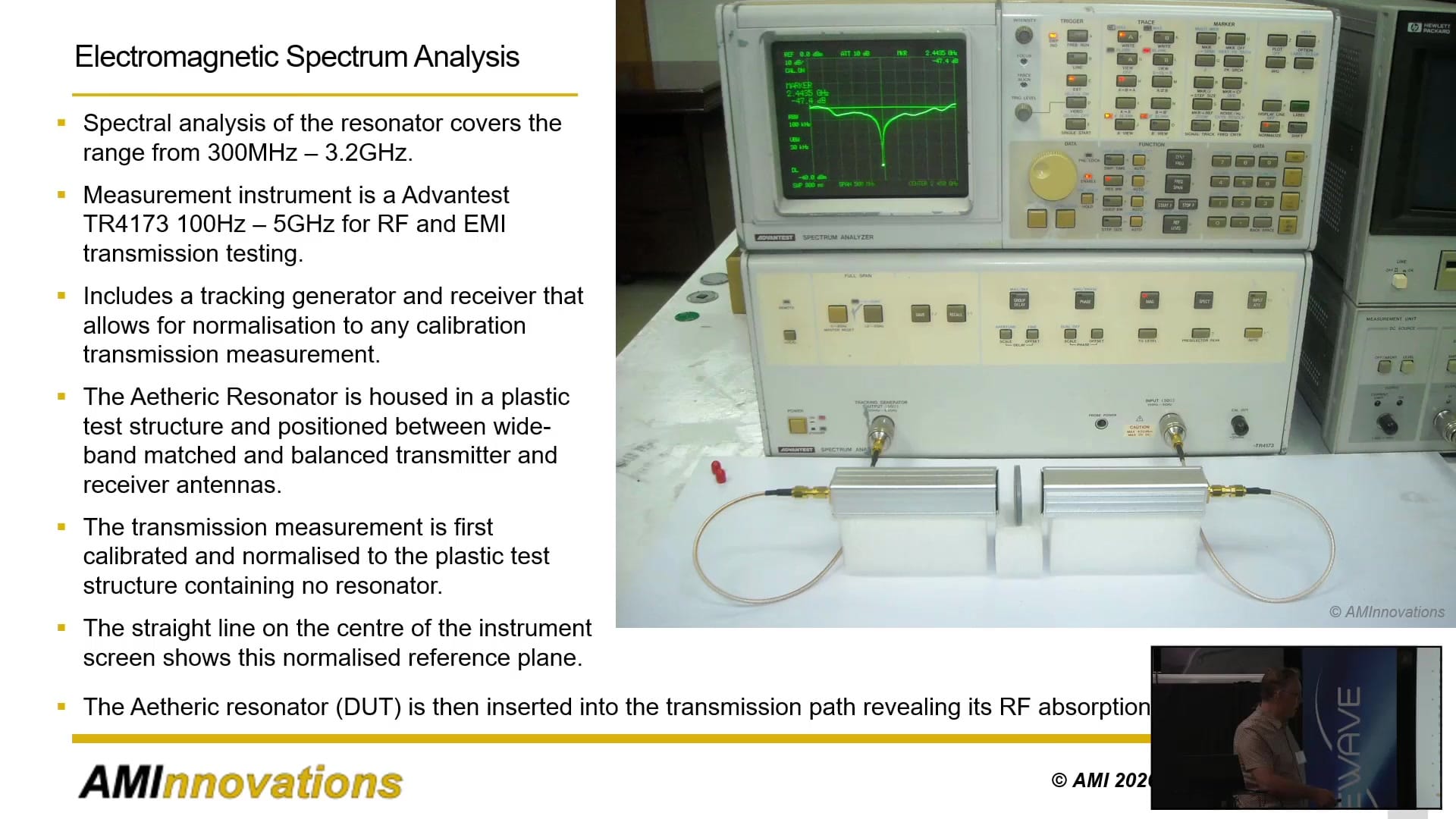
Marsh announces “a first-time disclosure” of what he calls an etheric resonator, a device he says resonates in both the electromagnetic spectrum and the etheric one. The full design is shown in the presentation. Then he puts it between two matched antennas on an Advantest TR4173 and sweeps it from 300 megacycles to 3.2 gigacycles.
- Calibrated first. The empty plastic test structure is measured and normalized flat before the resonator goes in.
- 2.45 gigacycles. The upper spectrum shows a major component there. “You might recognize that frequency.”
- 49 dB. The transmission attenuation at that component against the calibration without a resonator. Marsh explains why it is absorption and not reflection: “It’s not being reflected back to the generator. It’s a matched condition.”
- The rest of the spectrum. Major components at 1.3 and 1.4 gigacycles, which he places at the OH band and the hydrogen line, a minor at 1.54, and lower components at 375.6 and 780.
- On a phone. Mounted on a cell phone in an EMI test receiver setup, the resonator takes 33.5% off the two measured peaks. The phone’s 906 GSM frequency sits next to the resonator’s 920 minor resonance. “We didn’t design this.”
Oxygen-17 NMR: 68 Hz control, 59 Hz samples
Marsh reads the RF attenuation as absorption rather than reflection. He then turns to water to see whether exposure goes with other measurable changes. Two resonators go into ordinary tap water from the research facility and the samples go through oxygen-17 NMR, where the half-width is his measure of cluster size. The control reads 68 Hz, inside the 65 to 75 he gives as typical for tap water. Both resonator samples read 59 Hz, inside the 50 to 60 he gives for spring and natural water. The run takes about four hours and he states 2 to 3 Hz of drift over that time as the margin of error. A 9 Hz shift, he says, “shows a significant change in the structure of water and a reduction in the cluster size.” Dissolved oxygen follows, rising from about 54 to 65 after 15 minutes on the resonator and 67 at 30 minutes without agitation, and then a twelve-day plant comparison, repeated with cress.
He also says what is not settled. “Many aspects of the etheric resonator remain as yet unknown and unexplored. It is a research in itself.”
Inside the 141 minutes
The poll and the replication question. The two journeys, scientific and esoteric, and how he proposes bringing them together. The first-time disclosure and the equivalent circuit. The full sweep, the phone test, the NMR, the dissolved oxygen, the plants. And a Q and A on whether linear sine waves, sideband heterodyning and disruptive discharge are equal (the second and third, he says, produce a much stronger effect, “particularly the non-linear”), a follow-up on displacement current, and his capacitor-discharge explanation, demonstrable “with high voltages, with capacitors, inductors, and disruptive circuits. So spark gaps.”
The 2026 ESTC releases so far
Gangrene Energy, Eric Dollard, on the dirty electricity in the utility system. The Alexanderson Antenna, Eric Dollard, from the Bolinas blueprints to a radio telescope pointed into the Earth. Onan and Dynamotor Tech, Al Francoeur, a motor-generator that ran from April 17 to the solstice. And out this morning with this one, free, The coMra Effect, Marsh’s other 2026 talk and the first half of this argument. The free 2026 Panel Discussion, nine presenters with no script and no slides, follows on Tuesday.
Hear about each release first
Energy Times readers hear about each ESTC 2026 release as it goes live, along with new books, papers and research from emediapress.com. It is free, and you can leave any time. Get Energy Times.
Get A Foundation for True Science
Aaron Murakami
Energy Science and Technology Conference · emediapress.com