Posted on Leave a comment

Three Grounds, Only One Is Real — TCS Transmitter Bench at EPD Labs

Eric Dollard and Connor Fisher walk through the new TCS bench setup at EPD Laboratories in Tonopah, Nevada.

The Ground Problem

The site has three things that we would be tempted to refer to as ground — only one actually is.

The telluric transmission coil transmits through a large water tank buried underground. That tank measures 1 ohm against the power line neutral. Because the coil is actively transmitting through this tank; it is hot — not ground. A second tank is buried nearby to the first, but has an induced current from the first tank resulting from the telluric coil transmission; thus they are electrically coupled making the second tank hot. Also not ground.

The power company’s so called ground is also not legitimate since it is bonded to the high voltage neutral at the main panel. Due to some national dictate most transformer connections are being bypassed; connecting the customer directly to the high voltage neutral on the secondary side of the power line transformer. Driving a couple ground rods at the main panel do not in any way reconcile this issue; they are simply there as a result of misguided electrical codes, and in a sense are “just for show.”

In order to establish an actual ground for the telluric test platform radio equipment; the crew at EPD drove six ground rods spaced 10′ apart. These are all bonded, and terminate inside the lab to an aluminum bus on the back of the TCS workbench. The resistance between the water tank and this station ground measured about 3 to 5 ohms — acceptable.

The TCS Bench

The A.C power coming into the building is run through an isolation transformer in order to seperate our power supply from the high voltage neutral. Either leg of each outlet measures 60V with reference to ground, but compound with eachother to provide a standard 120V A.C connection. This floating ground arrangement is consistent with how the NAVY would typically wire their ships.

A 12-volt DC power supply with twist lock outlets runs the full bench length. We have a battery arrangement with associated charging appartus; along with a separate 12-volt DC power supply which can be run off of the above mentioned A.C system. A 24-volt D.C leg on our twist lock outlets is planned as well for other radio equipment, but is not actively implimented.

Gang Green Energy

In this demonstration, Eric puts the power company’s signal as picked up between their high voltage neutral, and our isolated ground on the oscilloscope. It looks more like a video signal than anything from a power frequency standpoint. It has a repetition rate at the power frequency, but there’s nothing about it that even remotely resembles a sine wave. Very unstable — it can be seen in previous demonstrations that this visual signal morphs and tranforms based on as of yet unkown conditions.

The waveform is more likely 180 cycles per second rather than 60 because of the three phases adding up in the neutral. The distortion is caused in part by rectifiers converting AC to DC. There is not a proper inductance on the line in order to prevent transients from appearing; nor is there implimented synchronous condensors to keep everything in phase based on the inertia of mechanical apparatus. Switching power supplies produce further glitches and RF on the line. This is what happens when you use a Y-connected power system and start hooking inappropriate equipment to the power line.

This is what plays havoc with all audio and radio equipment and permeates the entire electrical system. That’s why so much effort went into the isolated ground system.

Eric points out that every recording studio and radio station he built was wired this same way. Normally if you took the active lead on a phone plug in a guitar amplifier and touched your finger to the tip, you’d blow your speakers out. In the studios he built, all you’d hear would be the buzzing of the gang green energy off in the distance — no damage, no overpowering of the speakers.

Once the TCS system is fully lit up and everything’s hot with RF, restrictions get even tighter on keeping it all stable. This is an ongoing effort; the work of EPD Laboratories is presently reliant on the donations from people like yourself. If you are interested in seeing the continuation of our efforts; please contribute to our work!

ESTC 2026 – Meet Eric in Person

Eric Dollard will be presenting at the 13th Annual Energy Science & Technology Conference — June 24-28, 2026 in Spokane, Washington. All 55 in-person seats are sold out. Live streaming tickets are still available.

Get all the details and tickets at: emediapress.com/conference

Support EPD Laboratories Inc 501(c)(3) with donations at: ericpdollard.com/donate

Explore Eric Dollard’s Work

Check out the extensive collection of Eric’s presentations, books, and videos:

emediapress.com/product-category/authors-presenters/eric-dollard/

Posted on Leave a comment

Live Call: Eric Dollard on Earth Signal Reception, Audio Amplifiers & EPD Labs Update

Here’s a new video from a recent live call featuring Eric Dollard, Adrian Marsh PhD, Hakasays, and several callers asking questions. We covered a lot of ground in this discussion – from the live earth signal reception system now streaming at epdlabs.org to the novel audio amplifier project, the legendary “Glom Locker” full of vintage surplus parts, and some fascinating observations about what’s happening with solar activity and earth signals.


Earth Signal Reception – Now Live

One of the main topics Eric covered was the seismic streaming system that’s now live. This is the culmination of over $300,000 and 10 years of infrastructure development at the EPD Laboratories facility in Nevada.

The system uses a 4,800 ft antenna section (about 5/6 of a mile) running from pole 26 to pole 49, with transmission lines going to a shack at pole 54. That’s over a mile of wire total, with two conductors – so basically double that length when you add it all up.

What you’re hearing when you tune in are the electrical signals between the ionosphere and the interior of the earth (about 5 miles underneath your feet, as Eric explains). The pops and clicks are lightning strikes. But the really interesting part is when those strikes start to make pitches – chirps and squeaks at very high frequencies that are responses to the lightning creating standing wave situations in the earth.

Eric explained that when things start getting stressed inside the earth, those pitches drop down in frequency and sound more like “breaking beer bottles” and chirping noises. You also get frequency sweeps which are waves propagating through the magnetic field of the earth. The more coherent and musical the sounds become, the more likelihood there may be seismic activity brewing – though as Eric notes, it’s more complicated than that simple correlation.

The system intercepts the electrostatic displacement current between the ionosphere and the interior of the earth through a mutual capacitance configuration. It’s a remarkable setup.

Listen live at: epdlabs.org/seismic-streaming/

Note: you may need to set “original sound for musicians” in your audio settings because the pops and clicks can get filtered out otherwise as “interference.”


The “Glom Locker”

We also showed some footage of the famous Glom Locker – an intermodal shipping container filled with thousands of rare vacuum tubes, cases of capacitors, and all kinds of vintage surplus parts. Much of this was acquired by Steve Hills (the director of EPD Laboratories Inc) over decades in the surplus business, along with contributions from Mark McKay.

My friend Jari Karvonen spent about a week helping organize some of this during a recent trip, but we really only scratched the surface. The importance of this collection cannot be overstated – as Eric pointed out, modern components simply don’t work like the old stuff. Brand new electrolytic capacitors from top name brands had so much effective series resistance they weren’t even functioning as capacitors. The new stuff just doesn’t cut it.

When you’re building one-of-a-kind equipment like the Navy TBM transmitter setup or the earth signal amplifiers, you have to glean eBay for the last of the real components from the 50s and earlier. It’s actually cheaper in the long run, and you know it’s going to work.


The Novel Audio Amplifier Project

Eric has been developing a completely novel audio amplifier design that’s unlike anything else in the audio world. This isn’t a voltage gain amplifier like virtually everything else on the market (including all solid state amplifiers). Instead, the transformers themselves amplify – the tubes just add power.

The design extends the original Macintosh concept of equal loading in the cathode and anode with bifilar winding, taking it to multi-stage transformer configurations that are also multi-stage amplifiers. The transformers are coupled with the vacuum tubes into something like a traveling wave amplifier.

The development path goes from small triodes to 6AS7G tubes (which have high transconductance but people use them as voltage amplifiers and get nowhere), then to the Western Electric 300 type triode, and finally to the 811 and 812 power triodes for a 300 watt per channel final version.

The commercial version will be based on a Western Electric 143A theater amplifier design – we found one on eBay from Japan for $27,000, which gives you an idea of what the authentic units go for. This design uses currently available tubes like the 6SN7 and 6550.

The key innovation is focusing on eliminating intermodulation distortion rather than just harmonic distortion. As Eric explained, it’s intermodulation distortion that creates phantom signals – beat frequencies between higher frequencies that don’t actually have any real existence. That’s especially critical when amplifying earth signals where you don’t want artifacts.

Custom transformers and chokes are currently being engineered by a well-known company to go on the prototype panels I cut while I was down there. Once we have a working proof of concept, the goal is to produce a limited edition of maybe 10 rack-mount units to raise funds, then potentially set up an audio company to bring a commercial version to market.

And here’s the kicker – there won’t be a single component made in China in the whole thing. All vintage quality parts sourced from eBay.


Observations on Solar Activity and Earth Signals

One of the more sobering parts of the discussion was Eric’s observations about what’s happening with solar and earth electrical activity. Steve McGreevy and others who have monitored these signals for decades have reported that the earth just seems to be getting quieter and quieter. The solar cycles have been getting weaker and weaker, and quite possibly the next solar minimum will be the biggest dip we’ve seen since this stuff has been recorded.

Even when the earth got hit by a significant coronal mass ejection recently, nothing showed up on the antenna – normally around midnight it would go into “complete war” during such an event. So the whole sun/earth electrical system seems to be in some kind of declining phase. As Eric noted, this could be a sine wave 25,000 years in length – about one aeon. It’s happened before during things like the dark ages grand minimum.

This makes the work of capturing and recording these signals now even more important – so we have historical data for when activity eventually picks back up.


What’s Needed to Continue This Work

Eric was candid about the funding situation. About $50,000 has been used up getting to what you see here, and significant donations haven’t come in for quite a while. The next big expenses include:

  • Another NV Energy power connection at the mine: $15,000
  • Contractor to put up toll entrance cable on the right of way: $14,000
  • Labor costs for specialized workers to advance the projects

The donations are what keep the motor running – whether it’s big contributions like the $10,000 someone donated to buy the 5 miles of brand new copper wire, or smaller amounts that add up over time.

Support EPD Laboratories Inc 501(c)(3) with donations at: ericpdollard.com/donate

Every donation goes directly into furthering this work in the electrical sciences. For those who don’t have money to donate, sharing these videos and driving traffic to the websites helps us reach people who might be able to contribute.


ESTC 2026 – Meet Eric in Person

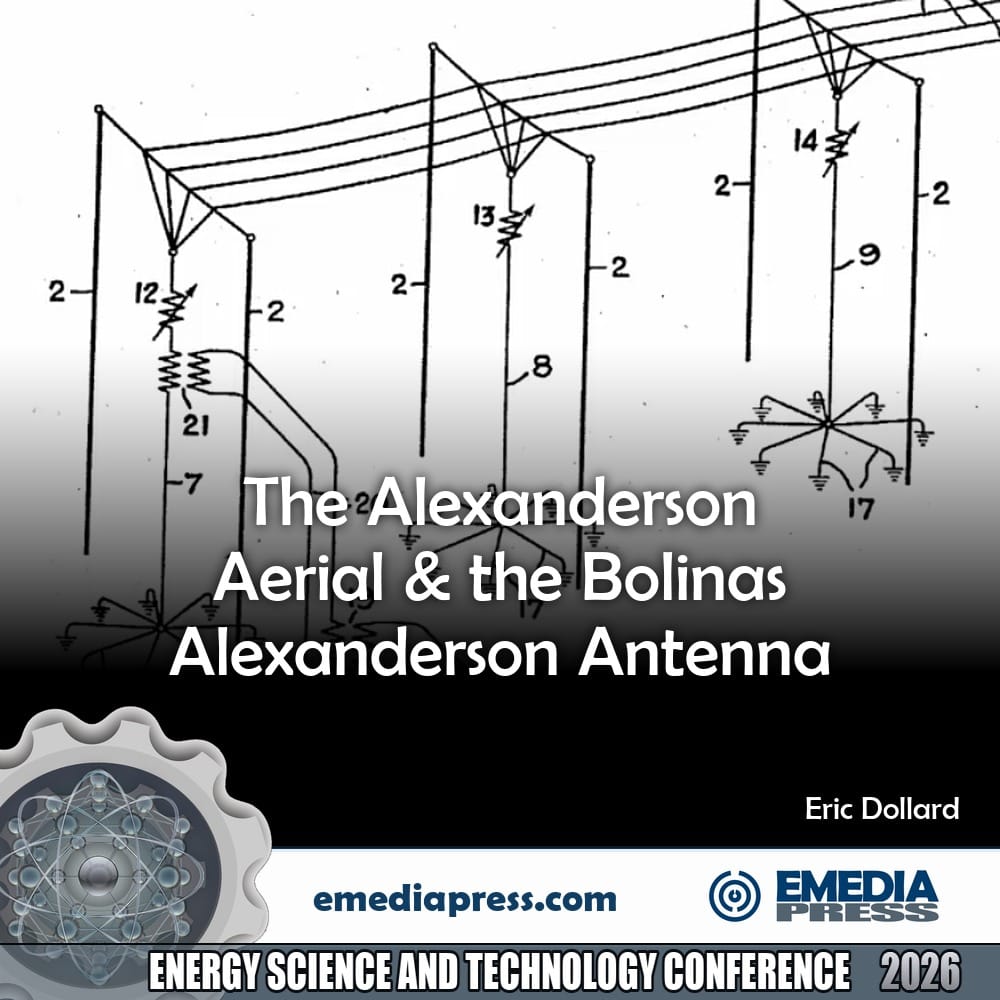
Speaking of Eric Dollard – the 13th Annual Energy Science & Technology Conference is happening June 24-28, 2026 here in Spokane, Washington. Eric is scheduled to present on “The Alexanderson Ariel & Bolinas Alexanderson Antenna” and “Gangrene Energy” (with live demo).

This is your chance to meet Eric in person, ask questions, and experience live demonstrations you won’t see anywhere else.

Only 19 in-person seats remain out of 55 total. And here’s the thing – this is the same weekend as Hoopfest (the world’s largest 3-on-3 basketball tournament), so hotels are already filling up.

Super Early Bird pricing of $347 (save $100) ends February 28th.

Other highlights include:

  • Adrian Marsh PhD presenting on “The coMra Effect” and “A Foundation for Esoteric Science”
  • Hakasays demonstrating “Tesla’s Extra Coils”
  • Justin Miller’s status report on the EPD Long Line Facility
  • Davy Oneness on gravity wave detectors and John Bedini’s B.A.S.E. processor
  • Carmen Miller presenting a 2-phase AC motor allegedly built by Tesla himself
  • 23+ presentations total with 11+ live demonstrations

Get all the details and tickets at: emediapress.com/energy-science-and-technology-conference/


Explore Eric Dollard’s Work

For those wanting to dive deeper into Eric’s work, check out the extensive collection of his presentations, books, and videos:

emediapress.com/product-category/authors-presenters/eric-dollard/


Watch the Full Discussion:


Sincerely,
Aaron Murakami Emediapress.com

Posted on Leave a comment

2025-11-15 Ground Radio Transmission & Reception LIVE CALL

This call had discussion of the various projects we shared and showed videos on with all updates that happened at EPD Laboratories, Inc this summer. This is 90 minutes of a 3 hour call from a month ago. This segment focuses on ground radio reception and telluric transmission. Lots of discussion on the topic between Eric Dollard and Adrian Marsh PhD, Q & A

Donate to EPD Laboratories, Inc 501(c)3 non-profit to help support these projects: https://ericpdollard.com/donate

This is the blog with video on the Telluric Transmitter: https://emediapress.com/2025/11/10/telluric-transmitter-beacon-its-live/

This is the blog with video on the ground radio reception: https://emediapress.com/2025/10/06/2025-09-01-ground-reception-at-epd-laboratories-inc-with-eric-dollard/

Posted on 1 Comment

Self Running Oscillator

Back in 2007 I filmed a little demonstration — a completely self-running, closed-loop Bedini SG oscillator built around a trifilar coil. No batteries in the loop… just capacitors that keep charging themselves indefinitely while the system runs at a voltage far below what the transistor is “supposed” to need.

Watch the newly re-uploaded video here (details below the video):

What you’re seeing:

  • Classic trifilar Bedini SG coil (23-gauge, ~2,000 turns): power, trigger, and one completely isolated recovery winding
  • RCA 3055 transistor (yes, the old-school one)
  • Front-end powered only by capacitors that are being conditioned with a high-frequency, high-voltage relay/ignition-coil pulse circuit
  • Recovery energy from the isolated winding is fed straight back to the input capacitors — the input side literally cannot “see” the output side – if it did, it would wind down fast and defeat itself
  • A simple ground rod connected to the circuit (just like John Bedini showed on the original 1990s KeelyNet schematics)

The result? The input capacitor drops a little at start-up, then climbs back up and just… stays there. I left it running for a long time until I literally got bored. The system stabilizes and oscillates forever on its own recovered energy — and it does it while running on less than a volt, way under the official transistor spec. That alone tells you something very non-conventional is happening with the current.

John Bedini always insisted the earth ground made the machine “run stronger.” Most builders ignored that detail. This demo proves he was right — you can see the dramatic difference the moment the ground rod is connected.

Those old original schematics that John originally posted are down below.

Why this matters in 2025

Two weeks ago I wrote about the Benitez self-running systems from the early 1900s. After personally witnessing multiple closed-loop devices over the years — including this simple oscillator — I’m no longer surprised that Benitez may have been telling the truth. In fact, when you study his patents side-by-side with some of the later “free energy” circuits that became famous, the family resemblance is unmistakable.

The real magic isn’t in complicated hardware. It’s in understanding switching, energy recovery, conditioning (caps or batteries), and the role of the local environment (yes, including that ground rod most people leave out).

The treasure trove awaits you

Everything I’ve learned over decades — plus thousands of posts, photos, scopes shots, and complete build details from John Bedini, Peter Lindemann, Eric Dollard and many others — lives inside Energetic Forum.

We’re actively posting new material again, and some of the most exciting SG-related projects I’ve been working on behind the scenes will start appearing there first.

Join today — it’s 100% free, approvals happen several times a day, and you’ll instantly get access to gigabytes of the most authoritative open-source material on the planet for these topics.

👉 https://www.energeticforum.com

Come share your thoughts, your builds, and your questions. The forum is alive again — and the next wave of breakthroughs is going to come from builders like you

Posted on Leave a comment

EPD Laboratories, Inc. Work Episode Summary

This video wraps up the work episode at EPD Laboratories, Inc. from Aug to Sep timeframe. This includes the ground radio receiption, telluric transmission, earth signal reception, novel audo amplifier project, glom locker cleanup and misc. A LOT was accomplished. Help us accomplish even more by supporting this work with your donations.

To support EPD Laboratories, Inc. 501(c)3 non profit with is Telluric, Earth Signal and other electrical research, please donate here: https://ericpdollard.com/donate

Learn more about Eric Dollard’s work here: https://emediapress.com/product-category/authors-presenters/eric-dollard/

Posted on Leave a comment

Charged for Discovery: Reviving the Forgotten Science of Electrostatic Power

A Spark from the Past

Long before modern electronics, inventors like James Wimshurst were exploring how nature separates charge…
It was the heart of early X-ray experiments and high-voltage demonstrations—and an early example of what we might now call an open system, pulling energy dynamically from its surrounding electric field. In the 1860s, physicist Poggendorff went a step further, creating the first corona motor—a device that used ionized air, not mechanical brushes, to push a rotor. More than a century later, Oleg Jefimenko revived that work to show that electric fields themselves can do mechanical work directly, bypassing the conventional closed-circuit model of electricity. Those classic experiments are the foundation for much of today’s exploration into electrokinetic and open-energy systems.
That’s the legacy our students tapped into—literally by hand—at the fair.

Designing the Demonstration

I designed and built the demonstration system with assistance from the students, prepared the Wimshurst generators, and helped set up the components for the presentation. During the setup period I spoke with teachers, students, and visitors about how the devices operate and about their significance in exploring open-system physics—where charge, field, and motion interact continuously with the environment. I explained how the work of pioneers such as Oleg Jefimenko, John G. Trump, and later experimenters like Eric Dollard and Chris Carson helped extend this field of study. Carson’s self-sustaining high-voltage electrostatic rotary converter, inspired by Trump’s MIT research, demonstrated the same basic principle: energy can circulate through the electric field itself rather than being consumed. We also discussed the remarkable Testatika machine built by Paul Baumann of the Methernitha Christian Community in Switzerland—a large Wimshurst-type generator said to power their facilities through similar electrostatic processes.
While I handled much of the technical design and preparation, the students themselves conducted the official presentation before the judges, in keeping with the competition’s rules. Their confidence and understanding showed that they truly grasped what they were demonstrating.

Building the Machines

We used two Wimshurst generators: one commercial unit and one that I constructed from locally sourced materials—polycarbonate discs, aluminum sectors, brass combs, and Leyden jars made from plastic tubing and foil. Both produced visible sparks several centimeters long. For the second exhibit, we built a corona motor using an empty soda can as the rotor. The can’s rim had several tiny tangential holes sanded to bright aluminum, mounted on a stainless-steel marinade-injector needle pivot connected to one of the Wimshurst terminals. Opposite the can, a sharp sewing needle, connected to the other terminal, was aimed just off tangent to the can’s surface. When the Wimshurst machine spun up, faint bluish plumes of corona discharge arced from the sewing needle toward the can. The invisible ion wind pushed air along the can’s surface, producing pure electrostatic thrust. The can began to rotate—first hesitantly, then faster and smoother—powered entirely by electric-field interactions. No magnets. No moving coils. Just field, air, and geometry.

The Demonstration

During the judging, Emmanuel, Sheenaia, and Vivian operated the Wimshurst machines and demonstrated the corona motor to the panel. Two neon bulbs connected to the terminals flickered orange with each charge pulse, showing the potential difference across the Leyden jars. As the can rotated, they brought it near an aluminum backplate. Immediately, the can was attracted to the plate—a vivid display of electric-field interaction—and the corona brightened to a deep violet glow. The audience could see and hear electricity in motion. Teachers leaned in, students gasped, and judges nodded appreciatively. The excitement in the room was palpable as they witnessed a nineteenth-century principle come alive again through twenty-first-century craftsmanship.

Beyond the Sparks

What made the project stand out was that it revealed open-system behavior in a tangible, student-friendly form.
Unlike ordinary circuits that consume stored charge, the Wimshurst and corona motor are self-recharging systems that draw and separate charge directly from their surroundings. They invite students to think beyond conventional energy models—to ask where the “push” really comes from, and how fields themselves can store and exchange energy dynamically. Every hiss from the corona and every pulse from the Leyden jars reminded the students that the universe is not inert—it is an active electrical medium waiting to be understood.

Inspiring the Next Generation

When our team’s name was announced for 2nd Place, the students’ excitement said it all. Dozens of others gathered afterward to ask how to build their own machines. Teachers expressed interest in future workshops, and local officials congratulated the group for reviving curiosity about classic high-voltage experiments. For me, the real reward was watching young people realize that science is still full of mysteries worth exploring. You could see it in their expressions—the moment they recognized that even a simple hand-cranked machine could unlock questions about the nature of energy itself.

Looking Ahead

We plan to expand our work with larger electrostatic systems and explore continuous-operation versions powered by modern high-voltage supplies. There is a vast field of discovery waiting in the interplay between electrostatics, induction, and resonance—territory that pioneers like Jefimenko, Trump, Dollard, Carson, and Baumann have already begun to map. Alternative-energy research doesn’t always require exotic materials or expensive laboratories.
Sometimes it just needs a soda can, a crank, and the courage to look at electricity differently.

Epilogue

The Misamis Oriental Science Fair was more than a competition—it was proof that when curiosity meets craftsmanship, even century-old ideas can feel revolutionary again. Our students demonstrated that high-voltage electrostatics, far from being obsolete, can still capture imaginations and open minds to the broader possibilities of open-system energy research. As we packed up that day, a few last sparks jumped between the terminals of the Wimshurst machine—small, fleeting, and beautiful, like the moment of discovery that started them.

About the Author

Ed Becnel is a retired software engineer who earned a Bachelor of Science degree in Electrical Engineering. He has been keenly interested and involved in alternative-energy and overunity research for many years. Originally from Louisiana, Ed relocated to the Philippines in 2021, where he continues to mentor young students in experimental science and engineering. He is currently collaborating with colleagues in the U.S. on various projects related to alternative energy production and utilizationr.

Author: Ed Becnel
Mentor, Misamis Oriental National High School
With students Emmanuel Bongcas, Sheenaia Cabanig, and Vivian Aboc
Tagoloan, Misamis Oriental – October 2025

Posted on Leave a comment

Developing the Most Novel Audio Amplifier in History – Invented by Eric Dollard

Here are the beginning stages of the development of an audio amplifier invented by Eric Dollard, which is not a voltage gain amplifier. Just about every commerical amplifier is based on the early 1920s RCA patents. John Bedini developed the feed forward amp, McIntosh advanced the output transformer and a couple other innovations, but no matter what, they’re all still voltage gain amplifiers. Those are the best in their own respective category but what we’re moving into is something different altogether.

The amplifier developed by Eric has a longintudinal network and some other features that are not only not used in all the amplifiers, most audio engineers are completely unaware of some of these aspects. The main, full feature amp will be used to amplify Earth signals but there is a simplified version that will be for commercial use. Once we have a few custom items in hand, the goal is to get it wired up and tested. There might be a few tweaks needed for it to be ready for sale to the public, but the primary intent is to generate funds for EPD Laboratories, Inc. and to extend Dollard’s legacy into another area.

The commercial audio amp application of this technology has been discussed a few times on some calls, etc. but the decision was made to finally move forward with it so its the EPD Labs project that I’m the most involved with. The schematics are blurred out in the video because of the proprietary nature of the amplifier but there is enough to show where we’re going with it.

This commercial amplifier project is 100% funded by Emediapress.com – no donations are used for it’s parts, materials, etc. All donations are only used for the other projects that are being showcased in these blogs, videos, etc.

To support EPD Laboratories, Inc. 501(c)3 non profit with is Telluric, Earth Signal and other electrical research, please donate here: https://ericpdollard.com/donate

Learn more about Eric Dollard’s work here: https://emediapress.com/product-category/authors-presenters/eric-dollard/

Posted on Leave a comment

Aaron Murakami Interviewed on the Church & State Podcast

Caleb Collier, a Spokane local and Marine Veteran, was kind enough to have me on his Libertarian podcast so I could share some of the work that I’ve been involved with. He took a tour at my shop to check out the MWO, Tesla Turbine, water purification machine and other technologies – due to time constrains, we could only cover a few topics, which I hope you’ll enjoy.

Caleb’s Church and State Podcast’s homepage is: https://churchandstate.media/

Posted on Leave a comment

Telluric Transmitter Beacon – It’s LIVE

Here’s a video showing the Telluric transmitter broadcasting into the Earth at 1.999 mc. See if you can pick it up if you can. We don’t know how far the broadcast goes but in early tests, for less than 5 watts, it was received at over 120 miles or so.

This is part of the ongoing projects with EPD Laboratories, Inc. 501(c)3 non profit. Donate to support this work: https://ericpdollard.com/donate

Find Eric Dollard’s presentations related to this subject here: https://emediapress.com/product-category/authors-presenters/eric-dollard/

Posted on Leave a comment

Carlos F. Benitez’s Self-Charging Battery System

Carlos F. Benitez, a Mexican civil engineer from Guadalajara, filed a series of patents in the 1910s that described self-sustaining electrical systems capable of running motors and lights indefinitely while recharging their own batteries—and producing surplus energy. A century later, these ideas remain controversial, but they’ve influenced modern free-energy work, especially John Bedini’s SG (School Girl) systems. Whether Bedini knew about Benitez early on or not, the principles are essentially identical: discharge one battery to pulse another with radiant spikes, yielding more than what left the input. In this post, I’ll break down Benitez’s patents, compare them to Bedini SG, and explain why low-impedance batteries can make results easier to achieve. I’ve spent years digging into this, from witnessing Paul Babcock’s shop demos to running my own Bedini setups.

The Bedini SG is a simple circuit: a battery charges a coil, the switch turns off, and the collapse spike pulses another battery. Scaled right (e.g., with big cell tower batteries and a 10-coiler), tests around 2004 by Bedini and Peter Lindemann showed 500% more work provided to real loads on the output batteries compared to what left the input batteries. Experimenters have had mixed results, often due to high-impedance batteries or poor switching. Of course, plenty of folks have pondered motor-generator setups that self-charge—sounds crazy, but utilizing certain principles, there have been many successes, and none of it violates any laws of thermodynamics.

Benitez iterated from basic commutator switching to his ultimate design with a Poulsen arc and mercury vapor rectifiers (MVRs), pulsing DC at 50–60 Hz envelopes containing ringing from the LC tank. That ringing—radiant spikes—overcharges the idle battery. MVRs shine here: virtually no voltage drop and ultra-fast recovery, outpacing even SiC diodes.

Low-impedance batteries help because these impulses dissipate in resistance. For lead-acid, starters have lower impedance (for high bursts) compared to deep cycles (higher for sustained low current). Marine batteries are the worst case—they try to be both starter and deep cycle but never work right. Lithium iron phosphate batteries seem even better because their impedance is so low it’s hard to measure—this is what Paul Babcock found with the successes he demonstrated in his home shop that I witnessed on multiple occasions. It may make results easier, but it’s not the only factor.

Bedini wasn’t only for long swaps; short/high-freq swaps work too. Fast switching intervals runs on surface charge (that “electrostatic fluffy charge on top”), not deep capacity so the batteries don’t run down. John Bedini told me about his intention to start experimenting with high-frequency battery swapping (e.g., 30 kHz) using PIC chips for LEDs and small models, likely with LiFePO4 like 18650s—but he passed within a year or so of looking into doing that.

Benitez’s system needs a fresh look—it’s been hashed out on my forums (energeticforum.com and energyscienceforum.com), which are updated and blazing fast now. They need a little maintenance: I’ll scrub the membership list soon and automate sign-ups (manual process was too time-intensive to keep spammers out). More positive results came from those threads than anywhere else, thanks to authoritative experts like John Bedini, Peter Lindemann, and Eric Dollard personally contributing in mass abundance—a treasure trove they didn’t share much elsewhere.

Peter Lindemann’s 2018 presentation is a great intro (available at Self-Recharging Battery Supply of Carlos F. Benitez). You can start with Benitez’s earliest method (simple commutator) and scale to the full Poulsen arc/MVR setup—post your builds in energeticforum.com to keep the momentum going.

Benitez’s Complete Patent List (Including the Unrelated Fluid Motor)

Benitez filed seven patents (one U.S., two French, four British) from 1908–1918. The electrical ones (1913–1918) build from basic oscillations to automated self-runners. The 1908 fluid motor is mechanical and unrelated—included for completeness. All are public domain; patent numbers link to Espacenet.

File/Grant DatePatent NumberTitleSummary
Aug 13, 1908 / Oct 4, 1910US971517AFluid-MotorReciprocating piston motor for motive fluids (steam/air) with direct piston-valve actuation for efficient admission/exhaust. Convertible modes; no electrical tie-in.
Aug 28, 1913 / Jul 4, 1914FR474690ANew Process for the Production of Electric CurrentsFoundational oscillatory circuit: Induction coil interrupts DC to excite secondary, charging capacitors resonantly without vapor converters.
Jul 28, 1914 / May 13, 1915GB17811ASystem for the Generation of Electric CurrentsRotary commutator switches capacitor banks through induction coil; secondary pulses charge auxiliaries and self-drive motor.
Jul 28, 1914 (Add.) / Aug 19, 1915GB5591ASystem for the Generation of Electric Currents (Addition to GB17811A)Refines feedback: Direct secondary-to-primary via transformers; sequenced discharges for surplus energy.
Jul 4, 1914 (Add.) / Mar 22, 1916FR20076ENew Process for the Production of Electric Currents (Addition to FR474690A)Enhances electrolytic capacitors for high-frequency resonance and impedance compensation.
Jul 28, 1914 / Aug 17, 1916GB14311ASystem for the Generation of Electric CurrentsBattery integration: Reciprocal series/parallel charging via primaries, condensers, and spark gaps.
Apr 10, 1918 / Dec 24, 1918GB121561ANew Process for the Generation of Electrical EnergyUltimate: Dual-battery with clock-solenoid switching; motor-alternator feeds Poulsen arc/condenser tank; MVRs rectify ringing to overcharge.

Bedini SG vs. Benitez: The Solid-State Evolution

Bedini SG and Benitez share the same principle: discharge one battery to pulse another with radiant spikes, yielding more than what left the input. Bedini simplified it for modern parts; Benitez used mechanical/early vacuum tech.

AspectBedini SGBenitez System
Core ActionBattery charges coil; switch off → collapse spike pulses secondary battery.Active battery powers motor/alternator → coil/arc collapse → ringing spike pulses idle battery.
SwitchingSolid-state transistor (e.g., 2N3055); timed swaps.Mechanical commutator (early) or clock-solenoids (hourly in GB121561A).
Spike GenerationInductive collapse.Poulsen arc chops alternator AC → LC tank ringing (50–60 Hz envelope + kHz ringing).
Results500% more work to real loads on output batteries (Bedini/Lindemann 2004 tests with cell tower batteries/10-coiler); mixed for small setups.“Excess electrical energy” (GB121561A); overcharges idle battery while running loads.
LoadOften self-contained (coil as “load”); mechanical work on the shaft for turning fans or a generator for more net electrical gain.Motors/lights via terminals (40–41); surplus for tools/industry.
BatteriesLow-impedance key (starters lower than deep cycles; LiFePO4 even better per Babcock).Galvanic (lead-acid implied); modern low-ESR helps.

Note on Capacitors

Benitez used “condensers” (1910s term) and in FR20076E mentioned “electrolytic devices” for structural improvements — but never explicitly “electrolytic capacitor.” The high-voltage self-recharge effect I’ve empirically verified (50–95% voltage rebound post-short) is almost exclusively seen in electrolytic capacitors (aluminum oxide dielectric). This may not be related to what Benitez was doing, but you should know about this. I discovered this effect on my own for the first time around 2002 with a 1200V 0.1uF AC capacitor from a microwave, charged via Bedini SG made from a Sony Capstan (reel to reel) motor. I found that by charging the capacitors with high voltage pulses—whether it was 100V or 10,000V—it changed the properties in the capacitor to act like an electret, where it retained a permanent type of ability to recharge almost all the way back up to the top of where I was charging it. It reached 100V, a neon bulb triggered an SCR to discharge to another battery—and after conditioning, it self-charged to nearly 100V without input. I did this with canister electrolytics charged by oscillating high-frequency ignition coil output, conditioning them to self-charge and self-run the oscillator. My 2007 demo ran indefinitely on two conditioned 33,000 µF electrolytics at 0.6V — proof this radiant “memory” is dielectric-specific and possible that this is one of several ways that Benitez’s system worked even if he didn’t understand that principle. Video of this self-running oscillator is down below.

Low-Impedance Batteries: Why They Help

These spikes are high voltage, low current, radiant impulses. Impedance kills them:

  • Lead-Acid: Starters have lower impedance (for high bursts) vs. deep cycles (higher for sustained low current).
  • Marine Batteries: Worst—try to be both starter/deep cycle but never work right.
  • LiFePO4: Near-zero impedance—Babcock’s demos I saw ran forever on them. May make results easier.

Dive Deeper: Forums, Resources, and Build Plans

Discuss Benitez on my forums—more positive results there than anywhere else, thanks to experts like John Bedini, Peter Lindemann, and Eric Dollard personally contributing in mass abundance—a treasure trove they didn’t share much elsewhere:

Peter’s presentation: Self-Recharging Battery Supply of Carlos F. Benitez (great starter).

For Bedini SG mastery, get the Bedini SG Trilogy —still the most authoritative resource based on years of experience personally working with John Bedini.

You can start with Benitez’s earliest method (simple commutator) and scale to the full Poulsen arc/MVR setup—post your builds in energeticforum.com to keep the momentum going.

Here’s the old self-running Bedini oscillator video from around 2007-2008: