
Posted on — Leave a comment

Regenerative Grazing: Justin Miller at ESTC 2026

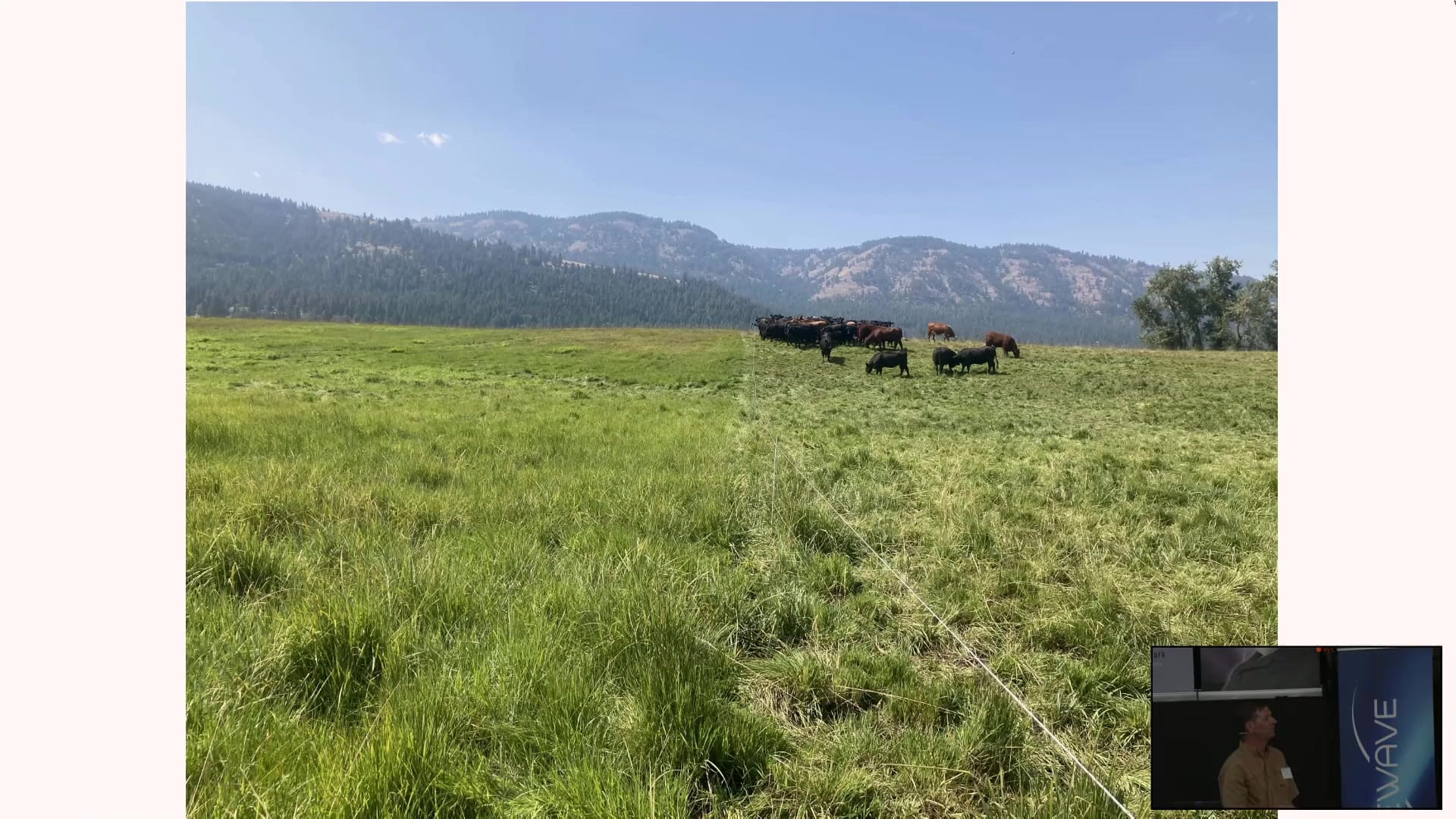
Cattle grazing behind a single polywire fence, with the grazed and ungrazed sides of the paddock visible

In his 64-minute ESTC 2026 presentation, first-generation rancher Justin Miller shows footage of himself moving upwards of a hundred head of cattle on foot, without a horse or dogs. The cattle come to him because, in his words, “these cows are coming to me because they’ve been trained to do that.”

From 2012 he managed a 1,100-acre preserve whose owners had banned livestock and torn out the cross fences, where the management was “a hundred percent mechanical” and the mower was his office. A 2014 conference introduced him to stockmanship and to the idea that “as beef producers, we’re actually grass farmers.”

Get Regenerative Grazing, the full 64-minute presentation

Same mowing, different regrowth

At a 30,000-acre preserve in Southern California, both sides of a road get the same mowing. On the side whose owner refuses grazing, the cut material lies there dry and not decomposing. The grazed side has regrowth, “totally due to the grazing.” “So that was a big eye-opener for me.”

Paddock timing, fencing and low-stress handling

  • One or two days, then rest: how long he leaves a herd in a paddock, 60 to 90 days of recovery on the California coast, and why in northeast Oregon he “could return in 30 days.”
  • Single-wire paddocks: poly wire on reels and fiberglass posts, hard fencing only on the perimeter, and why “Goats don’t respect it.”
  • Handling without pressure: “I don’t have to go chase these guys around.”
  • Machines against cattle: a crawler pulling an open disc over brush “looked a lot like having a large herd of cattle come through,” without the nutrient cycling.
  • What it costs: “the wire and the posts. It’s not cheap,” daily fence checks, and water as “one of the biggest challenges.”

Field observations and unanswered questions

Overgrazed and understocked at the same time. The stock density slide he credits to Understanding Ag. A cold wire run into a poison oak thicket the cows had “no interest at all to go into.” Footage of him “right in the midst of them, one man on the ground, no dogs.” And a Q and A on water, fencing and soil, where he describes water infiltration and brix tests without giving readings. His own line on the whole subject: “Somebody said to me at one point, why do we want to sustain a broken system?”

The 2026 ESTC releases so far

Hear about each release first

Energy Times readers hear about each ESTC 2026 release as it goes live, along with new books, papers and research from emediapress.com. It is free, and you can leave any time. Get Energy Times.

Get the full 64-minute Regenerative Grazing video

Aaron Murakami
Energy Science and Technology Conference · emediapress.com
Posted on — Leave a comment

EPD Telluric Transmitter: Hakasays and Justin Miller at ESTC 2026

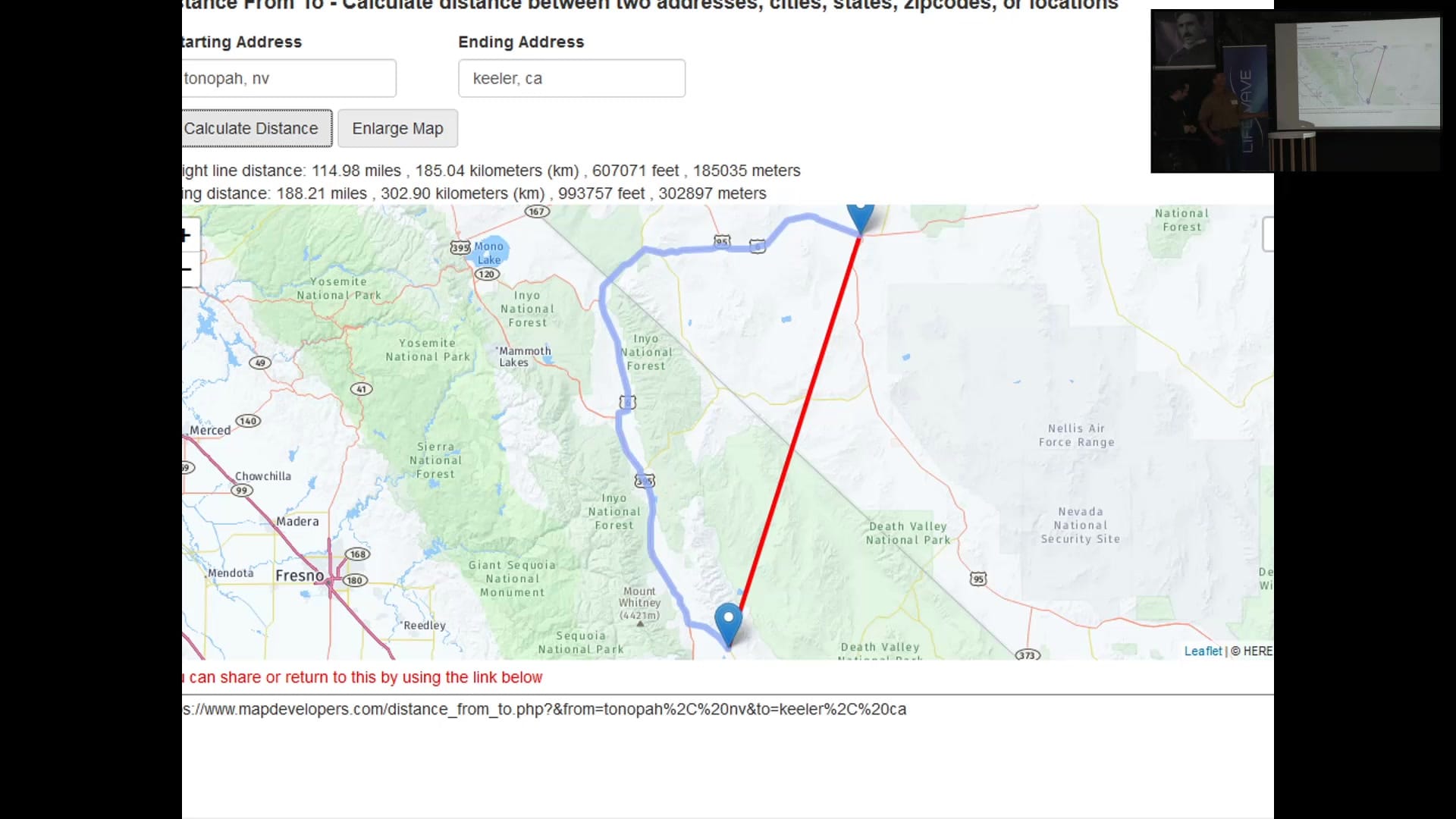
Distance calculation from Tonopah, Nevada to Keeler, California: 114.98 miles straight line

At 5 watts, the EPD Laboratories transmitter in Tonopah was still heard 115 miles away in Keeler, according to the presenters. Steve McGreevy received the signal on a radio receiver, not a matched coil. Hakasays and Justin Miller document the apparatus, measurements and range tests in their 111-minute ESTC 2026 presentation.

The project follows Tesla’s Colorado Springs research into earth-coupled transmission. The team has not yet measured propagation speed or separated the radio and telluric contributions to the received signal: “we can’t measure the speed of propagation at the moment.”

Get EPD Telluric Transmitter, the full 111-minute presentation

Buried-tank ground electrode system

The site’s electrode is “a pair of 10,000 gallon buried water tanks.” Justin Miller shows the digging, sealing, welding and backfilling it took to make them usable: “So again, huge amount of work to excavate these tanks, secure them.” With about 100 watts and careful tuning, Hakasays measured “about 2.4, 2.5 amps of RF current going into the earth.”

Current measurements, range tests and beacon hardware

  • 2019 wired scale model: Eric Dollard’s 2019 20-to-1 model of the Colorado Springs system, where “this one wire is powering up 500 watts,” through a wire, not the earth.
  • Ten feet that mattered: moving the coil from the deck into the shop took the impedance from about 10 ohms to about 18.
  • Light bulbs as test loads: automotive turn signal bulbs as an impedance check when the vector network analyzer “wasn’t giving us the right info.”
  • Below 5 watts: with the radio at its minimum, they detuned the system and estimate reception in Keeler fell away “somewhere between, we think, about 1 and 2 watts.”
  • A daytime drive: two eight-foot CB whip antennas on Eric’s car, to a minimum discernible signal about 56 miles out.
  • CW beacon hardware: an Arduino CW keyer built around a mercury-wetted relay, so surges from the transmitter would not “smoke the electronics.”

What the 115-mile reception does not establish

“We know it has a radio component to it, we know it has a telluric component to it,” Hakasays says. To separate the two, he proposes a time-of-flight test with GPS-disciplined oscillators at each end. It has not been run yet: “And we just don’t know until we do deeper measurements.”

Supporting Eric Dollard’s research

EPD Laboratories, Inc. is a 501(c)(3) nonprofit research organization carrying Eric Dollard’s work forward at its Tonopah, Nevada field site, where this transmitter stands. Donations are tax-deductible. Donate to EPD Laboratories.

The 2026 ESTC releases so far

Hear about each release first

Energy Times readers hear about each ESTC 2026 release as it goes live, along with new books, papers and research from emediapress.com. It is free, and you can leave any time. Get Energy Times.

Get the EPD Telluric Transmitter MP4 (111 minutes)

Aaron Murakami
Energy Science and Technology Conference · emediapress.com
Posted on — Leave a comment

Pole 26 – A New Terminal on the World’s Largest Tesla-Type Measurement Instrument

In 1919, Marconi completed five high-frequency power plants around the world — including the one at Bolinas, California, on the San Andreas Fault. Driven by Alexanderson alternators and built on principles Tesla had discovered, those stations weren’t using the Hertzian (electromagnetic-radiation) wireless that became “radio” as we know it today. They used something different — longitudinal dielectric induction, what Tesla called rays of induction propagating through the earth itself.

The Bolinas station is gone. The antennas are down. The buildings are derelict.

Out in the Nevada desert, Eric Dollard has been building the modern successor for the last twelve years.

The EPD Long Line at EPD Laboratories’ Tonopah field site is an above-ground Beverage pole-pair receiving antenna — 4,800 feet of it — picking up earth signals. It is the world’s largest publicly known Tesla-type measurement instrument. Eric calls it “a massive scientific instrument” and “a massive analog computer.” It streams live, 24/7.

Listen now: Live earth-signal stream — epdlabs.org/seismic-streaming/


What’s New at Pole 26

The Long Line has two ends, and they listen to two different bands.

The Shack end handles the lower frequencies — VLF and ULF, up to around 20 kHz — and that’s what’s been streaming live online for some time now.

The other end is at Pole 26. Until this week, it was just a termination point with old experimental hardware hanging off it. In the latest field session, Eric and the crew stripped all of that off, ran new conduit and grounds, and installed a proper terminal cabinet at eye level. Pole 26 is now a working field terminal — Eric can connect meters, instruments, and test equipment directly, without making the trip out and up to the Shack.

Pole 26 is dedicated to LF and MF reception, up to around 3,000 kHz, including the maritime mobile band near 500 kHz. That’s the band where Eric has been hearing earthquake precursors and unusual signals for years — including the precursor to the Ridgecrest earthquake, picked up on a modified AM receiver in his car. Steven McGreevy will be doing his own AM broadcast and low-band reception work from this terminal as well.

Two separate ground systems were installed at Pole 26 — a signal ground (connecting to a network of buried ground rods running down the wash) and an electrostatic / lightning ground (with its own dedicated network). They’re not metallically connected. The site has, in Eric’s words, “ground ten times over what you would ever expect in desert terrain like this” — because of the underground water running below the antenna line. Marconi chose Bolinas for the same reason: an underground spring runs beneath that antenna field, and the station was oriented along the San Andreas Fault. Geography is part of the instrument.

We caught the whole build on video — Eric walks through the antenna, the two-band setup, the grounding system, and what’s coming next.

Watch the video:

Why This Antenna Is Different

A modern radio antenna radiates Hertzian waves — transverse electromagnetic waves spraying out into space, with energy density dropping off as the square of distance. The energy is lost the moment it leaves the antenna.

What Tesla discovered, and what Marconi built at Bolinas, was different. Tesla’s system used longitudinal dielectric induction — standing waves of energy reciprocating between transmitter and receiver through the earth itself, with the earth acting as a propagation medium, not just a ground reference. The energy didn’t dissipate. It bounced back and forth until something demanded it.

The Long Line at Tonopah is a receiving instrument built on those same principles. The Shack end was already online and streaming. What just got added at Pole 26 is the field terminal that makes the other end of this instrument practical to work with — without trekking to the Shack every time. From here, Eric can experiment with terminations, run instrument measurements, and characterize what the Line is picking up in real time.

Want the deeper background? Watch and read Eric’s recent piece on the engineering lineage:

👉 Tesla–Marconi Wireless System (May 3, 2026)

Essential viewing for understanding what Pole 26 actually is, and why it matters.


What Comes Next

Eric is twelve years into this build, and estimates roughly twelve more before the system is finished as conceived. The next steps from Pole 26: build out a terminal facility at the mine site (where utility power has been arranged), run signals there from both ends of the antenna, and eventually carry them on through open wire, toll-entrance cable, and fiber into town. The full plan was laid out in detail in this latest field session.

Eric will also be talking about all of this — the engineering, the history, and where it’s going — at the upcoming conference.


🎤 ESTC 2026 — Eric Dollard’s Presentations

Eric will be giving two presentations at the Energy Science & Technology Conference 2026:

  • The Alexanderson Aerial — Ernst Alexanderson’s wireless transmission system and Eric’s research building on it. Don’t miss it.
  • Gangrene Energy — Eric’s framing for the dirty electricity loose in our utility infrastructure — millions of volt-amperes of it bleeding into the ground at any given moment. What it does to the electromagnetic environment, what it means for measurement and reception, and why it’s getting worse.

Streaming tickets are available for those who can’t attend in person.

👉 Full details, in-person tickets, and streaming tickets at emediapress.com/conference


Support EPD Laboratories

EPD Laboratories, Inc. is a 501(c)(3) nonprofit research organization. Every dollar goes directly into field research, infrastructure, and Eric’s ongoing work. Donations are tax-deductible.

👉 Donate to EPD Laboratories


Eric Dollard’s Books & Videos

The complete library of Eric’s published work — books, video presentations, and technical material — is here:

👉 Eric Dollard’s books and videos at EMediaPress


EPD Laboratories, Inc. · Tonopah, Nevada · 501(c)(3) nonprofit research organization

Posted on — Leave a comment

EPD Laboratories, Inc. – Eric Dollard & Crew 2026-05-03

Here’s the latest up Eric Dollard’s upcoming presentations at the 2026 Energy Science & Technology Conference, Earth Signal streaming update, upcoming EPD labs work episode, Tesla Turbine update and more.

Support EPD Laboratories, Inc https://ericpdollard.com/donate

2026 ESTC Streaming Tickets available: https://emediapress.com/energy-science-and-technology-conference/

Energy Times Newsletter https://emediapress.com/energytimes

Seismic Streaming live: https://epdlabs.org/seismic-streaming/

Lakhovsky MWO: https://emediapress.com/mwo

Posted on — Leave a comment

EPD Laboratories, Inc. Work Episode Summary

This video wraps up the work episode at EPD Laboratories, Inc. from Aug to Sep timeframe. This includes the ground radio receiption, telluric transmission, earth signal reception, novel audo amplifier project, glom locker cleanup and misc. A LOT was accomplished. Help us accomplish even more by supporting this work with your donations.

To support EPD Laboratories, Inc. 501(c)3 non profit with is Telluric, Earth Signal and other electrical research, please donate here: https://ericpdollard.com/donate

Learn more about Eric Dollard’s work here: https://emediapress.com/product-category/authors-presenters/eric-dollard/