
Posted on — Leave a comment

EPD Telluric Transmitter: Hakasays and Justin Miller at ESTC 2026

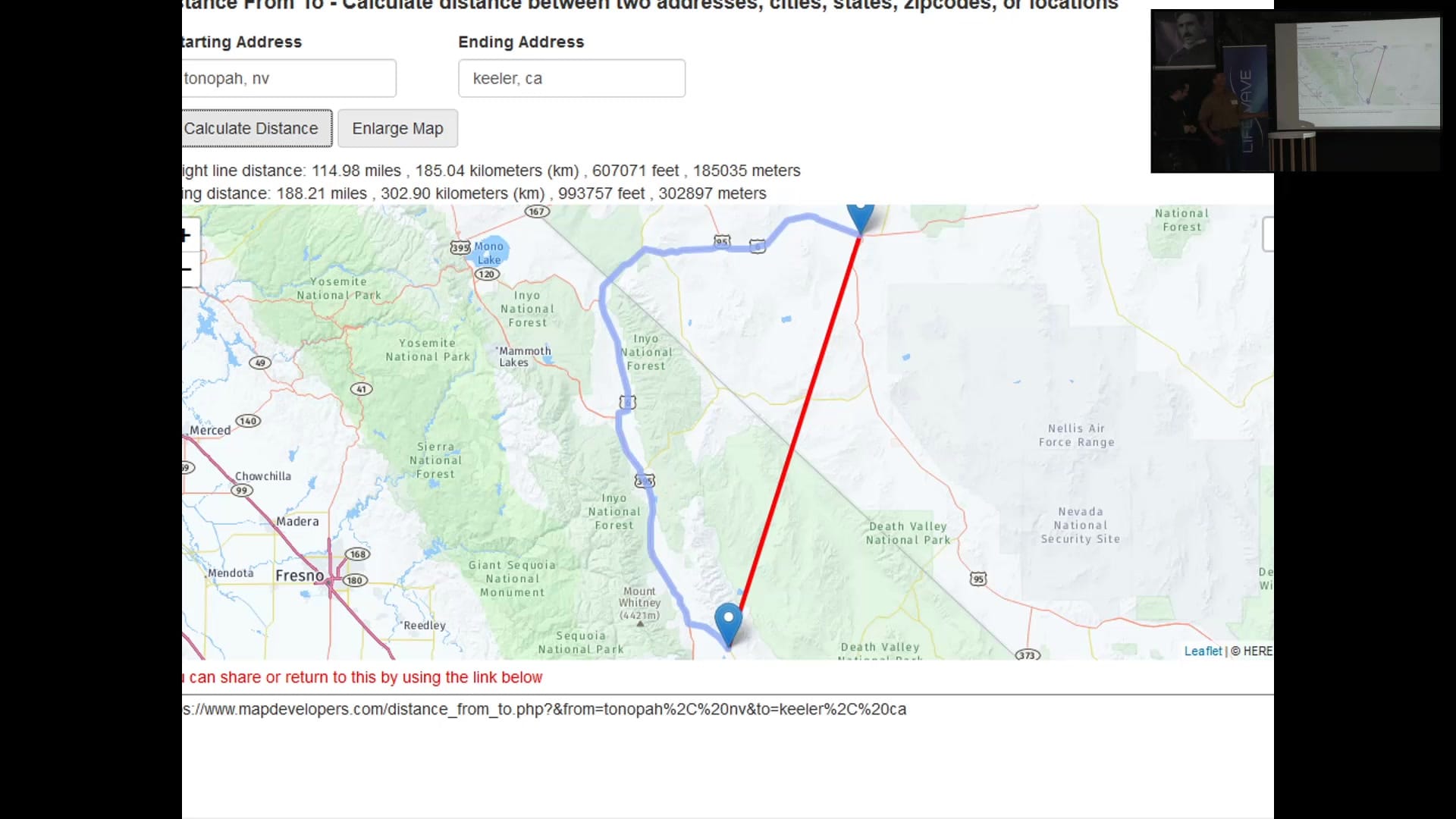
Distance calculation from Tonopah, Nevada to Keeler, California: 114.98 miles straight line

At 5 watts, the EPD Laboratories transmitter in Tonopah was still heard 115 miles away in Keeler, according to the presenters. Steve McGreevy received the signal on a radio receiver, not a matched coil. Hakasays and Justin Miller document the apparatus, measurements and range tests in their 111-minute ESTC 2026 presentation.

The project follows Tesla’s Colorado Springs research into earth-coupled transmission. The team has not yet measured propagation speed or separated the radio and telluric contributions to the received signal: “we can’t measure the speed of propagation at the moment.”

Get EPD Telluric Transmitter, the full 111-minute presentation

Buried-tank ground electrode system

The site’s electrode is “a pair of 10,000 gallon buried water tanks.” Justin Miller shows the digging, sealing, welding and backfilling it took to make them usable: “So again, huge amount of work to excavate these tanks, secure them.” With about 100 watts and careful tuning, Hakasays measured “about 2.4, 2.5 amps of RF current going into the earth.”

Current measurements, range tests and beacon hardware

  • 2019 wired scale model: Eric Dollard’s 2019 20-to-1 model of the Colorado Springs system, where “this one wire is powering up 500 watts,” through a wire, not the earth.
  • Ten feet that mattered: moving the coil from the deck into the shop took the impedance from about 10 ohms to about 18.
  • Light bulbs as test loads: automotive turn signal bulbs as an impedance check when the vector network analyzer “wasn’t giving us the right info.”
  • Below 5 watts: with the radio at its minimum, they detuned the system and estimate reception in Keeler fell away “somewhere between, we think, about 1 and 2 watts.”
  • A daytime drive: two eight-foot CB whip antennas on Eric’s car, to a minimum discernible signal about 56 miles out.
  • CW beacon hardware: an Arduino CW keyer built around a mercury-wetted relay, so surges from the transmitter would not “smoke the electronics.”

What the 115-mile reception does not establish

“We know it has a radio component to it, we know it has a telluric component to it,” Hakasays says. To separate the two, he proposes a time-of-flight test with GPS-disciplined oscillators at each end. It has not been run yet: “And we just don’t know until we do deeper measurements.”

Supporting Eric Dollard’s research

EPD Laboratories, Inc. is a 501(c)(3) nonprofit research organization carrying Eric Dollard’s work forward at its Tonopah, Nevada field site, where this transmitter stands. Donations are tax-deductible. Donate to EPD Laboratories.

The 2026 ESTC releases so far

Hear about each release first

Energy Times readers hear about each ESTC 2026 release as it goes live, along with new books, papers and research from emediapress.com. It is free, and you can leave any time. Get Energy Times.

Get the EPD Telluric Transmitter MP4 (111 minutes)

Aaron Murakami
Energy Science and Technology Conference · emediapress.com
Posted on — Leave a comment

Build A Better Tesla Coil: Hakasays at ESTC 2026

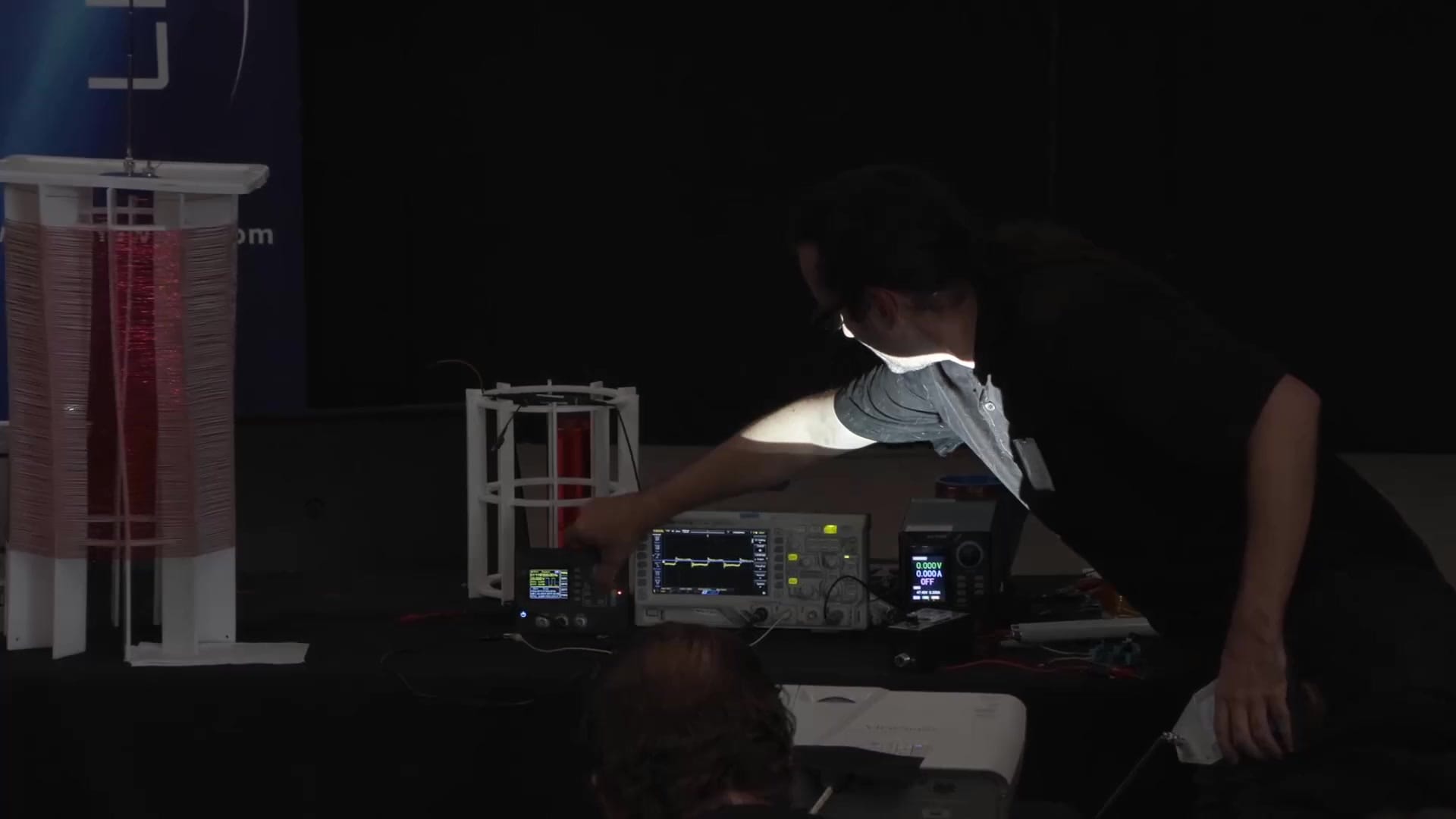
Hakasays at the bench with signal generator and oscilloscope, characterizing the coil wound during the conference

Hakasays lights a bulb using the self-oscillating exciter circuit most people buy online, drawing about seven watts. Then he removes the feedback winding, the primary and the driver circuit, one at a time. On a hobby signal generator putting out a quarter to a third of a watt, the bulb stays lit. “So I think we’ve made a better Tesla coil. We’ve done the same output with almost no power.” His 2026 ESTC presentation, Build A Better Tesla Coil, 137 minutes, is out now as a download.

The two-coil spark gap machine everyone calls a Tesla coil is not the three-coil arrangement Tesla ran at Colorado Springs. Hakasays has been building coils alongside the EPD Laboratories work, including the telluric transmission platform, ever since the 2019 conference showed a 20-to-1 replica of the Colorado Springs system built by Eric Dollard and Bruce Gavin.

Get Build A Better Tesla Coil, the full 137-minute presentation

Measured, not judged by the sparks

The coil on his bench was wound at the conference itself, in the first day and a half. He finds its resonance live with a signal generator, a scope and a field strength meter. Then he works the quality factor of an earlier coil on screen: 1470 and 1463 kilocycles, 7 kilocycles of bandwidth, “we divide that, the 1466 by 7, and we get a 209 quality factor.” He compares that 209 with the 30 to 60 he reports for faithful spark gap replicas. “And you can see for yourself. You don’t have to trust me for this.”

For builders

  • Frame material, ranked by loss: “The PVC is one of the worst materials that you could use to wind a Tesla coil on.” And: “You’d be better off winding a coil around a tree.”
  • 3D printing: why dark filaments are a trap (the pigment is usually carbon) and what to print with instead.
  • Wire and spacing: gauge, cost and weight, and why turn spacing changes what the coil is.
  • What killed a telluric coil: unpolished copper tubing oxidized in the air, and the fix.
  • Matching the drive: Bruce Gavin’s method for letting a 50-ohm ham radio see a match, “set it and forget it.”

Inside the 137 minutes

Three demonstrations on stage. The striations in the lit tube, which he attributes to “where the fields have nodes.” The field strength meter walked backward across the room, 50, 40, 15, down to about 5, “nowhere near the coil.” Why Tesla ran between 50 and 100 kilocycles. One three-coil system lighting 400 watts on another through a single wire. And his closing line: “Go forth and build.”

The 2026 ESTC releases so far

Gangrene Energy and The Alexanderson Antenna, Eric Dollard. Onan and Dynamotor Tech, Al Francoeur. A Foundation for True Science and the free The coMra Effect, Adrian Marsh PhD. Orgone Energy, Tom DiFerdinando. The free 2026 Panel Discussion. And today, Build A Better Tesla Coil, Hakasays.

Hear about each release first

Energy Times readers hear about each ESTC 2026 release as it goes live, along with new books, papers and research from emediapress.com. It is free, and you can leave any time. Get Energy Times.

Get Build A Better Tesla Coil

Aaron Murakami
Energy Science and Technology Conference · emediapress.com
Posted on — Leave a comment

The Alexanderson Antenna: Eric Dollard From Bolinas to Tonopah

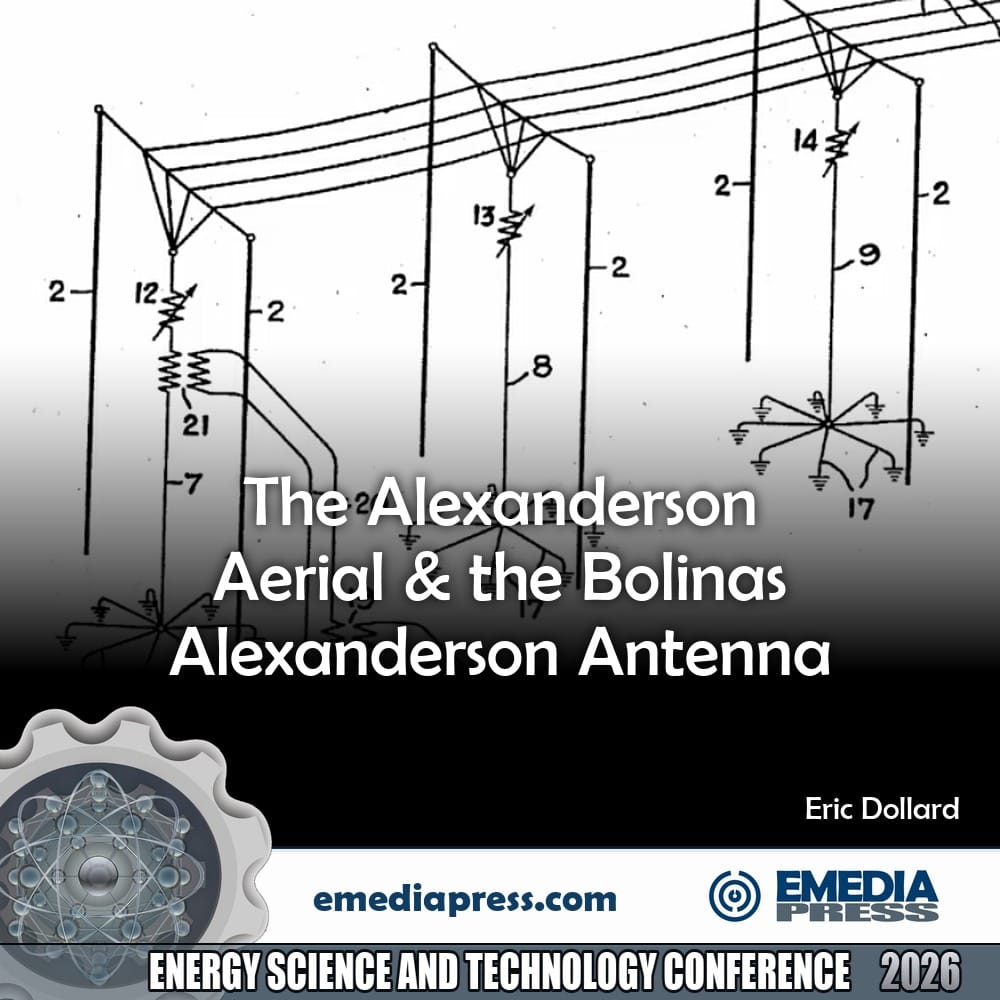
Alexanderson Antenna cover - 2026 Energy Science & Technology Conference

At 14, Eric Dollard walked into the RCA transmitting station on the cliffs at Bolinas, California. By 16 he had the keys. He held the original Marconi blueprints while he was still in high school, learned the station from men who had worked for Marconi, General Electric and RCA, and later inherited the station records and diagrams.

What had been built there was not what RCA taught him. His 223-minute presentation from the 2026 Energy Science and Technology Conference explains what the Alexanderson Aerial actually was, why it is not an ordinary antenna, and what he is building with it in mind at Tonopah, Nevada.

Get the Alexanderson Antenna, the full 223-minute presentation

The drawings, and what came out of the ground

Dollard did not stop at paper. He lived in the powerhouse and the antenna field and dug the Marconi, GE and RCA dumps along the cliffs for the hardware that had been thrown away: porcelain inserts from the series coil with the corona burns still on them, and an eight-saddle shunt-coil insulator he spent a week breaking out of Navy concrete. The pieces told him what the drawings left out, including series condensers nobody had drawn.

A structure that operates in unison

His conclusion, from the blueprints, the station records and the dirt, is that the phase of the current is invariant along the whole length of the Aerial. “There’s no delay and there’s no advance. Everything operates in unison.” He builds the case from the loading of transmission lines in the work of Steinmetz and Heaviside: lag networks and lead networks arranged so the advance of one cancels the delay of the other. When he ran the numbers, the electrostatic power flow was orders of magnitude larger than the electromagnetic. In his analysis the Aerial is electric, not electronic, and not an electromagnetic antenna at all.

A scale model makes it physical: 2,700 feet becomes 27 feet, 19 kilocycles becomes 1,900 kilocycles in the 160-meter amateur band, and the reactance stays at 1,800 ohms.

The Marconi aerial by the numbers

From the constants of the Marconi setup, Dollard works out the aerial that came before it: 3,000 feet long, 600 feet wide, 300 feet up, 44.77 kilocycles, 1,540 amperes at 100,000 volts, a magnification factor of 513. “It rang like a bell.” The RCA-207 water-cooled triodes that followed took 22 volts at 55 amps on the filament, and four of them made 50 kilowatts continuous. “It made all the lights dim in the town of Bolinas when you key one of these things.”

Ten years listening at Landers

Dollard built a receiving version at Landers: a 900-foot Alexanderson antenna under an 1,800-foot beverage antenna, ground rods driven into greasewood roots because the granite would not take them, the inside of the Earth on one speaker and the outside on the other. “And what I heard there and measured was absolutely stunning.” It taught him why Tesla built metallic roots instead of a radial ground, and why each loading network needs its own spot of ground. “Whatever is up in the air has got to be buried in the ground.” His summary of the whole idea: “This thing is a radio telescope to listen to the interior of Earth.”

The Tonopah line, pole by pole

The last part of the presentation leaves the equations and walks the right of way: a 54-pole line over about 2.1 miles, built to Bell System open-wire standards from hardware harvested out of the Mojave and the Great Basin. The aerial section strung so far runs 4,800 feet, from pole 49 to pole 26, with the Alexanderson pair in the center and the outer pairs transposed so they cannot talk to it. For now it runs as a simple capacitance aerial, like the Marconi aerial at Bolinas; the Alexanderson loading networks are the next stage.

Dollard shows the loading points, the 120-year-old pole on a 45-degree slope, the guying that stops one broken pole from pulling the whole antenna down, and the Bell carrier repeater cabinet in the ravine where the signal comes out at a level you can hear in a telephone receiver. “Everything you see here is basically a museum.” Still to come are the carrier pairs to the mine, its seismic transducers, and the public display he calls the musical seismograph. “I’m going to hang a sign on the door that says no software allowed past this point.”

What is inside the full 223 minutes

  • Bolinas from the inside: the 1913 Marconi powerhouse, the Navy pushing Marconi out, and Steinmetz handing the antenna to Ernst Alexanderson.
  • The lineage of the electric wireless, from Franklin’s kite through Loomis, Tesla, Hertz and Marconi.
  • The units rebuilt from scratch in CGS, and the Steinmetz-Heaviside power equation in plain algebra.
  • Loading, from the undersea telegraph cable to the Aerial, and the space scalar condition.
  • The scale model, the Landers installation, and the Tonopah crossarm patterns.
  • The Q&A, including the working Alexanderson station in Sweden and the analog instruments Dollard trusts.

You do not need to be an engineer. The opening is history and people, the mathematics is simple algebra with the units defined before they are used, and the last part is photographs and pole numbers. The video gives you the derivation and the Tonopah line in one sitting, from the one person who slept in the Bolinas powerhouse and is building the next one.

Get the Alexanderson Antenna, the full 223-minute presentation

More from the 2026 conference

Dollard’s other 2026 presentation, Gangrene Energy, is his master class on dirty electricity. Al Francoeur’s Onan and Dynamotor Tech is the bench report on a motor-generator that ran from April 17 to the solstice. For the background on Bolinas itself, see Wireless Giant of the Pacific.

EPD Laboratories, Inc. is a 501(c)(3) nonprofit carrying Eric Dollard’s work forward at its Tonopah, Nevada field site, where the line is being built. Donations are tax-deductible. Donate to EPD Laboratories.

Energy Times announces each 2026 conference release as it comes out. It is free, and you can leave any time. Get Energy Times.

Aaron Murakami
Energy Science and Technology Conference · emediapress.com

Posted on — Leave a comment

EPD Laboratories, Inc. Earth Signals Live Streaming Test

Here are some pictures that encompasses most of what is going on in this current work episode.

Please help support EPD Laboratories, Inc. 501(c)3 non profit by donating here: https://ericpdollard.com/donate

SEISMIC TEST AUDIO PLAYER AT THE BOTTOM OF THIS POST

Jari is cleaning up a power supply that has been sitting in the desert for years. Hakasays is working on a test beacon to broadcast with the telluric transmitter. When that is running, you can try to listen to this ground transmission by tuning into the frequency of 1.999 mc. Jari scanned in about 1000 images and pages of text from Eric Dollard’s notes. Justin and Connor have been working on installing/fabricating the roof setup for the shack on the hill so it can have enough solar power for everything inside. I’m working with Eric on panelizing the amplifier on the bench, which is operating in a way that is the most novel design in audio amplifier history. That particular one will be amplifying Earth signals and I’ll be putting together the initial proof of concept simplified version that will become the commercially available amp. Last pic in front of the shack: Jari, Aaron, Hakasays, Justin, Connor

There’s a picture below overlooking the town of Tonopah – you can see some poles with wire – that is the long line antennae for above ground signals that are being broadcast (details below). These are electrostatic impulses that are related to global lightning activity and if these sounds build up aggressively in amplitude or quantity, it is strongly suggestive of an upcoming earthquake 6.0 and above within the next 24-72 hours. We are not making any forecasting claims, but based on Eric’s research at the Lander’s facility years ago, it’s a fact. More to come…

If you hear some kind of music, that means the signal got knocked off and it defaulted to that. Although this is a test, we’ll try to keep it on air as long as there is enough power to keep the battery(s) charged to keep it on air. For now, this is done through a MiFi transmitter and the connection could get a bit sketchy here and there.

Please help support EPD Laboratories, Inc. 501(c)3 non profit by donating here: https://ericpdollard.com/donate

Your donations makes it possible to complete these projects and share the results, science and details with you.

Take a listen here: https://epdlabs.org/seismic-streaming/ – just click the play button on the embedded player. It is streaming from the “shack” out at the end of the long line antenna here in Tonopah.

Posted on — Leave a comment

February 7, 2024 Live EPD Zoom Call Recording

This call goes into a lot of Griffin Brock’s earth signal reception system with an Alexanderson type of antennae elevated above his entire home and Adrian Marsh PhD covers more about the Golden Ratio discharge experiments including an astonishing “Golden Dragon” discharge.

Please donate to EPD Laboratories, Inc. 501(c)3 Non Profit at https://ericpdollard.com/donate