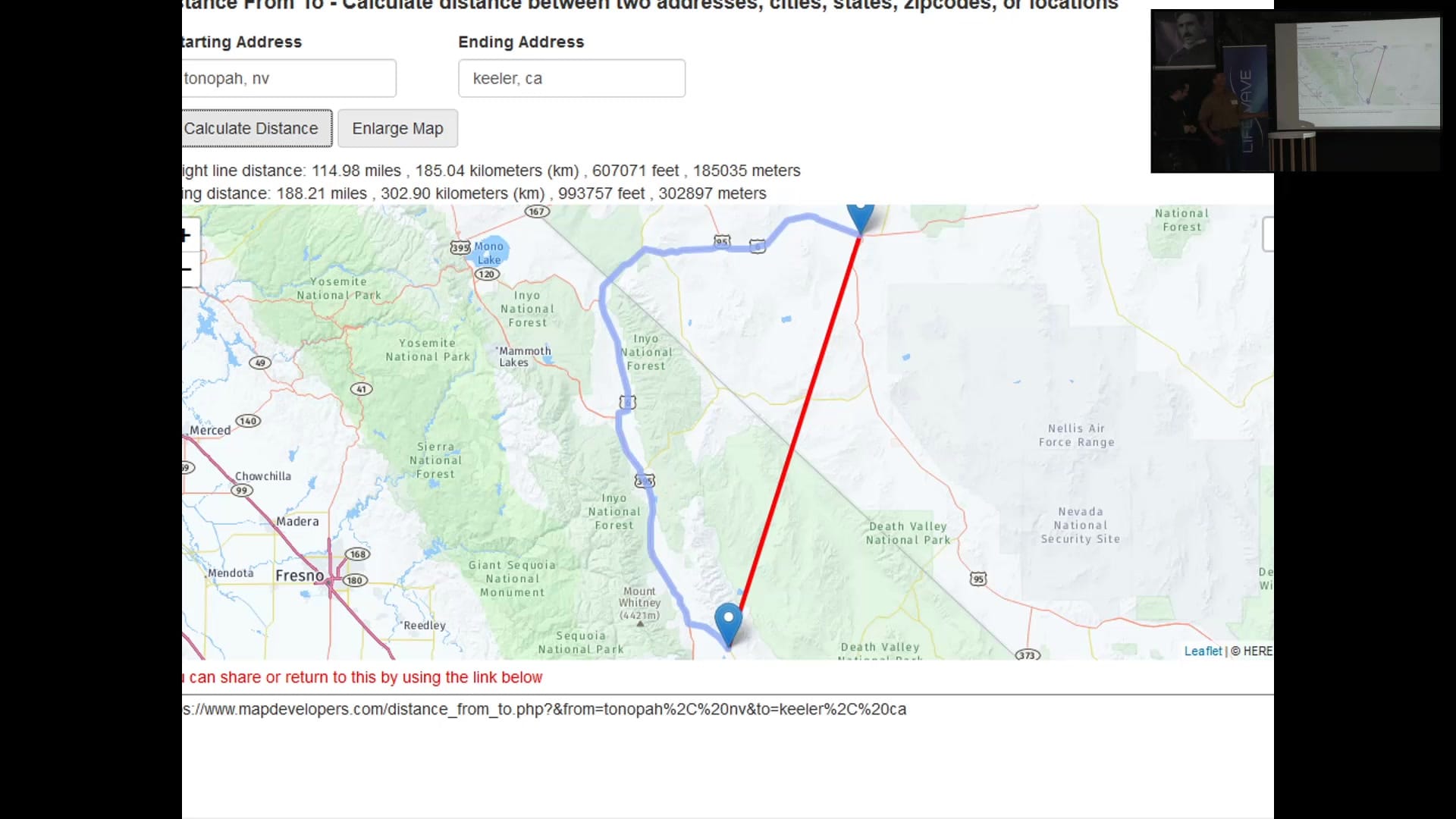
At 5 watts, the EPD Laboratories transmitter in Tonopah was still heard 115 miles away in Keeler, according to the presenters. Steve McGreevy received the signal on a radio receiver, not a matched coil. Hakasays and Justin Miller document the apparatus, measurements and range tests in their 111-minute ESTC 2026 presentation.
The project follows Tesla’s Colorado Springs research into earth-coupled transmission. The team has not yet measured propagation speed or separated the radio and telluric contributions to the received signal: “we can’t measure the speed of propagation at the moment.”
Get EPD Telluric Transmitter, the full 111-minute presentation
Buried-tank ground electrode system
The site’s electrode is “a pair of 10,000 gallon buried water tanks.” Justin Miller shows the digging, sealing, welding and backfilling it took to make them usable: “So again, huge amount of work to excavate these tanks, secure them.” With about 100 watts and careful tuning, Hakasays measured “about 2.4, 2.5 amps of RF current going into the earth.”
Current measurements, range tests and beacon hardware
- 2019 wired scale model: Eric Dollard’s 2019 20-to-1 model of the Colorado Springs system, where “this one wire is powering up 500 watts,” through a wire, not the earth.
- Ten feet that mattered: moving the coil from the deck into the shop took the impedance from about 10 ohms to about 18.
- Light bulbs as test loads: automotive turn signal bulbs as an impedance check when the vector network analyzer “wasn’t giving us the right info.”
- Below 5 watts: with the radio at its minimum, they detuned the system and estimate reception in Keeler fell away “somewhere between, we think, about 1 and 2 watts.”
- A daytime drive: two eight-foot CB whip antennas on Eric’s car, to a minimum discernible signal about 56 miles out.
- CW beacon hardware: an Arduino CW keyer built around a mercury-wetted relay, so surges from the transmitter would not “smoke the electronics.”
What the 115-mile reception does not establish
“We know it has a radio component to it, we know it has a telluric component to it,” Hakasays says. To separate the two, he proposes a time-of-flight test with GPS-disciplined oscillators at each end. It has not been run yet: “And we just don’t know until we do deeper measurements.”
Supporting Eric Dollard’s research
EPD Laboratories, Inc. is a 501(c)(3) nonprofit research organization carrying Eric Dollard’s work forward at its Tonopah, Nevada field site, where this transmitter stands. Donations are tax-deductible. Donate to EPD Laboratories.
The 2026 ESTC releases so far
- Gangrene Energy, Eric Dollard
- The Alexanderson Antenna, Eric Dollard
- Onan and Dynamotor Tech, Al Francoeur
- A Foundation for True Science, Adrian Marsh PhD
- The coMra Effect, Adrian Marsh PhD, free
- Orgone Energy, Tom DiFerdinando
- 2026 Panel Discussion, nine presenters, free
- Build A Better Tesla Coil, Hakasays
- Efficient Wind Catching Tech, Peter Lindemann and Terry McMenomy
- EPD Telluric Transmitter, Hakasays and Justin Miller (today)
Hear about each release first
Energy Times readers hear about each ESTC 2026 release as it goes live, along with new books, papers and research from emediapress.com. It is free, and you can leave any time. Get Energy Times.
Get the EPD Telluric Transmitter MP4 (111 minutes)
Aaron Murakami
Energy Science and Technology Conference · emediapress.com