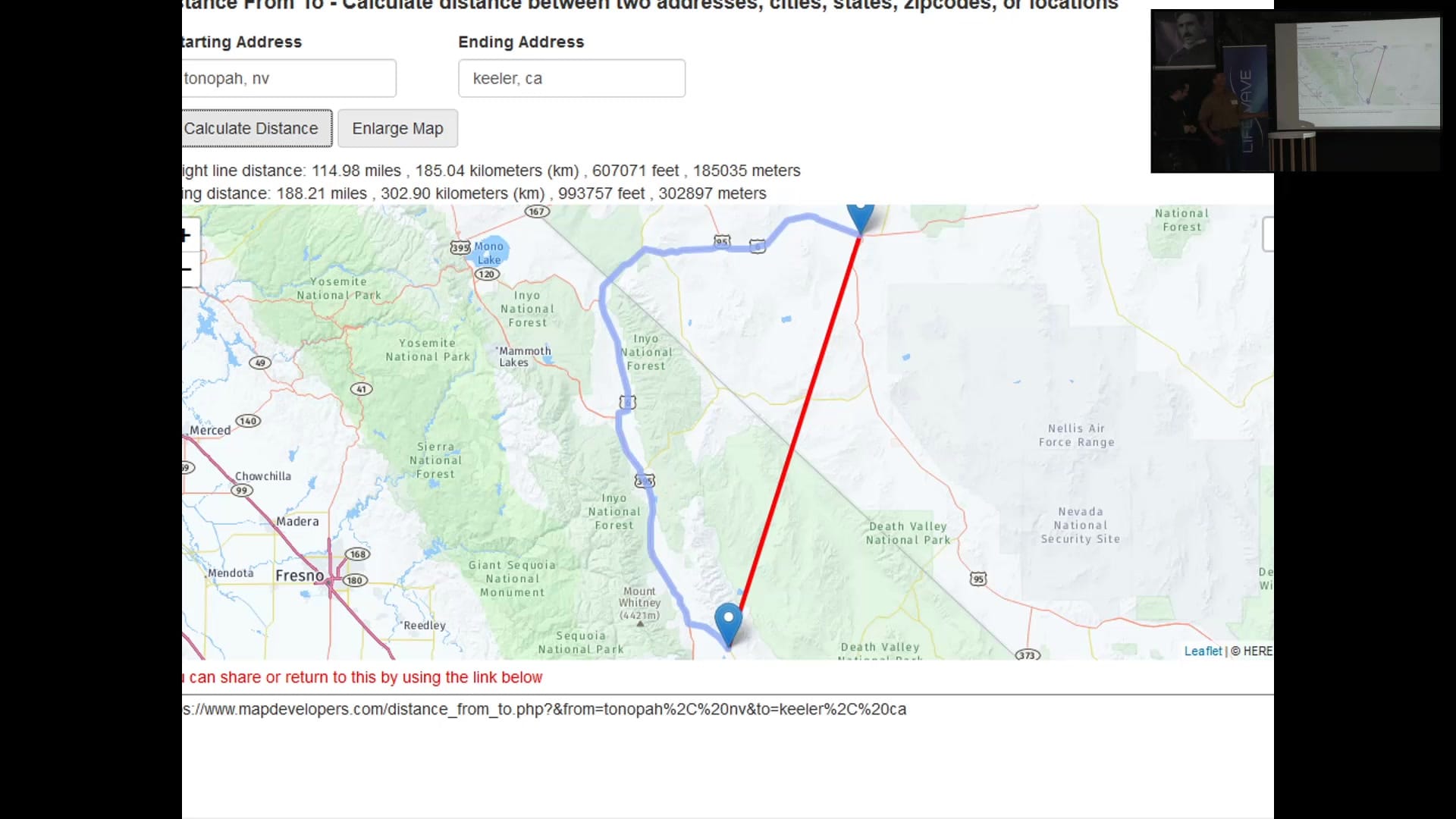
At 5 watts, the EPD Laboratories transmitter in Tonopah was still heard 115 miles away in Keeler, according to the presenters. Steve McGreevy received the signal on a radio receiver, not a matched coil. Hakasays and Justin Miller document the apparatus, measurements and range tests in their 111-minute ESTC 2026 presentation.
The project follows Tesla’s Colorado Springs research into earth-coupled transmission. The team has not yet measured propagation speed or separated the radio and telluric contributions to the received signal: “we can’t measure the speed of propagation at the moment.”
The site’s electrode is “a pair of 10,000 gallon buried water tanks.” Justin Miller shows the digging, sealing, welding and backfilling it took to make them usable: “So again, huge amount of work to excavate these tanks, secure them.” With about 100 watts and careful tuning, Hakasays measured “about 2.4, 2.5 amps of RF current going into the earth.”
Current measurements, range tests and beacon hardware
2019 wired scale model: Eric Dollard’s 2019 20-to-1 model of the Colorado Springs system, where “this one wire is powering up 500 watts,” through a wire, not the earth.
Ten feet that mattered: moving the coil from the deck into the shop took the impedance from about 10 ohms to about 18.
Light bulbs as test loads: automotive turn signal bulbs as an impedance check when the vector network analyzer “wasn’t giving us the right info.”
Below 5 watts: with the radio at its minimum, they detuned the system and estimate reception in Keeler fell away “somewhere between, we think, about 1 and 2 watts.”
A daytime drive: two eight-foot CB whip antennas on Eric’s car, to a minimum discernible signal about 56 miles out.
CW beacon hardware: an Arduino CW keyer built around a mercury-wetted relay, so surges from the transmitter would not “smoke the electronics.”
What the 115-mile reception does not establish
“We know it has a radio component to it, we know it has a telluric component to it,” Hakasays says. To separate the two, he proposes a time-of-flight test with GPS-disciplined oscillators at each end. It has not been run yet: “And we just don’t know until we do deeper measurements.”
Supporting Eric Dollard’s research
EPD Laboratories, Inc. is a 501(c)(3) nonprofit research organization carrying Eric Dollard’s work forward at its Tonopah, Nevada field site, where this transmitter stands. Donations are tax-deductible. Donate to EPD Laboratories.
Energy Times readers hear about each ESTC 2026 release as it goes live, along with new books, papers and research from emediapress.com. It is free, and you can leave any time. Get Energy Times.
Hakasays lights a bulb using the self-oscillating exciter circuit most people buy online, drawing about seven watts. Then he removes the feedback winding, the primary and the driver circuit, one at a time. On a hobby signal generator putting out a quarter to a third of a watt, the bulb stays lit. “So I think we’ve made a better Tesla coil. We’ve done the same output with almost no power.” His 2026 ESTC presentation, Build A Better Tesla Coil, 137 minutes, is out now as a download.
The two-coil spark gap machine everyone calls a Tesla coil is not the three-coil arrangement Tesla ran at Colorado Springs. Hakasays has been building coils alongside the EPD Laboratories work, including the telluric transmission platform, ever since the 2019 conference showed a 20-to-1 replica of the Colorado Springs system built by Eric Dollard and Bruce Gavin.
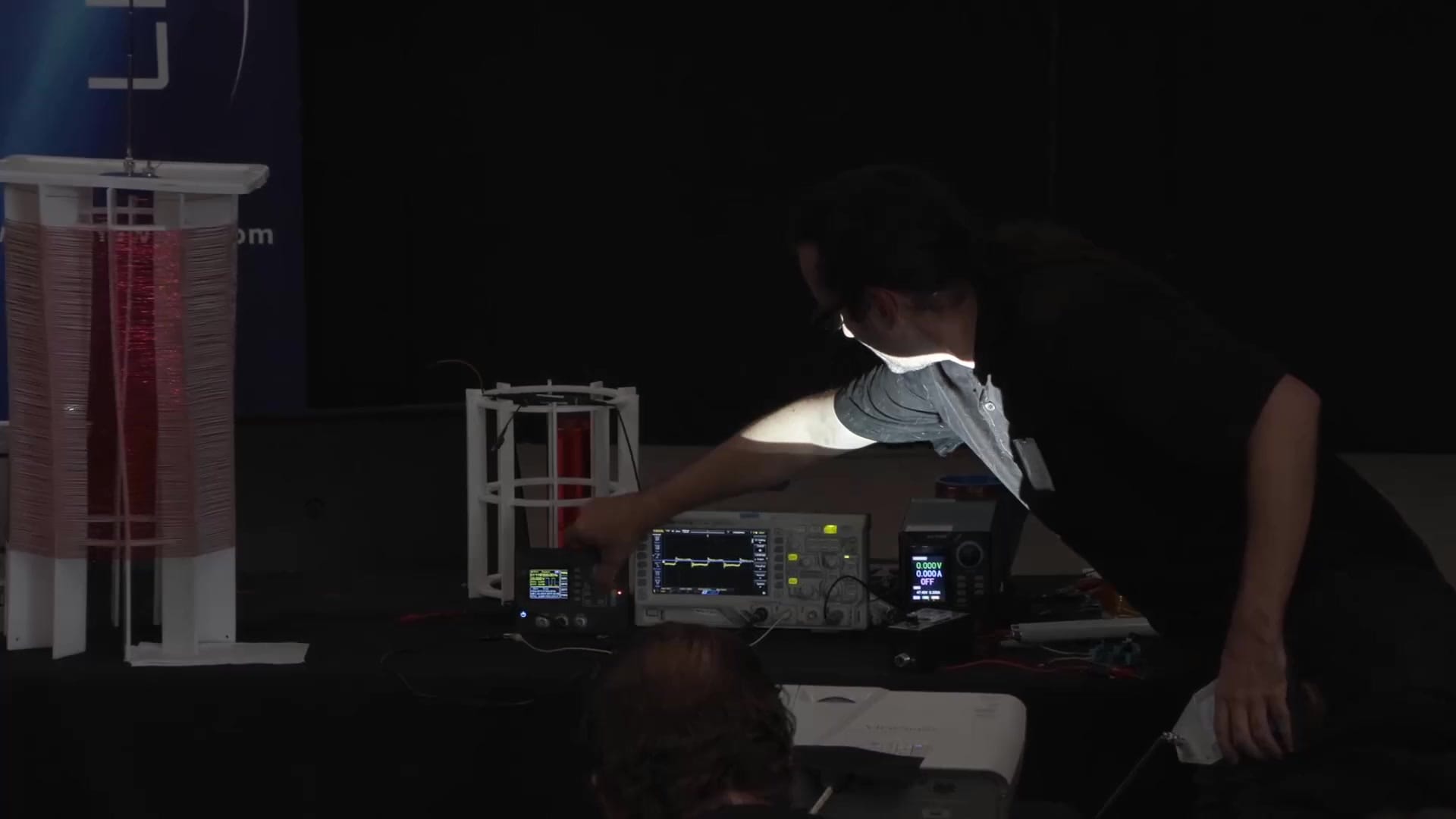
The coil on his bench was wound at the conference itself, in the first day and a half. He finds its resonance live with a signal generator, a scope and a field strength meter. Then he works the quality factor of an earlier coil on screen: 1470 and 1463 kilocycles, 7 kilocycles of bandwidth, “we divide that, the 1466 by 7, and we get a 209 quality factor.” He compares that 209 with the 30 to 60 he reports for faithful spark gap replicas. “And you can see for yourself. You don’t have to trust me for this.”
For builders
Frame material, ranked by loss: “The PVC is one of the worst materials that you could use to wind a Tesla coil on.” And: “You’d be better off winding a coil around a tree.”
3D printing: why dark filaments are a trap (the pigment is usually carbon) and what to print with instead.
Wire and spacing: gauge, cost and weight, and why turn spacing changes what the coil is.
What killed a telluric coil: unpolished copper tubing oxidized in the air, and the fix.
Matching the drive: Bruce Gavin’s method for letting a 50-ohm ham radio see a match, “set it and forget it.”
Inside the 137 minutes
Three demonstrations on stage. The striations in the lit tube, which he attributes to “where the fields have nodes.” The field strength meter walked backward across the room, 50, 40, 15, down to about 5, “nowhere near the coil.” Why Tesla ran between 50 and 100 kilocycles. One three-coil system lighting 400 watts on another through a single wire. And his closing line: “Go forth and build.”
Energy Times readers hear about each ESTC 2026 release as it goes live, along with new books, papers and research from emediapress.com. It is free, and you can leave any time. Get Energy Times.
Someone watching online asked what to do when you understand the theory but do not have the tools. The answer came straight back from the stage: “Kitchen table. Seriously. Work in your living room.” That is the closing panel of the 2026 Energy Science and Technology Conference in one exchange. The full 130 minutes is out now, free to download and keep.
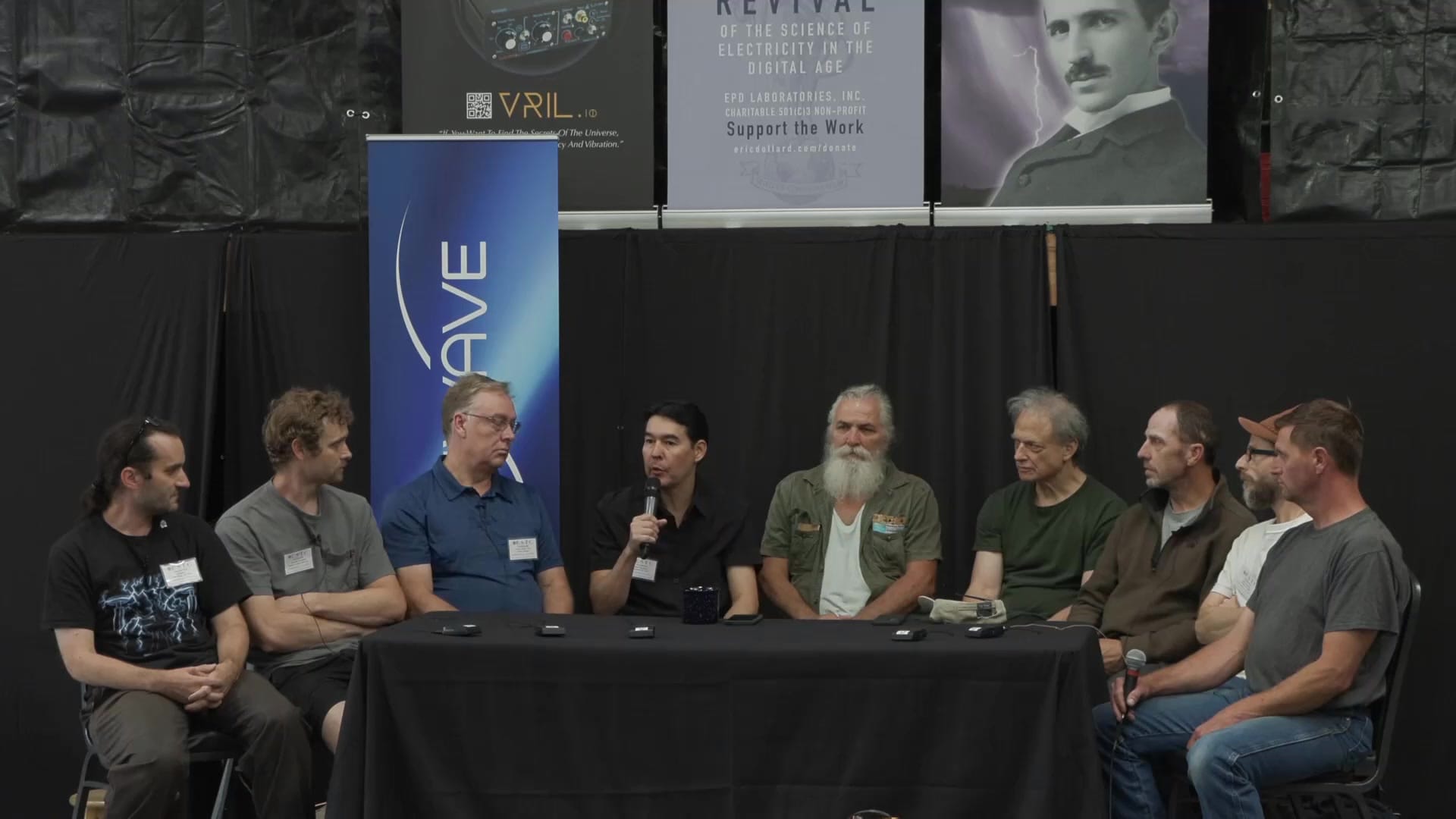
Aaron Murakami moderates Hakasays, Jeremiah Ferwerda, Adrian Marsh, Al Francoeur, Tom DiFerdinando, Terry McMenomy, Davy Oneness and Justin Miller. After a week of prepared talks they sit in a row and take questions from the floor and the online stream, with no slides and no script.
The coil in the luggage: Hakasays on building his demonstration coil two to four days before the conference, winding it on site, and knowing from geometry, wire and frame that it would perform before he measured it.
Nine pumps: Jeremiah Ferwerda on six years of prototyping, the shop, and the disk-spacing question he turns down: “we have had people try to copy and take our work.”
Half a mile of dead line: Justin Miller on the only cut he ever made on the 12 kV side of a transformer, how he confirmed the line was dead, and how badly his hands shook anyway.
Every band snowed: Al Francoeur firing his Mobius coil and finding UHF, VHF, television, AM and FM all turned to buzz.
Eight years off the grid: Al on the fridges, freezers, trailer and RV his system has run for over eight years, and the smart meter he refused.
The ether argument: Marsh and DiFerdinando on how to polarize more ether, then the real disagreement between them, which is not about the ether at all. Marsh: “The spirit is unknowable.” DiFerdinando: “If the spirit is real, it’s a part of reality.”
Where each presenter’s own talk picks up
Most of the panelists have a full 2026 presentation of their own, alone or with a partner. The panel is where you hear them argue about each other’s work; the talks are where each one shows his own. Tom DiFerdinando’s Orgone Energy came out yesterday, and Hakasays’ Build A Better Tesla Coil is out tomorrow.
Energy Times readers hear about each ESTC 2026 release as it goes live, along with new books, papers and research from emediapress.com. It is free, and you can leave any time. Get Energy Times.
Here’s the latest up Eric Dollard’s upcoming presentations at the 2026 Energy Science & Technology Conference, Earth Signal streaming update, upcoming EPD labs work episode, Tesla Turbine update and more.
Here’s a new video from a recent live call featuring Eric Dollard, Adrian Marsh PhD, Hakasays, and several callers asking questions. We covered a lot of ground in this discussion – from the live earth signal reception system now streaming at epdlabs.org to the novel audio amplifier project, the legendary “Glom Locker” full of vintage surplus parts, and some fascinating observations about what’s happening with solar activity and earth signals.
Earth Signal Reception – Now Live
One of the main topics Eric covered was the seismic streaming system that’s now live. This is the culmination of over $300,000 and 10 years of infrastructure development at the EPD Laboratories facility in Nevada.
The system uses a 4,800 ft antenna section (about 5/6 of a mile) running from pole 26 to pole 49, with transmission lines going to a shack at pole 54. That’s over a mile of wire total, with two conductors – so basically double that length when you add it all up.
What you’re hearing when you tune in are the electrical signals between the ionosphere and the interior of the earth (about 5 miles underneath your feet, as Eric explains). The pops and clicks are lightning strikes. But the really interesting part is when those strikes start to make pitches – chirps and squeaks at very high frequencies that are responses to the lightning creating standing wave situations in the earth.
Eric explained that when things start getting stressed inside the earth, those pitches drop down in frequency and sound more like “breaking beer bottles” and chirping noises. You also get frequency sweeps which are waves propagating through the magnetic field of the earth. The more coherent and musical the sounds become, the more likelihood there may be seismic activity brewing – though as Eric notes, it’s more complicated than that simple correlation.
The system intercepts the electrostatic displacement current between the ionosphere and the interior of the earth through a mutual capacitance configuration. It’s a remarkable setup.
Note: you may need to set “original sound for musicians” in your audio settings because the pops and clicks can get filtered out otherwise as “interference.”
The “Glom Locker”
We also showed some footage of the famous Glom Locker – an intermodal shipping container filled with thousands of rare vacuum tubes, cases of capacitors, and all kinds of vintage surplus parts. Much of this was acquired by Steve Hills (the director of EPD Laboratories Inc) over decades in the surplus business, along with contributions from Mark McKay.
My friend Jari Karvonen spent about a week helping organize some of this during a recent trip, but we really only scratched the surface. The importance of this collection cannot be overstated – as Eric pointed out, modern components simply don’t work like the old stuff. Brand new electrolytic capacitors from top name brands had so much effective series resistance they weren’t even functioning as capacitors. The new stuff just doesn’t cut it.
When you’re building one-of-a-kind equipment like the Navy TBM transmitter setup or the earth signal amplifiers, you have to glean eBay for the last of the real components from the 50s and earlier. It’s actually cheaper in the long run, and you know it’s going to work.
The Novel Audio Amplifier Project
Eric has been developing a completely novel audio amplifier design that’s unlike anything else in the audio world. This isn’t a voltage gain amplifier like virtually everything else on the market (including all solid state amplifiers). Instead, the transformers themselves amplify – the tubes just add power.
The design extends the original Macintosh concept of equal loading in the cathode and anode with bifilar winding, taking it to multi-stage transformer configurations that are also multi-stage amplifiers. The transformers are coupled with the vacuum tubes into something like a traveling wave amplifier.
The development path goes from small triodes to 6AS7G tubes (which have high transconductance but people use them as voltage amplifiers and get nowhere), then to the Western Electric 300 type triode, and finally to the 811 and 812 power triodes for a 300 watt per channel final version.
The commercial version will be based on a Western Electric 143A theater amplifier design – we found one on eBay from Japan for $27,000, which gives you an idea of what the authentic units go for. This design uses currently available tubes like the 6SN7 and 6550.
The key innovation is focusing on eliminating intermodulation distortion rather than just harmonic distortion. As Eric explained, it’s intermodulation distortion that creates phantom signals – beat frequencies between higher frequencies that don’t actually have any real existence. That’s especially critical when amplifying earth signals where you don’t want artifacts.
Custom transformers and chokes are currently being engineered by a well-known company to go on the prototype panels I cut while I was down there. Once we have a working proof of concept, the goal is to produce a limited edition of maybe 10 rack-mount units to raise funds, then potentially set up an audio company to bring a commercial version to market.
And here’s the kicker – there won’t be a single component made in China in the whole thing. All vintage quality parts sourced from eBay.
Observations on Solar Activity and Earth Signals
One of the more sobering parts of the discussion was Eric’s observations about what’s happening with solar and earth electrical activity. Steve McGreevy and others who have monitored these signals for decades have reported that the earth just seems to be getting quieter and quieter. The solar cycles have been getting weaker and weaker, and quite possibly the next solar minimum will be the biggest dip we’ve seen since this stuff has been recorded.
Even when the earth got hit by a significant coronal mass ejection recently, nothing showed up on the antenna – normally around midnight it would go into “complete war” during such an event. So the whole sun/earth electrical system seems to be in some kind of declining phase. As Eric noted, this could be a sine wave 25,000 years in length – about one aeon. It’s happened before during things like the dark ages grand minimum.
This makes the work of capturing and recording these signals now even more important – so we have historical data for when activity eventually picks back up.
What’s Needed to Continue This Work
Eric was candid about the funding situation. About $50,000 has been used up getting to what you see here, and significant donations haven’t come in for quite a while. The next big expenses include:
Another NV Energy power connection at the mine: $15,000
Contractor to put up toll entrance cable on the right of way: $14,000
Labor costs for specialized workers to advance the projects
The donations are what keep the motor running – whether it’s big contributions like the $10,000 someone donated to buy the 5 miles of brand new copper wire, or smaller amounts that add up over time.
Every donation goes directly into furthering this work in the electrical sciences. For those who don’t have money to donate, sharing these videos and driving traffic to the websites helps us reach people who might be able to contribute.
ESTC 2026 – Meet Eric in Person
Speaking of Eric Dollard – the 13th Annual Energy Science & Technology Conference is happening June 24-28, 2026 here in Spokane, Washington. Eric is scheduled to present on “The Alexanderson Ariel & Bolinas Alexanderson Antenna” and “Gangrene Energy” (with live demo).
This is your chance to meet Eric in person, ask questions, and experience live demonstrations you won’t see anywhere else.
Only 19 in-person seats remain out of 55 total. And here’s the thing – this is the same weekend as Hoopfest (the world’s largest 3-on-3 basketball tournament), so hotels are already filling up.
Super Early Bird pricing of $347 (save $100) ends February 28th.
Other highlights include:
Adrian Marsh PhD presenting on “The coMra Effect” and “A Foundation for Esoteric Science”
Hakasays demonstrating “Tesla’s Extra Coils”
Justin Miller’s status report on the EPD Long Line Facility
Davy Oneness on gravity wave detectors and John Bedini’s B.A.S.E. processor
Carmen Miller presenting a 2-phase AC motor allegedly built by Tesla himself
23+ presentations total with 11+ live demonstrations
This call had discussion of the various projects we shared and showed videos on with all updates that happened at EPD Laboratories, Inc this summer. This is 90 minutes of a 3 hour call from a month ago. This segment focuses on ground radio reception and telluric transmission. Lots of discussion on the topic between Eric Dollard and Adrian Marsh PhD, Q & A
There is a lot more discussed on the live call but that is the focus – please support EPD Laboratories, Inc. 501(c)3 non profit with donations to help further this kind of work: https://ericpdollard.com/donate