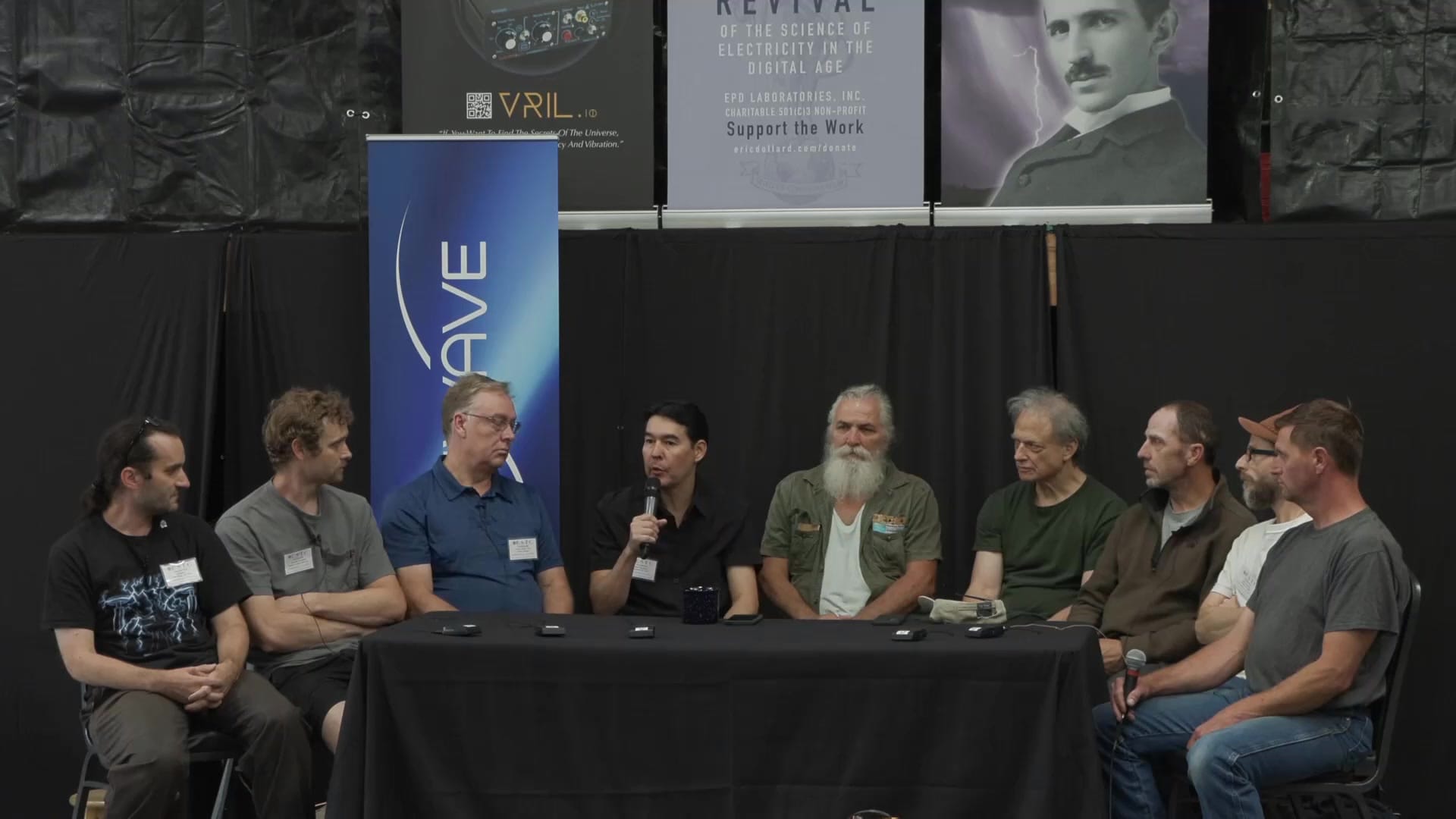
Someone watching online asked what to do when you understand the theory but do not have the tools. The answer came straight back from the stage: “Kitchen table. Seriously. Work in your living room.” That is the closing panel of the 2026 Energy Science and Technology Conference in one exchange. The full 130 minutes is out now, free to download and keep.
Aaron Murakami moderates Hakasays, Jeremiah Ferwerda, Adrian Marsh, Al Francoeur, Tom DiFerdinando, Terry McMenomy, Davy Oneness and Justin Miller. After a week of prepared talks they sit in a row and take questions from the floor and the online stream, with no slides and no script.
The coil in the luggage: Hakasays on building his demonstration coil two to four days before the conference, winding it on site, and knowing from geometry, wire and frame that it would perform before he measured it.
Nine pumps: Jeremiah Ferwerda on six years of prototyping, the shop, and the disk-spacing question he turns down: “we have had people try to copy and take our work.”
Half a mile of dead line: Justin Miller on the only cut he ever made on the 12 kV side of a transformer, how he confirmed the line was dead, and how badly his hands shook anyway.
Every band snowed: Al Francoeur firing his Mobius coil and finding UHF, VHF, television, AM and FM all turned to buzz.
Eight years off the grid: Al on the fridges, freezers, trailer and RV his system has run for over eight years, and the smart meter he refused.
The ether argument: Marsh and DiFerdinando on how to polarize more ether, then the real disagreement between them, which is not about the ether at all. Marsh: “The spirit is unknowable.” DiFerdinando: “If the spirit is real, it’s a part of reality.”
Where each presenter’s own talk picks up
Most of the panelists have a full 2026 presentation of their own, alone or with a partner. The panel is where you hear them argue about each other’s work; the talks are where each one shows his own. Tom DiFerdinando’s Orgone Energy came out yesterday, and Hakasays’ Build A Better Tesla Coil is out tomorrow.
Energy Times readers hear about each ESTC 2026 release as it goes live, along with new books, papers and research from emediapress.com. It is free, and you can leave any time. Get Energy Times.
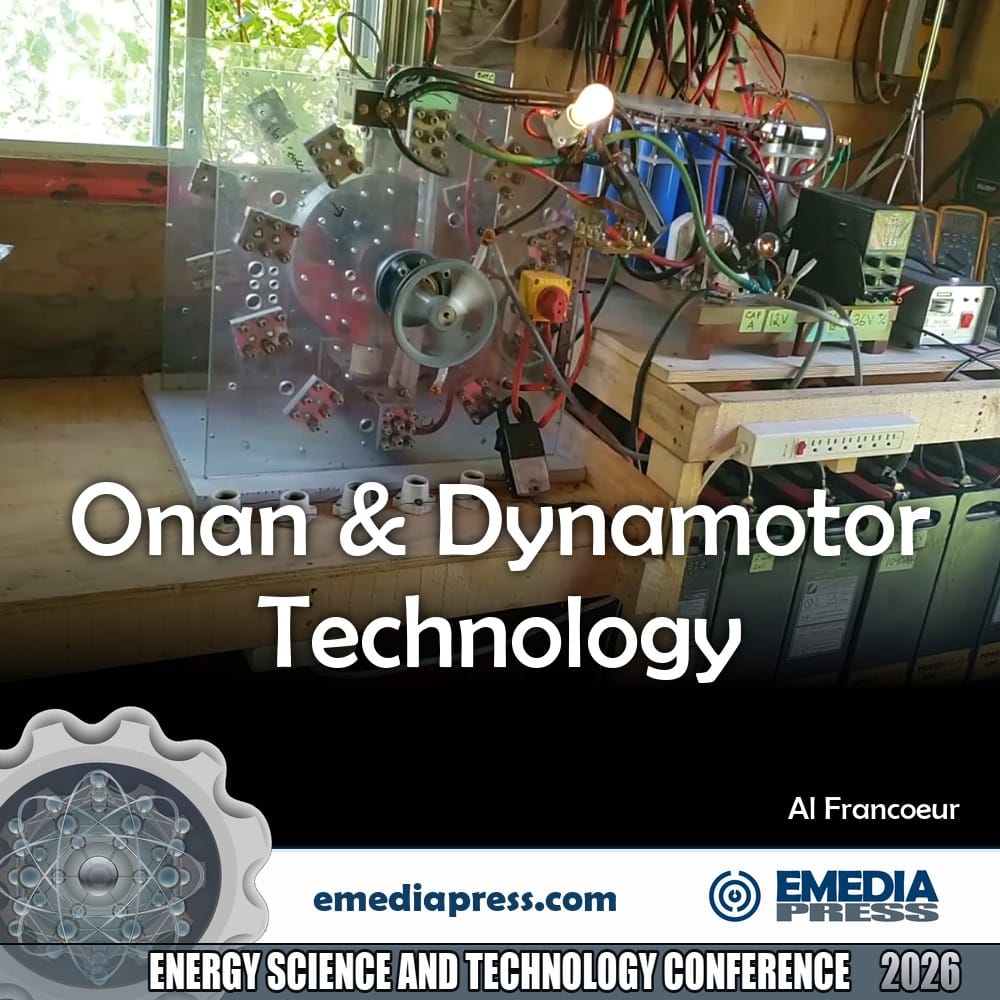
Al Francoeur switched on Dynamo No. 1 in his rebuilt power shop on April 17. He did not switch it off until June 21, the solstice, and only because he was leaving for the conference and will not leave it running unattended. Day and night at about 700 rpm, with two squirts of bearing grease once a month. “And it run flawless. Perfect.”
His 125-minute presentation from the 2026 Energy Science and Technology Conference is the bench report on that machine and the ones around it. He has been off-grid for eight years, since he refused a smart meter and the utility cut him off. He winds every coil by hand. Three dynamos are built, and a fourth is 90 percent complete.
Francoeur draws one line at the start and holds it: “pending third-party independent verification of all energy systems, I will refrain from stating over unity or efficiencies in these energy systems.” What he shows instead is the apparatus, the wiring, the run times, the scope traces and the burned bulbs, in enough detail to build the same thing. “Well, this is my fourth machine now. And again, it’s working. Again and again. It’s repeatable.”
A motor and a generator at the same time
The dynamo is a brushless permanent-magnet motor-generator that Francoeur calls a magnetic paddle wheel. Battery A drives the pulses. Battery B charges from the generator coils. Battery C catches the spike when the coils collapse, and the harder he loads the rotor, the bigger the spike into C. In his words, “the EVs aren’t doing that.”
The build is plain and visible. Ten-and-a-quarter-inch phenolic rotors carry neodymium magnets around a steel keeper ring, twelve poles on the rotor and ten coil positions at 36 degrees on the stator, Lexan and phenolic throughout, stainless axles. “It’s like a continuous horseshoe magnetic field around and around the rotor.”
It does not need speed. At about 180 rpm, the 35-pound rotor barely turning, it lights a bank of incandescent bulbs at full brightness. “It doesn’t need to go fast to produce power. Full power.” Off the solar panels it runs at 1,400 rpm, dipping and recovering as clouds cross the sun. “I don’t use LED lights at all. I want lights that load the system down.”
Two coils caught fire, so he rewound everything
The pulse coils on the early machine ran hot while the generator coils stayed cool, and one morning two of them burned, smoke in the room. He marked the hot side of each core with red tape and redesigned the windings. The classical coil took 59 feet of magnet wire; his double-helix mirror-image coil takes 10 feet a side, on hollow amorphous ribbon cores, and runs cooler. The switching is as simple as he could make it: one 1-megohm resistor, one hall sensor and one MOSFET on a removable module, terminal studs instead of a circuit board. Dynamo No. 3 adds X-vertex crossover wiring, and No. 4 moves the generator coils nearest the rotor.
One night the 35-pound rotor slowed to a stop and spun back up the other way, witnessed by two people. He suspects vibration shifted a hall sensor, and says that is a suspicion, not a finding.
The Onan that burns the bulbs
The second half of the talk is old iron. Francoeur tracked down five 1964 Onan LK light plants from fire stations and classified ads and converted four. The Onan LK is a 2.5-kilowatt light plant with AC slip rings and a DC commutator on the same rotor, and he sets his restored units beside the Onan in Robert Alexander’s patent to show the same machine design. Run on 24 volts through a 5-ohm potentiometer, a twist of the knob trades axle torque for AC output and back.
Then close the series field switch with the rotor at speed. The rotor slams to a stop while twelve 100-watt bulbs flash like a camera, with half-inch forked arcs inside the glass, and some of the bulbs burn out. The faster it stops, the bigger the burst. He scales up from there to three vintage 10-kilowatt Kohler generators, one from a junkyard with 2,100 hours on it.
What is inside the full 125 minutes
The three-battery system and the meter readings he reports on battery B and C.
The coils, the cores and the switching module, with every part number.
The closed loop: battery B through an inverter and a bench supply into six 1-farad capacitors, the rotor still at 700 rpm under load.
The dual-rotor Dynamo No. 2 and the iron flux gate between its rotors.
The waveform he asks the room about, seen on a digital scope and again on a vacuum-tube scope. “What do you call that? Is it real or not, or is it an error? Both scopes showed it.”
The Q&A: ignitrons versus MOSFETs, GaN switches, short coils versus long, and putting a Kohler in a Volkswagen as an analog EV that motors and generates at the same time.
You do not need to be an engineer. The talk is photographs and video from the shop, and the circuit is simple enough that he shows every part number. The video gives you what a post cannot: every coil, every meter reading and every demonstration, from a builder who has kept four machines running.
Eric Dollard’s Gangrene Energy is his master class on dirty electricity, and his Alexanderson Antenna goes from the Bolinas blueprints to a radio telescope pointed into the Earth.
Energy Times announces each 2026 conference release as it comes out. It is free, and you can leave any time. Get Energy Times.
Aaron Murakami Energy Science and Technology Conference · emediapress.com
The 13th Energy Science and Technology Conference ran five full days in Spokane, Washington, June 24 to 28, 2026. It was recorded start to finish: 23 presentations, 10 live demonstrations and 12 presenters. The presentations started releasing on emediapress.com on October 14, 2026.
ESTC 2026 on emediapress.com
Every 2026 release goes on the conference page as it comes out, beside the archive of every ESTC since 2012.
The presentations come out one at a time, almost every weekday, from October 14 into early November. Each release goes live on emediapress.com at its release time, with a preview on YouTube. Eric Dollard’s Gangrene Energy and The Alexanderson Antenna came out first, on October 14, followed by Al Francoeur’s Onan and Dynamotor Tech on October 16. Adrian Marsh PhD’s A Foundation For True Science and his free The coMra Effect follow on October 20.
What is in the 2026 recordings
Eric Dollard: The Alexanderson Aerial, on Ernst Alexanderson’s wireless transmission system and Eric’s research building on it, and Gangrene Energy, on the dirty electricity loose in our utility infrastructure.
Adrian Marsh PhD: The coMra Effect and A Foundation For True Science.
Al Francoeur: the Onan and Dynamotor technologies.
EPD Laboratories, Inc. is a 501(c)(3) nonprofit research organization carrying Eric Dollard’s work forward at its Tonopah, Nevada field site. Donations are tax-deductible, and every dollar goes into field research, infrastructure and Eric’s ongoing work. Donate to EPD Laboratories.
Hear about each release first
Energy Times readers hear about each release as it goes live, along with new books, papers and research from emediapress.com. It is free, and you can leave any time. Get Energy Times.
LifeWave was the exclusive platinum sponsor of the 2026 Energy Science and Technology Conference. Thank you to every presenter, vendor and attendee who made the 13th ESTC possible.
Electricity, Magnetism, Gravity & Singularity by Al Francoeur
There are many examples throughout nature where mirrored symmetry appears at the micro level up to the size of galaxies. The division line is very similar to the neutral line or Bloch Wall of a magnet.
This is the premise of much of the model that Al Francoeur has been working on in relation to explaining how he believes the Ed Gray power supply works.
The Gray Motor was verified in the past to operate at over 300 COP, which means 300 times more work was demonstrated compared to the net loss in the batteries that were powering the motor.
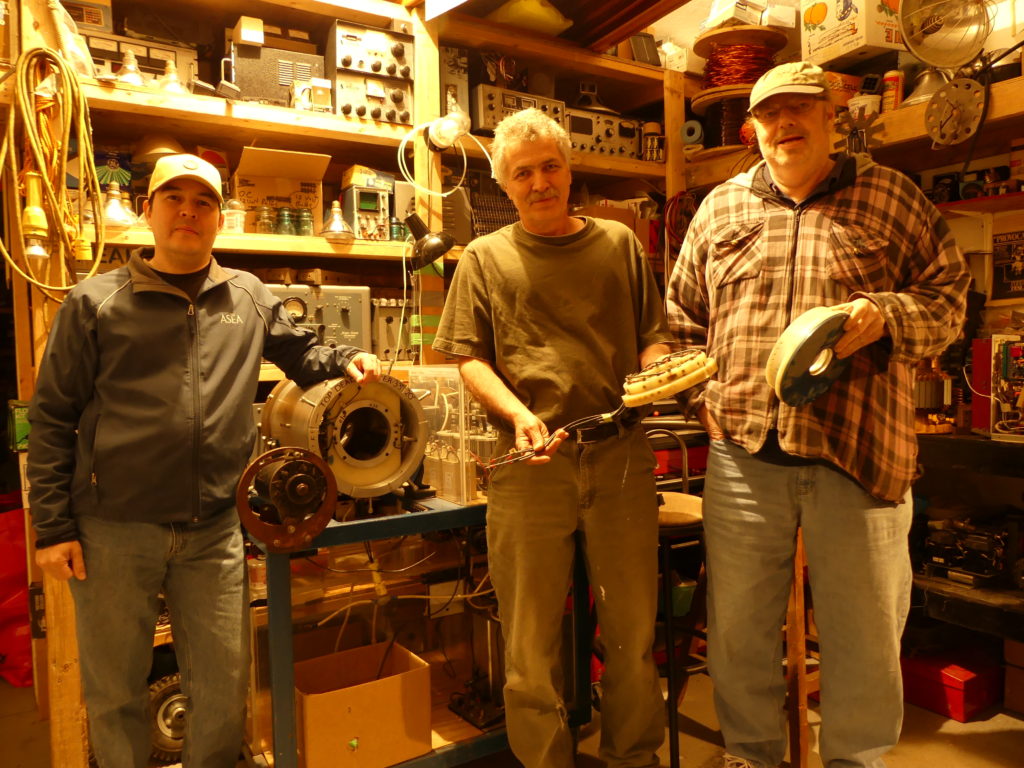
Al happens to own the largest collection of the remnants of Ed Gray’s technology and he has been diligently working to reverse engineer the power supply to see what if any components or how it is built is operating in some unusual way.
There appears to possibly be a transformer winding method that on the surface would appear to not work and it deals with counter-turned windings that oppose each other. Conventionally, the thought would be that it would cancel out the ability to generate a magnetic field, but there are other instances where this kind of winding method has been implemented and it actually gives very unusual performance such as is seen in the famous Kromrey Generator.
Al’s reverse engineering efforts are a work in progress but for the first time ever, he presents his findings of the power supply to a public audience. Although it is not a conclusive report, it is an exclusive release.
He also goes into other aspects of his research including this design for a fuel vaporizer and his interference generators. I have personally been emailed by those claiming that his interference generators do not work, but I visited Al’s shop with Paul Babcock and we saw the generators working with the ability to light a lot of incandescent bulbs. Anyone stating that Al’s interference generators don’t work is spreading misinformation.
If you’re a fan of Ed Gray’s technology, then this presentation is a must have. And if your not, you should be! It was one of the most profound demonstrations of Free Energy in history and we’ve never been this close to understanding the operating methodology.
ATTN: At the request of Al Francoeur, a portion of the proceeds and all royalties for this presentation will be donated to the local Salvation Army or Union Gospel Mission of Spokane, Washington to feed and shelter the homeless.
Electricity, Magnetism, Gravity & Singularity by Al Francoeur
Al Francoeur has been involved with energy technologies since the 1980’s and is the inventor of several interference generators that operate with reduced back emf.
He is the owner of several E.V. Gray Motors that were later converted to run conventionally. There are some clues in these motors and an original power supply, which appears to have never been tampered with. Al has found a few clues as to the original operating method and will be sharing his perspective on these aspects of the Ed Gray Motor technology at the 2017 Energy Science & Technology Conference.
Mark McKay is a researcher that has traveled the country visiting Ed Gray’s family, friends, engineers, etc. and has revealed his historical findings in these presentations: https://emediapress.com/shop/real-history-ed-gray-motor/
Al’s presentation will be a perfect companion to Mark’s presentations and will be released after the upcoming conference.
Come meet Al Francoeur at the 2017 Energy Science & Technology Conference – there are only 8 seats remaining: http://energyscienceconference.com