Posted on — Leave a comment

Al Francoeur’s Dynamotor Ran From April 17 to the Solstice

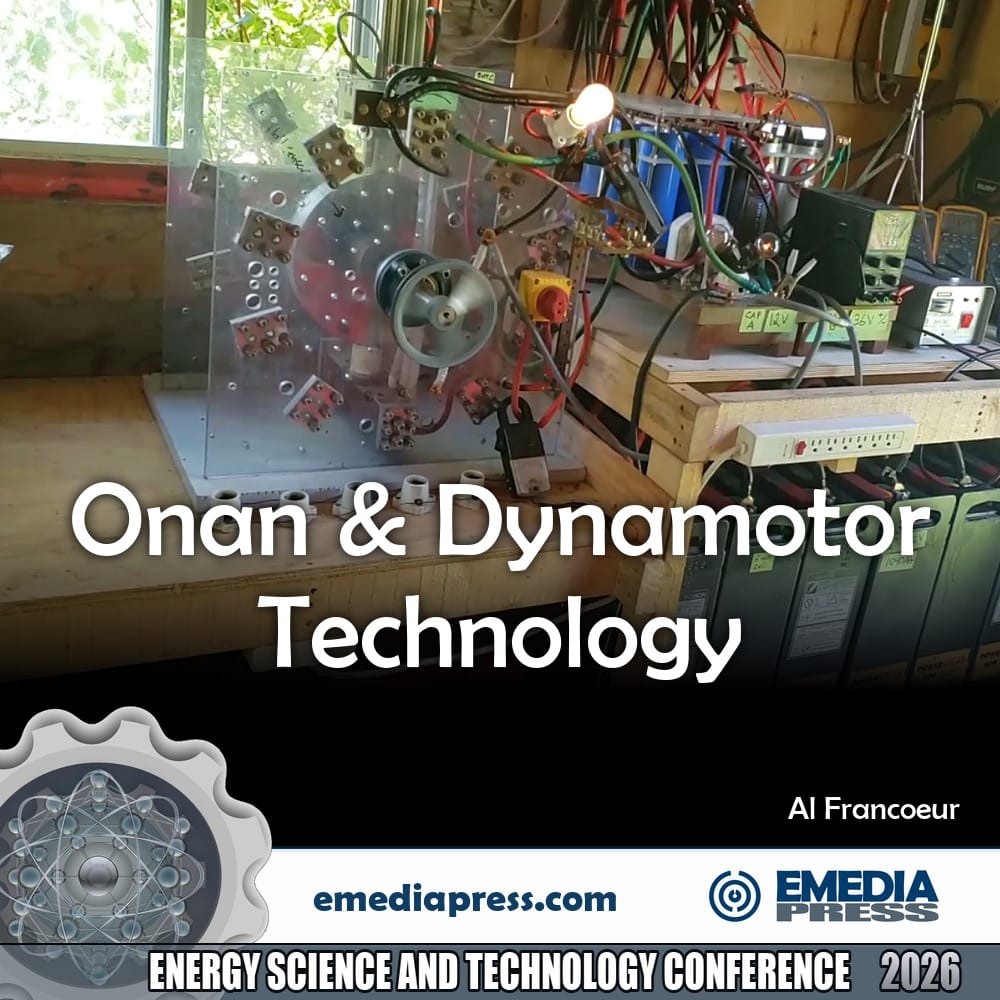
Onan And Dynamotor Tech cover - 2026 Energy Science & Technology Conference

Al Francoeur switched on Dynamo No. 1 in his rebuilt power shop on April 17. He did not switch it off until June 21, the solstice, and only because he was leaving for the conference and will not leave it running unattended. Day and night at about 700 rpm, with two squirts of bearing grease once a month. “And it run flawless. Perfect.”

His 125-minute presentation from the 2026 Energy Science and Technology Conference is the bench report on that machine and the ones around it. He has been off-grid for eight years, since he refused a smart meter and the utility cut him off. He winds every coil by hand. Three dynamos are built, and a fourth is 90 percent complete.

Get Onan and Dynamotor Tech, the full 125-minute presentation

He will not claim over-unity

Francoeur draws one line at the start and holds it: “pending third-party independent verification of all energy systems, I will refrain from stating over unity or efficiencies in these energy systems.” What he shows instead is the apparatus, the wiring, the run times, the scope traces and the burned bulbs, in enough detail to build the same thing. “Well, this is my fourth machine now. And again, it’s working. Again and again. It’s repeatable.”

A motor and a generator at the same time

The dynamo is a brushless permanent-magnet motor-generator that Francoeur calls a magnetic paddle wheel. Battery A drives the pulses. Battery B charges from the generator coils. Battery C catches the spike when the coils collapse, and the harder he loads the rotor, the bigger the spike into C. In his words, “the EVs aren’t doing that.”

The build is plain and visible. Ten-and-a-quarter-inch phenolic rotors carry neodymium magnets around a steel keeper ring, twelve poles on the rotor and ten coil positions at 36 degrees on the stator, Lexan and phenolic throughout, stainless axles. “It’s like a continuous horseshoe magnetic field around and around the rotor.”

It does not need speed. At about 180 rpm, the 35-pound rotor barely turning, it lights a bank of incandescent bulbs at full brightness. “It doesn’t need to go fast to produce power. Full power.” Off the solar panels it runs at 1,400 rpm, dipping and recovering as clouds cross the sun. “I don’t use LED lights at all. I want lights that load the system down.”

Two coils caught fire, so he rewound everything

The pulse coils on the early machine ran hot while the generator coils stayed cool, and one morning two of them burned, smoke in the room. He marked the hot side of each core with red tape and redesigned the windings. The classical coil took 59 feet of magnet wire; his double-helix mirror-image coil takes 10 feet a side, on hollow amorphous ribbon cores, and runs cooler. The switching is as simple as he could make it: one 1-megohm resistor, one hall sensor and one MOSFET on a removable module, terminal studs instead of a circuit board. Dynamo No. 3 adds X-vertex crossover wiring, and No. 4 moves the generator coils nearest the rotor.

One night the 35-pound rotor slowed to a stop and spun back up the other way, witnessed by two people. He suspects vibration shifted a hall sensor, and says that is a suspicion, not a finding.

The Onan that burns the bulbs

The second half of the talk is old iron. Francoeur tracked down five 1964 Onan LK light plants from fire stations and classified ads and converted four. The Onan LK is a 2.5-kilowatt light plant with AC slip rings and a DC commutator on the same rotor, and he sets his restored units beside the Onan in Robert Alexander’s patent to show the same machine design. Run on 24 volts through a 5-ohm potentiometer, a twist of the knob trades axle torque for AC output and back.

Then close the series field switch with the rotor at speed. The rotor slams to a stop while twelve 100-watt bulbs flash like a camera, with half-inch forked arcs inside the glass, and some of the bulbs burn out. The faster it stops, the bigger the burst. He scales up from there to three vintage 10-kilowatt Kohler generators, one from a junkyard with 2,100 hours on it.

What is inside the full 125 minutes

  • The three-battery system and the meter readings he reports on battery B and C.
  • The coils, the cores and the switching module, with every part number.
  • The closed loop: battery B through an inverter and a bench supply into six 1-farad capacitors, the rotor still at 700 rpm under load.
  • The dual-rotor Dynamo No. 2 and the iron flux gate between its rotors.
  • The waveform he asks the room about, seen on a digital scope and again on a vacuum-tube scope. “What do you call that? Is it real or not, or is it an error? Both scopes showed it.”
  • The Q&A: ignitrons versus MOSFETs, GaN switches, short coils versus long, and putting a Kohler in a Volkswagen as an analog EV that motors and generates at the same time.

You do not need to be an engineer. The talk is photographs and video from the shop, and the circuit is simple enough that he shows every part number. The video gives you what a post cannot: every coil, every meter reading and every demonstration, from a builder who has kept four machines running.

Get Onan and Dynamotor Tech, the full 125-minute presentation

More from the 2026 conference

Eric Dollard’s Gangrene Energy is his master class on dirty electricity, and his Alexanderson Antenna goes from the Bolinas blueprints to a radio telescope pointed into the Earth.

Energy Times announces each 2026 conference release as it comes out. It is free, and you can leave any time. Get Energy Times.

Aaron Murakami
Energy Science and Technology Conference · emediapress.com
Posted on — Leave a comment

The Alexanderson Antenna: Eric Dollard From Bolinas to Tonopah

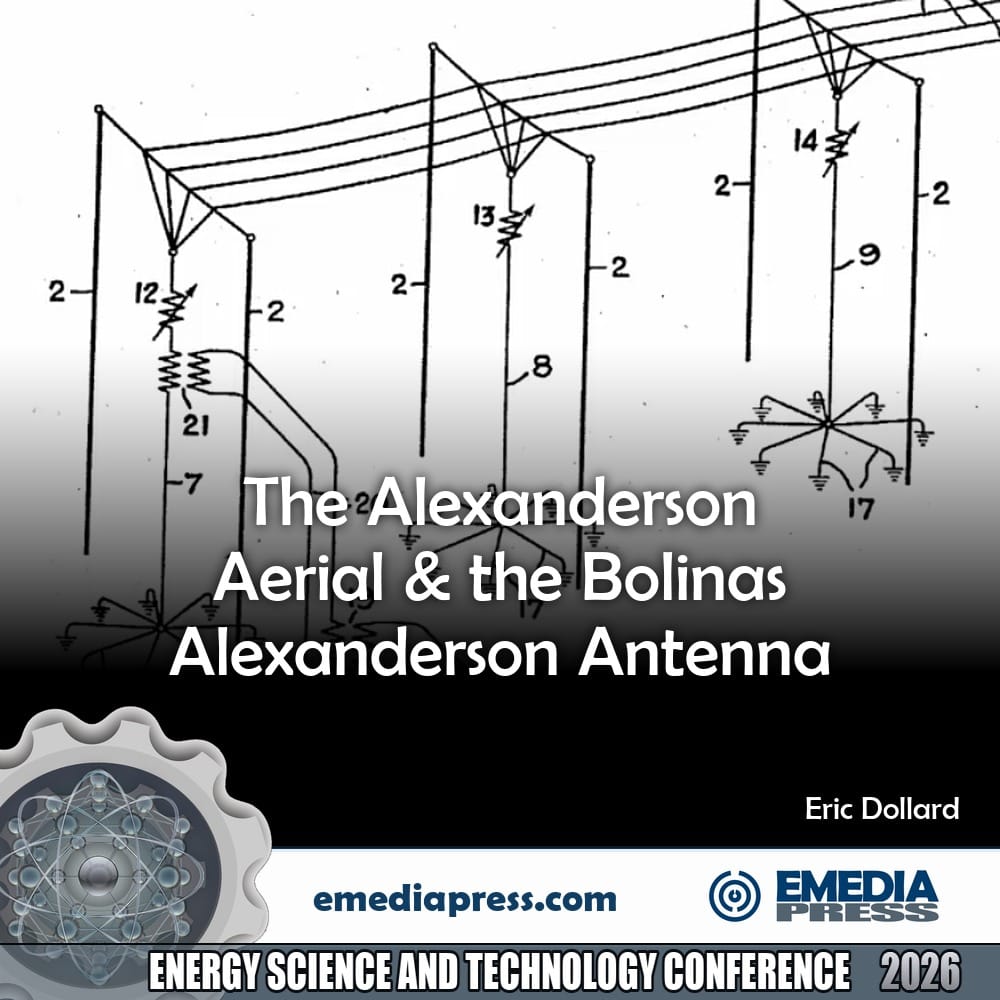
Alexanderson Antenna cover - 2026 Energy Science & Technology Conference

At 14, Eric Dollard walked into the RCA transmitting station on the cliffs at Bolinas, California. By 16 he had the keys. He held the original Marconi blueprints while he was still in high school, learned the station from men who had worked for Marconi, General Electric and RCA, and later inherited the station records and diagrams.

What had been built there was not what RCA taught him. His 223-minute presentation from the 2026 Energy Science and Technology Conference explains what the Alexanderson Aerial actually was, why it is not an ordinary antenna, and what he is building with it in mind at Tonopah, Nevada.

Get the Alexanderson Antenna, the full 223-minute presentation

The drawings, and what came out of the ground

Dollard did not stop at paper. He lived in the powerhouse and the antenna field and dug the Marconi, GE and RCA dumps along the cliffs for the hardware that had been thrown away: porcelain inserts from the series coil with the corona burns still on them, and an eight-saddle shunt-coil insulator he spent a week breaking out of Navy concrete. The pieces told him what the drawings left out, including series condensers nobody had drawn.

A structure that operates in unison

His conclusion, from the blueprints, the station records and the dirt, is that the phase of the current is invariant along the whole length of the Aerial. “There’s no delay and there’s no advance. Everything operates in unison.” He builds the case from the loading of transmission lines in the work of Steinmetz and Heaviside: lag networks and lead networks arranged so the advance of one cancels the delay of the other. When he ran the numbers, the electrostatic power flow was orders of magnitude larger than the electromagnetic. In his analysis the Aerial is electric, not electronic, and not an electromagnetic antenna at all.

A scale model makes it physical: 2,700 feet becomes 27 feet, 19 kilocycles becomes 1,900 kilocycles in the 160-meter amateur band, and the reactance stays at 1,800 ohms.

The Marconi aerial by the numbers

From the constants of the Marconi setup, Dollard works out the aerial that came before it: 3,000 feet long, 600 feet wide, 300 feet up, 44.77 kilocycles, 1,540 amperes at 100,000 volts, a magnification factor of 513. “It rang like a bell.” The RCA-207 water-cooled triodes that followed took 22 volts at 55 amps on the filament, and four of them made 50 kilowatts continuous. “It made all the lights dim in the town of Bolinas when you key one of these things.”

Ten years listening at Landers

Dollard built a receiving version at Landers: a 900-foot Alexanderson antenna under an 1,800-foot beverage antenna, ground rods driven into greasewood roots because the granite would not take them, the inside of the Earth on one speaker and the outside on the other. “And what I heard there and measured was absolutely stunning.” It taught him why Tesla built metallic roots instead of a radial ground, and why each loading network needs its own spot of ground. “Whatever is up in the air has got to be buried in the ground.” His summary of the whole idea: “This thing is a radio telescope to listen to the interior of Earth.”

The Tonopah line, pole by pole

The last part of the presentation leaves the equations and walks the right of way: a 54-pole line over about 2.1 miles, built to Bell System open-wire standards from hardware harvested out of the Mojave and the Great Basin. The aerial section strung so far runs 4,800 feet, from pole 49 to pole 26, with the Alexanderson pair in the center and the outer pairs transposed so they cannot talk to it. For now it runs as a simple capacitance aerial, like the Marconi aerial at Bolinas; the Alexanderson loading networks are the next stage.

Dollard shows the loading points, the 120-year-old pole on a 45-degree slope, the guying that stops one broken pole from pulling the whole antenna down, and the Bell carrier repeater cabinet in the ravine where the signal comes out at a level you can hear in a telephone receiver. “Everything you see here is basically a museum.” Still to come are the carrier pairs to the mine, its seismic transducers, and the public display he calls the musical seismograph. “I’m going to hang a sign on the door that says no software allowed past this point.”

What is inside the full 223 minutes

  • Bolinas from the inside: the 1913 Marconi powerhouse, the Navy pushing Marconi out, and Steinmetz handing the antenna to Ernst Alexanderson.
  • The lineage of the electric wireless, from Franklin’s kite through Loomis, Tesla, Hertz and Marconi.
  • The units rebuilt from scratch in CGS, and the Steinmetz-Heaviside power equation in plain algebra.
  • Loading, from the undersea telegraph cable to the Aerial, and the space scalar condition.
  • The scale model, the Landers installation, and the Tonopah crossarm patterns.
  • The Q&A, including the working Alexanderson station in Sweden and the analog instruments Dollard trusts.

You do not need to be an engineer. The opening is history and people, the mathematics is simple algebra with the units defined before they are used, and the last part is photographs and pole numbers. The video gives you the derivation and the Tonopah line in one sitting, from the one person who slept in the Bolinas powerhouse and is building the next one.

Get the Alexanderson Antenna, the full 223-minute presentation

More from the 2026 conference

Dollard’s other 2026 presentation, Gangrene Energy, is his master class on dirty electricity. Al Francoeur’s Onan and Dynamotor Tech is the bench report on a motor-generator that ran from April 17 to the solstice. For the background on Bolinas itself, see Wireless Giant of the Pacific.

EPD Laboratories, Inc. is a 501(c)(3) nonprofit carrying Eric Dollard’s work forward at its Tonopah, Nevada field site, where the line is being built. Donations are tax-deductible. Donate to EPD Laboratories.

Energy Times announces each 2026 conference release as it comes out. It is free, and you can leave any time. Get Energy Times.

Aaron Murakami
Energy Science and Technology Conference · emediapress.com
Posted on — Leave a comment

Eric Dollard’s Gangrene Energy: 80 Amps Where There Should Be Zero

Gangrene Energy, Eric Dollard's 2026 ESTC presentation on dirty electricity in the utility grid

Eric Dollard put his ammeter on an 800-amp switchboard in a building with a computer center. Phase A read 80 amps. Phase B, 80 amps. Phase C, 80 amps. He had been taught that when the phases are balanced the neutral carries nothing, so he almost did not measure it. The neutral read 80 amps, and none of it was 60 cycles. It was all triple odd harmonics: the 3rd, the 9th, the 15th.

That reading is where Gangrene Energy begins. It is Dollard’s name for dirty electricity, and the subject of his 155-minute presentation from the 2026 Energy Science and Technology Conference: where the current in a balanced neutral comes from, how the grid was opened up to carry it, and what the ground pin in every wall outlet is really connected to.

Get Gangrene Energy, the full 155-minute presentation

The grid Dollard grew up with had no harmonics

Dollard was drawing utility poles at six. A fifth-grade teacher carried his transformer drawings to the Pacific Gas and Electric engineering office, and PG&E line practice became his schooling. Then came the multi-megawatt lines feeding the RCA station at Bolinas, the Navy, and a working life in power, transmission, telephone and maritime systems.

The system he learned had two loads, the incandescent lamp and the induction motor. “Neither of those generate any harmonics,” he says. It was delta connected, insulated and closed, and a delta winding gave the triple harmonics a loop to circulate in instead of a wire to travel on. Every induction motor was also a generator, so the iron and copper spinning across the country carried the system through a brownout.

How the system was turned inside out

The Y connection came in through office-building lighting, and fluorescent lamps put the first third-harmonic current on the lines. In a four-wire Y system the triple harmonics do not cancel in the neutral; they add. Then the high-voltage neutral was bonded to the customer’s neutral and ground rod. In Dollard’s words, “the whole system has been turned inside out Delta into an open system, which is Y, which is an antenna.”

The loads changed too. “Rectifiers are a very prodigious source of harmonics,” he says, and the grid is now full of them: inverters, LEDs, variable-frequency drives that short the line for a microsecond every half cycle. One example is close to home: a gas station motor controller in Tonopah that shock-excites his Tesla transformer through the shared neutral.

The ground pin in your outlet is not ground

“Don’t get any idea that the ground pin on your wall outlet is any type of ground at all,” Dollard says. The round pin connects to the building’s equipment-grounding wire, and in a typical North American service that wire is bonded to the neutral at the panel. It is not a private wire to clean earth.

He makes it concrete with the washing machine. Under the old arrangement its metal case was tied to your neutral, your ground rod and your neighbors’ ground rods, a local reference. With the transformers bypassed and a high-voltage neutral brought in, the same wet hands are connected to the high side of the line all the way back to the substation.

The same change took away the protection. With the grounded neutral, ground-fault relaying disappeared, so ground faults now burn instead of tripping, and Dollard shows the substation and pole-fire footage. His verdict on why it continues: “It’s not an engineering problem we’re dealing with here. It’s a sociology problem.”

Earthing sheets plugged into the outlet are not earthing you

Most people who sleep on an earthing sheet or mat plugged into the ground hole of a wall outlet believe it connects them to the earth. It does not. That wire runs to the building’s grounding conductor, which is bonded to the neutral at the panel, and the neutral is where the harmonics and switching noise of every load on the system end up. Plug yourself into it and your body is wired into that circuit, with its noise riding on you all night.

Dollard put a scope on it. “If you put a scope on the ground on any of the regular 110-volt outlets, that ground is very noisy. And people that are connecting these earthing mats and all the pads on the beds with the wire into that ground, you’re soaking all that garbage up. It’s better to do nothing than to use these earthing mats connected to ground.” His summary in the Q&A is blunter: “You’re connecting yourself right to the gangrene energy.”

It is also an electrical safety issue. A wiring fault, a lost neutral or a miswired outlet can put voltage on that ground wire, and anything tied to it, including a person lying on a sheet, is tied to that voltage. If you want to be connected to the earth, in Dollard’s words, “you’ve got to get down in it.”

Measured, not theorized

Dollard does not ask you to imagine a bad sine wave. He shows the traces: the waveforms from wall outlets in town after town on a drive across the country, and the scope on the neutral at Tonopah, referenced to his own station ground. The neutral current, he says, “has all these radio frequency type things on top of it,” and looks more like a television video signal than anything that should come out of a wall outlet. When a digital scope image is too poor to tell an instrument artifact from a real waveform, he says so.

What is inside the full 155 minutes

  • The 80-amp neutral reading, step by step, and why it drove Dollard off every Y-connected service for the rest of his career.
  • The Rural Electrification Administration decisions that put transmission voltages on Y loads.
  • The substation that exploded when a traveling wave jumped the gap between its 33 kV and 7,200-volt sides and burned out the electronics in a whole town.
  • The transformer connections chapter from his unpublished 800-page three-phase book, including why a delta-to-Y conversion shifts the reference 90 degrees, not the 30 taught in school.
  • The Q&A: what he would do to fix the grid, and the isolation-transformer arrangement he recommends for a house. “Isolation transformer is the only thing that works.”

The video gives you what a post cannot: the drawings, the traces and the full reasoning, connection by connection, so that when you look at a pole or a panel you see what he sees.

Get Gangrene Energy, the full 155-minute presentation

More from the 2026 conference

Dollard’s other 2026 presentation, The Alexanderson Antenna, goes from the Bolinas blueprints to a radio telescope pointed into the Earth. Al Francoeur’s Onan and Dynamotor Tech is the bench report on a motor-generator that ran from April 17 to the solstice.

EPD Laboratories, Inc. is a 501(c)(3) nonprofit carrying Eric Dollard’s work forward at its Tonopah, Nevada field site. Donations are tax-deductible. Donate to EPD Laboratories.

Energy Times announces each 2026 conference release as it comes out. It is free, and you can leave any time. Get Energy Times.

Aaron Murakami
Energy Science and Technology Conference · emediapress.com
Posted on — Leave a comment

ESTC 2026 Presentations Release October 15

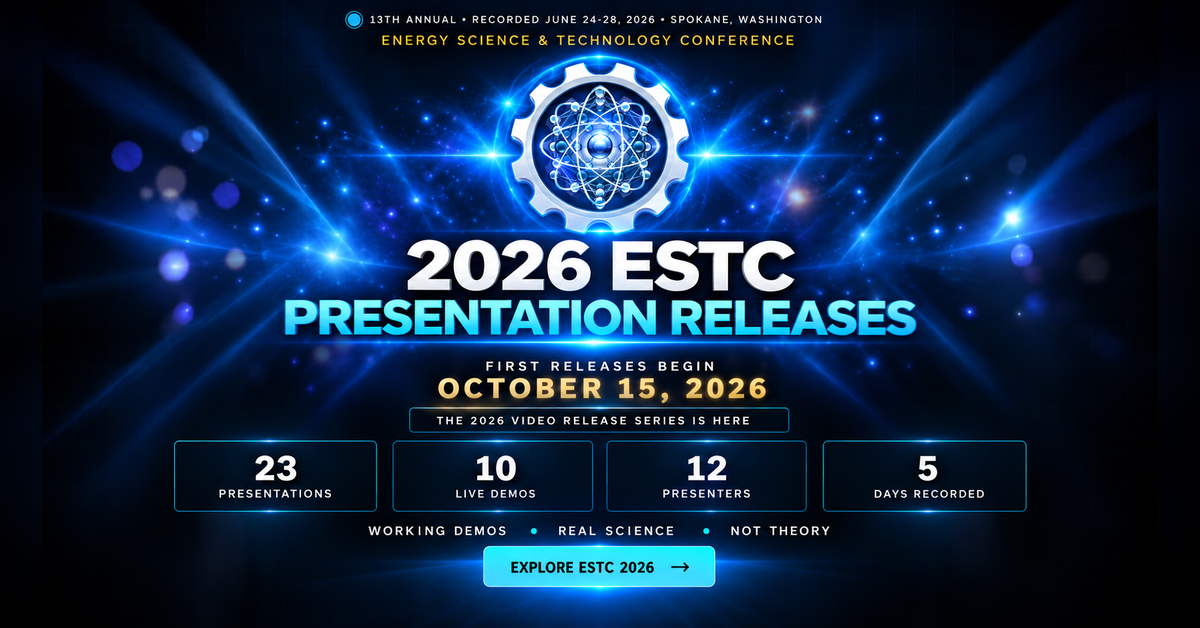
The 13th Energy Science and Technology Conference ran five full days in Spokane, Washington, June 24 to 28, 2026. It was recorded start to finish: 23 presentations, 10 live demonstrations and 12 presenters. The presentations started releasing on emediapress.com on October 14, 2026.

ESTC 2026 on emediapress.com

Every 2026 release goes on the conference page as it comes out, beside the archive of every ESTC since 2012.

See the 2026 ESTC

How the releases work

The presentations come out one at a time, almost every weekday, from October 14 into early November. Each release goes live on emediapress.com at its release time, with a preview on YouTube. Eric Dollard’s Gangrene Energy and The Alexanderson Antenna came out first, on October 14, followed by Al Francoeur’s Onan and Dynamotor Tech on October 16. Adrian Marsh PhD’s A Foundation For True Science and his free The coMra Effect follow on October 20.

What is in the 2026 recordings

  • Eric Dollard: The Alexanderson Aerial, on Ernst Alexanderson’s wireless transmission system and Eric’s research building on it, and Gangrene Energy, on the dirty electricity loose in our utility infrastructure.
  • Adrian Marsh PhD: The coMra Effect and A Foundation For True Science.
  • Al Francoeur: the Onan and Dynamotor technologies.
  • Aaron Murakami: pure water.
  • The ESTC 2026 panel discussion.

That is a small part of five days of free energy, Tesla and electrical science research, much of it demonstrated live rather than described. For the background on Eric Dollard’s Alexanderson work, read Pole 26: a new terminal on the world’s largest Tesla-type measurement instrument and watch the Tesla-Marconi Wireless System.

Supporting Eric Dollard’s research

EPD Laboratories, Inc. is a 501(c)(3) nonprofit research organization carrying Eric Dollard’s work forward at its Tonopah, Nevada field site. Donations are tax-deductible, and every dollar goes into field research, infrastructure and Eric’s ongoing work. Donate to EPD Laboratories.

Hear about each release first

Energy Times readers hear about each release as it goes live, along with new books, papers and research from emediapress.com. It is free, and you can leave any time. Get Energy Times.

LifeWave was the exclusive platinum sponsor of the 2026 Energy Science and Technology Conference. Thank you to every presenter, vendor and attendee who made the 13th ESTC possible.

See the 2026 ESTC

Aaron Murakami
Energy Science and Technology Conference · emediapress.com
Posted on — Leave a comment

LifeWave – Exlusive Platinum Sponsor of the 2026 ESTC!

LifeWave — Exclusive Platinum Sponsor of the 2026 Energy Science & Technology Conference

Exclusive Platinum Sponsor

LifeWave is the exclusive platinum sponsor of the 2026 Energy Science & Technology Conference.

This is a meaningful partnership and one I personally couldn’t be more enthusiastic about. Let me tell you why.

About David Schmidt and LifeWave

David Schmidt is one of the most successful businessmen in the wellness industry — but at his core, he’s an inventor. Per LifeWave, his experience in business and product development spans over 30 years and includes 200+ patents.

LifeWave’s technology has a remarkable origin story. David was invited by the U.S. Navy to be part of an elite research team tasked with developing a product to help mini-sub crews stay awake without drugs or stimulants. Through that research, David developed a patch that would increase energy in the body using phototherapy — which became the first LifeWave prototype, the Energy Enhancer.

Here’s how LifeWave describes the technology: your body emits heat, including heat in the infrared spectrum. Their patches are designed to trap that infrared energy when placed on the body, which causes them to reflect it back to stimulate specific points on the skin. LifeWave’s approach draws on both phototherapy and acupressure — acupressure working on the same principle as acupuncture, based on the body’s energy field flowing through “meridians.” It’s a patented, proprietary form of phototherapy, and no drugs or stimulants enter your body.

Per LifeWave, their flagship X39 patch supports improved energy flow, improved exercise performance, improvements in strength and stamina, and overall health and well-being.

At its heart, the Energy Science & Technology Conference is an inventor’s and innovator’s conference — so we deeply appreciate David and LifeWave’s support of what we’re doing here.

A Personal Note From Aaron

I’ve been deeply involved in natural health for over 30 years. I used to own a vitamin and health food store, I’ve worked with many companies in this space, and I’ve personally tested countless products and modalities over the decades.

The LifeWave X39 patches are one of the very few things I’ve stayed with. I’ve used them every single day for the last 5-6 years. I push myself hard — sometimes 18 hours a day, 7 days a week, for weeks at a stretch depending on the projects I’m working on. I need every advantage I can get, and I can tell I get less fatigued when I’m using the X39 patches than when I’m not. That’s the simple reason I keep using them.

I don’t endorse anything lightly, and I don’t keep using something this long unless it’s working.

— Aaron

Watch David’s Free 2021 ESTC Presentation

If you want to go deeper, David Schmidt actually presented at the 2021 Energy Science & Technology Conference in Coeur d’Alene, Idaho. In his presentation he goes into the science behind the technology, the research, and some experiments that were genuinely mind-blowing. He also touched on his Double Helix Conductor coil technology. Hear it directly from David himself — it’s available to watch for free:

▶ Watch David Schmidt’s 2021 ESTC Presentation — FREE

Learn More About LifeWave

Explore LifeWave’s full product line and the science behind it »

$2,500 Donation to EPD Laboratories

As part of this sponsorship, $2,500 of the sponsorship fees is being donated to EPD Laboratories, Inc., a 501(c)(3) non-profit, in LifeWave’s name to advance electrical science research. That’s the kind of sponsor they are — supporting both the conference and the ongoing research that comes out of it.

ESTC 2026 — June 24-28, Spokane WA

If you haven’t grabbed your streaming ticket yet, the conference is just weeks away. 5 days. 15+ presenters. 11+ live demonstrations of technologies you won’t see anywhere else. Streaming tickets are available now:

Get Streaming Access — ESTC 2026 »