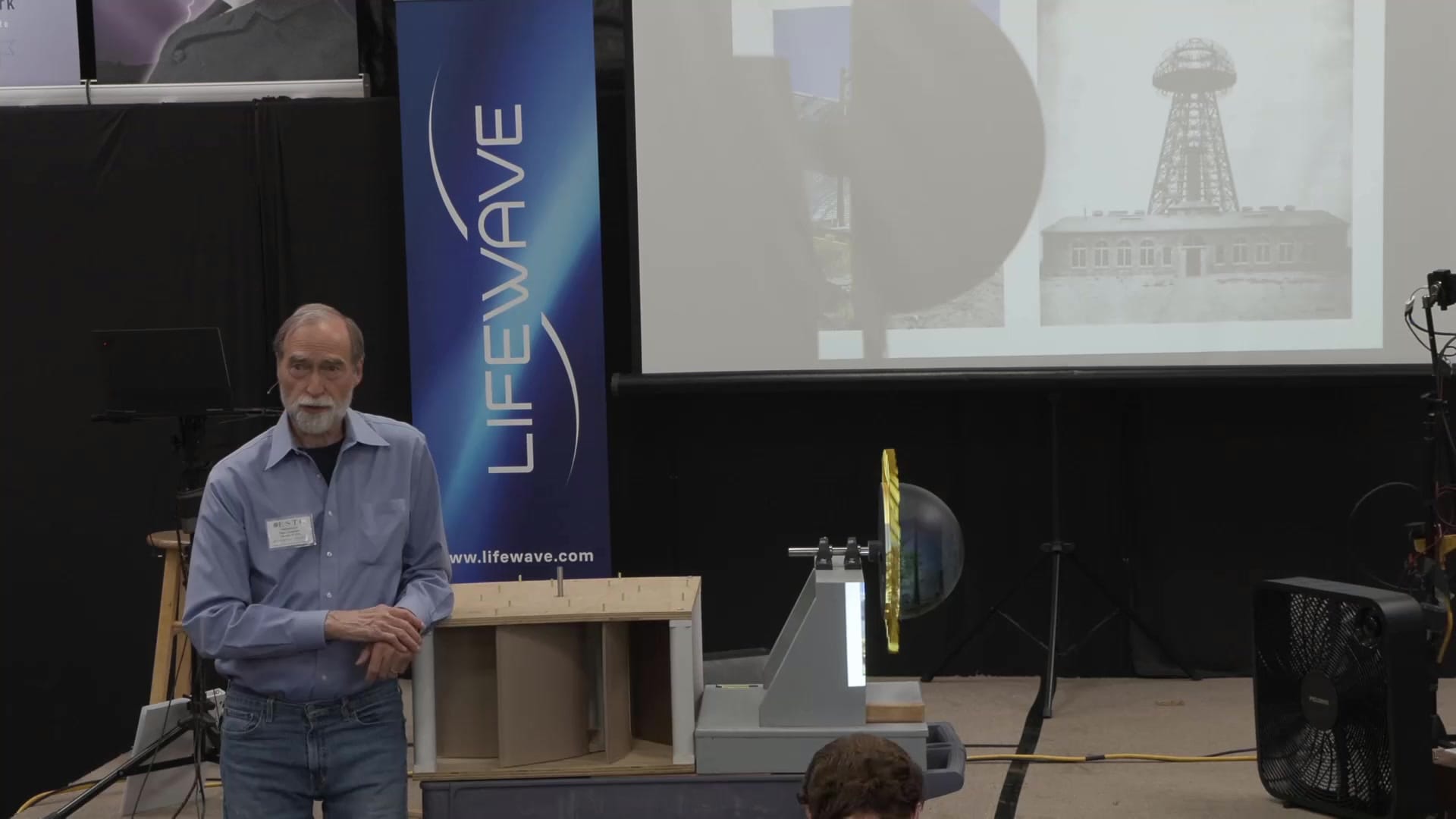
Terry McMenomy’s unfinished wind catcher turns in his field video as his wind meter reads 5.6, then 9.8. He calls the wind “less than 10” and says “10 miles an hour is a daily thing” where he lives. His 82-minute Efficient Wind Catching Tech presentation with Peter Lindemann, from ESTC 2026, is now available to download.
Lindemann co-founded this conference with John Bedini and has spent decades on motors, batteries and energy research. Here he turns to inexpensive wind-catching concepts for home builders, showing how the ideas performed in the shop and what remains to be tested.
Get Efficient Wind Catching Tech, the full 82-minute presentation
The separate conventional windmill that faults in gusts
McMenomy then shows the conventional windmill they already own, 50 feet off the ground. It runs at 20 to 40 miles an hour. When a gust spikes past 40, “it sends it into fault,” and “it takes it five minutes to reset itself, and by the time it’s reset, the wind is gone.”
Cross-flow versus Savonius: speed and torque
- Drag versus lift: cup anemometers, Savonius rotors and Darrieus machines, the basic vertical axis wind turbine shapes, against propellers, and why, unlike aircraft, “wind turbines can use drag to increase efficiency.”
- A fan on a variac: “so we could vary the speed and see how well the different rotors that we built worked.”
- Speed against torque: “The cross-flow fan turned the fastest, and the multi-bladed Savonius had the most torque.”
- A design that hit a limit: a deeper-cup version that, “even if we threw twice the wind at it, it wouldn’t go faster.”
- The first shop spin: McMenomy’s leaf-blower test of the larger rotor, a spin he timed at two minutes, before it went outside.
Windmill history, Waters’ calculation and open questions
The community of windmills at Nashtafan, Iran, that ground grain on a prevailing wind. A grid-tied machine about a mile from Lindemann’s house, installed in 2011, whose owner, Lindemann says, “wouldn’t do it again.”
Mike Waters’ prototype against a six-foot propeller, with the hundred-fold figure Lindemann gives as Waters’ calculation, not a measurement. Diverters that close around the rotor “in about five minutes” when the forecast says high winds. And the online question on mass flow and back pressure: “Those ideas may have validity, and my basic philosophy is everything should be tried.”
The 2026 ESTC releases so far
- Gangrene Energy, Eric Dollard
- The Alexanderson Antenna, Eric Dollard
- Onan and Dynamotor Tech, Al Francoeur
- A Foundation for True Science, Adrian Marsh PhD
- The coMra Effect, Adrian Marsh PhD, free
- Orgone Energy, Tom DiFerdinando
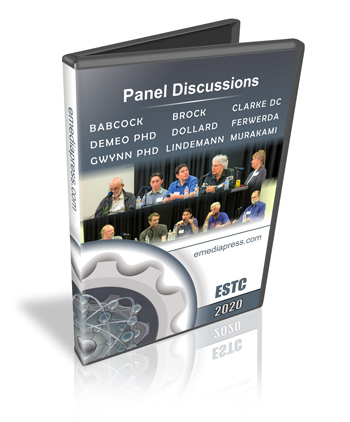
- 2026 Panel Discussion, nine presenters, free
- Build A Better Tesla Coil, Hakasays
- Efficient Wind Catching Tech, Peter Lindemann and Terry McMenomy (today)
Hear about each release first
Energy Times readers hear about each ESTC 2026 release as it goes live, along with new books, papers and research from emediapress.com. It is free, and you can leave any time. Get Energy Times.
Download Efficient Wind Catching Tech, the complete 82-minute MP4
Aaron Murakami
Energy Science and Technology Conference · emediapress.com