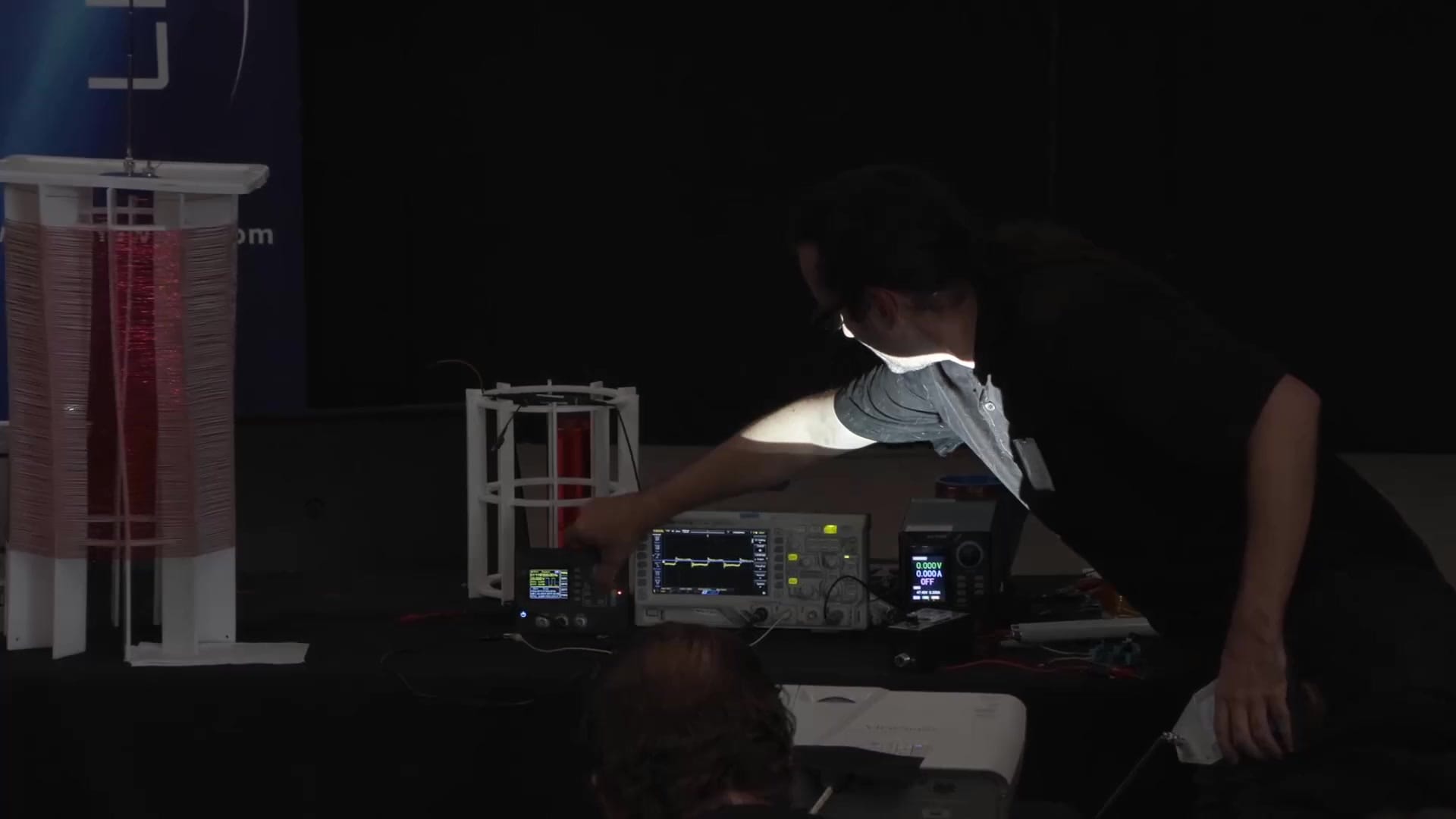
Hakasays lights a bulb using the self-oscillating exciter circuit most people buy online, drawing about seven watts. Then he removes the feedback winding, the primary and the driver circuit, one at a time. On a hobby signal generator putting out a quarter to a third of a watt, the bulb stays lit. “So I think we’ve made a better Tesla coil. We’ve done the same output with almost no power.” His 2026 ESTC presentation, Build A Better Tesla Coil, 137 minutes, is out now as a download.
The two-coil spark gap machine everyone calls a Tesla coil is not the three-coil arrangement Tesla ran at Colorado Springs. Hakasays has been building coils alongside the EPD Laboratories work, including the telluric transmission platform, ever since the 2019 conference showed a 20-to-1 replica of the Colorado Springs system built by Eric Dollard and Bruce Gavin.
Get Build A Better Tesla Coil, the full 137-minute presentation
Measured, not judged by the sparks
The coil on his bench was wound at the conference itself, in the first day and a half. He finds its resonance live with a signal generator, a scope and a field strength meter. Then he works the quality factor of an earlier coil on screen: 1470 and 1463 kilocycles, 7 kilocycles of bandwidth, “we divide that, the 1466 by 7, and we get a 209 quality factor.” He compares that 209 with the 30 to 60 he reports for faithful spark gap replicas. “And you can see for yourself. You don’t have to trust me for this.”
For builders
- Frame material, ranked by loss: “The PVC is one of the worst materials that you could use to wind a Tesla coil on.” And: “You’d be better off winding a coil around a tree.”
- 3D printing: why dark filaments are a trap (the pigment is usually carbon) and what to print with instead.
- Wire and spacing: gauge, cost and weight, and why turn spacing changes what the coil is.
- What killed a telluric coil: unpolished copper tubing oxidized in the air, and the fix.
- Matching the drive: Bruce Gavin’s method for letting a 50-ohm ham radio see a match, “set it and forget it.”
Inside the 137 minutes
Three demonstrations on stage. The striations in the lit tube, which he attributes to “where the fields have nodes.” The field strength meter walked backward across the room, 50, 40, 15, down to about 5, “nowhere near the coil.” Why Tesla ran between 50 and 100 kilocycles. One three-coil system lighting 400 watts on another through a single wire. And his closing line: “Go forth and build.”
The 2026 ESTC releases so far
Gangrene Energy and The Alexanderson Antenna, Eric Dollard. Onan and Dynamotor Tech, Al Francoeur. A Foundation for True Science and the free The coMra Effect, Adrian Marsh PhD. Orgone Energy, Tom DiFerdinando. The free 2026 Panel Discussion. And today, Build A Better Tesla Coil, Hakasays.
Hear about each release first
Energy Times readers hear about each ESTC 2026 release as it goes live, along with new books, papers and research from emediapress.com. It is free, and you can leave any time. Get Energy Times.
Aaron Murakami
Energy Science and Technology Conference · emediapress.com