
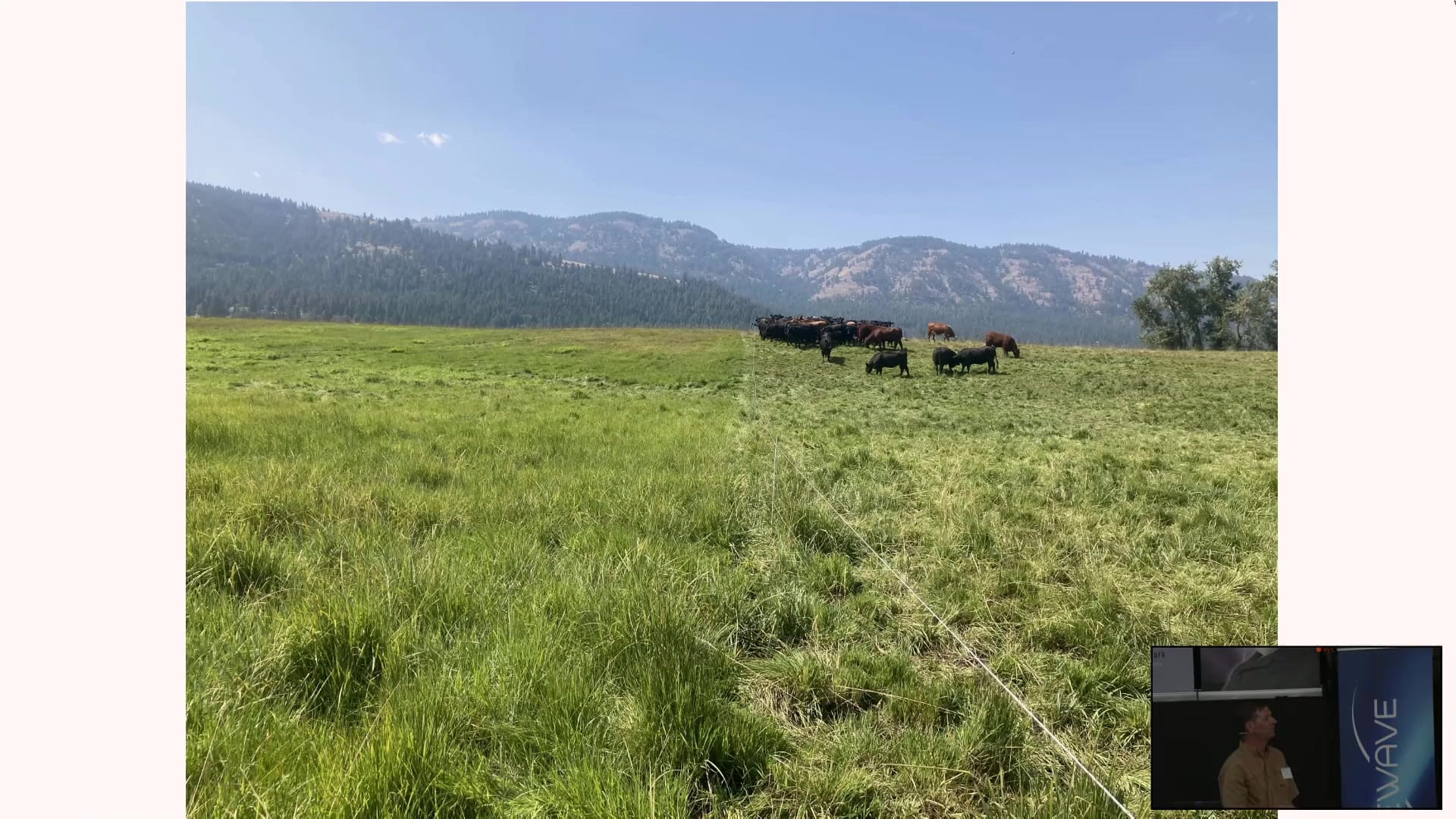
In his 64-minute ESTC 2026 presentation, first-generation rancher Justin Miller shows footage of himself moving upwards of a hundred head of cattle on foot, without a horse or dogs. The cattle come to him because, in his words, “these cows are coming to me because they’ve been trained to do that.”
From 2012 he managed a 1,100-acre preserve whose owners had banned livestock and torn out the cross fences, where the management was “a hundred percent mechanical” and the mower was his office. A 2014 conference introduced him to stockmanship and to the idea that “as beef producers, we’re actually grass farmers.”
Get Regenerative Grazing, the full 64-minute presentation
Same mowing, different regrowth
At a 30,000-acre preserve in Southern California, both sides of a road get the same mowing. On the side whose owner refuses grazing, the cut material lies there dry and not decomposing. The grazed side has regrowth, “totally due to the grazing.” “So that was a big eye-opener for me.”
Paddock timing, fencing and low-stress handling
- One or two days, then rest: how long he leaves a herd in a paddock, 60 to 90 days of recovery on the California coast, and why in northeast Oregon he “could return in 30 days.”
- Single-wire paddocks: poly wire on reels and fiberglass posts, hard fencing only on the perimeter, and why “Goats don’t respect it.”
- Handling without pressure: “I don’t have to go chase these guys around.”
- Machines against cattle: a crawler pulling an open disc over brush “looked a lot like having a large herd of cattle come through,” without the nutrient cycling.
- What it costs: “the wire and the posts. It’s not cheap,” daily fence checks, and water as “one of the biggest challenges.”
Field observations and unanswered questions
Overgrazed and understocked at the same time. The stock density slide he credits to Understanding Ag. A cold wire run into a poison oak thicket the cows had “no interest at all to go into.” Footage of him “right in the midst of them, one man on the ground, no dogs.” And a Q and A on water, fencing and soil, where he describes water infiltration and brix tests without giving readings. His own line on the whole subject: “Somebody said to me at one point, why do we want to sustain a broken system?”
The 2026 ESTC releases so far
- Gangrene Energy, Eric Dollard
- The Alexanderson Antenna, Eric Dollard
- Onan and Dynamotor Tech, Al Francoeur
- A Foundation for True Science, Adrian Marsh PhD
- The coMra Effect, Adrian Marsh PhD, free
- Orgone Energy, Tom DiFerdinando
- 2026 Panel Discussion, nine presenters, free
- Build A Better Tesla Coil, Hakasays
- Efficient Wind Catching Tech, Peter Lindemann and Terry McMenomy
- EPD Telluric Transmitter, Hakasays and Justin Miller
- Regenerative Grazing, Justin Miller (today)
Hear about each release first
Energy Times readers hear about each ESTC 2026 release as it goes live, along with new books, papers and research from emediapress.com. It is free, and you can leave any time. Get Energy Times.
Get the full 64-minute Regenerative Grazing video
Aaron Murakami
Energy Science and Technology Conference · emediapress.com