
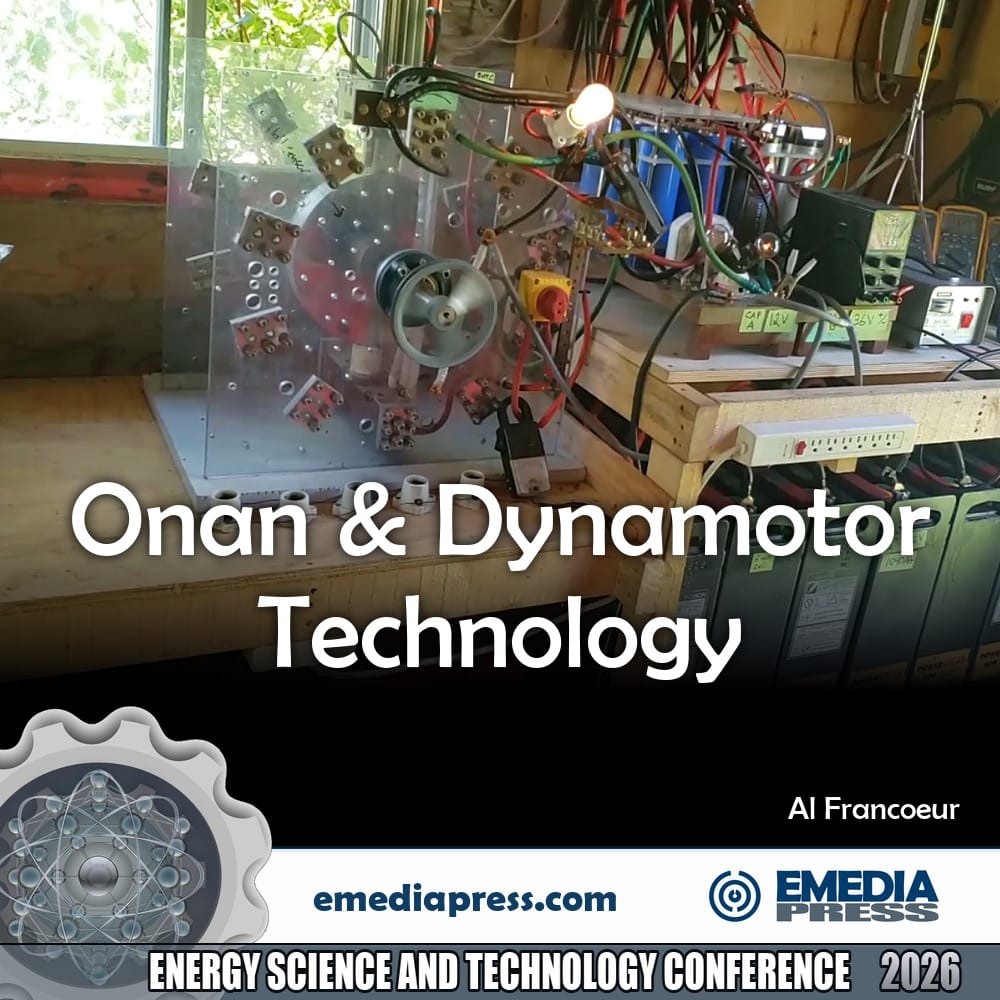
Al Francoeur switched on Dynamo No. 1 in his rebuilt power shop on April 17. He did not switch it off until June 21, the solstice, and only because he was leaving for the conference and will not leave it running unattended. Day and night at about 700 rpm, with two squirts of bearing grease once a month. “And it run flawless. Perfect.”
His 125-minute presentation from the 2026 Energy Science and Technology Conference is the bench report on that machine and the ones around it. He has been off-grid for eight years, since he refused a smart meter and the utility cut him off. He winds every coil by hand. Three dynamos are built, and a fourth is 90 percent complete.
Get Onan and Dynamotor Tech, the full 125-minute presentation
He will not claim over-unity
Francoeur draws one line at the start and holds it: “pending third-party independent verification of all energy systems, I will refrain from stating over unity or efficiencies in these energy systems.” What he shows instead is the apparatus, the wiring, the run times, the scope traces and the burned bulbs, in enough detail to build the same thing. “Well, this is my fourth machine now. And again, it’s working. Again and again. It’s repeatable.”
A motor and a generator at the same time
The dynamo is a brushless permanent-magnet motor-generator that Francoeur calls a magnetic paddle wheel. Battery A drives the pulses. Battery B charges from the generator coils. Battery C catches the spike when the coils collapse, and the harder he loads the rotor, the bigger the spike into C. In his words, “the EVs aren’t doing that.”
The build is plain and visible. Ten-and-a-quarter-inch phenolic rotors carry neodymium magnets around a steel keeper ring, twelve poles on the rotor and ten coil positions at 36 degrees on the stator, Lexan and phenolic throughout, stainless axles. “It’s like a continuous horseshoe magnetic field around and around the rotor.”
It does not need speed. At about 180 rpm, the 35-pound rotor barely turning, it lights a bank of incandescent bulbs at full brightness. “It doesn’t need to go fast to produce power. Full power.” Off the solar panels it runs at 1,400 rpm, dipping and recovering as clouds cross the sun. “I don’t use LED lights at all. I want lights that load the system down.”
Two coils caught fire, so he rewound everything
The pulse coils on the early machine ran hot while the generator coils stayed cool, and one morning two of them burned, smoke in the room. He marked the hot side of each core with red tape and redesigned the windings. The classical coil took 59 feet of magnet wire; his double-helix mirror-image coil takes 10 feet a side, on hollow amorphous ribbon cores, and runs cooler. The switching is as simple as he could make it: one 1-megohm resistor, one hall sensor and one MOSFET on a removable module, terminal studs instead of a circuit board. Dynamo No. 3 adds X-vertex crossover wiring, and No. 4 moves the generator coils nearest the rotor.
One night the 35-pound rotor slowed to a stop and spun back up the other way, witnessed by two people. He suspects vibration shifted a hall sensor, and says that is a suspicion, not a finding.
The Onan that burns the bulbs
The second half of the talk is old iron. Francoeur tracked down five 1964 Onan LK light plants from fire stations and classified ads and converted four. The Onan LK is a 2.5-kilowatt light plant with AC slip rings and a DC commutator on the same rotor, and he sets his restored units beside the Onan in Robert Alexander’s patent to show the same machine design. Run on 24 volts through a 5-ohm potentiometer, a twist of the knob trades axle torque for AC output and back.
Then close the series field switch with the rotor at speed. The rotor slams to a stop while twelve 100-watt bulbs flash like a camera, with half-inch forked arcs inside the glass, and some of the bulbs burn out. The faster it stops, the bigger the burst. He scales up from there to three vintage 10-kilowatt Kohler generators, one from a junkyard with 2,100 hours on it.
What is inside the full 125 minutes
- The three-battery system and the meter readings he reports on battery B and C.
- The coils, the cores and the switching module, with every part number.
- The closed loop: battery B through an inverter and a bench supply into six 1-farad capacitors, the rotor still at 700 rpm under load.
- The dual-rotor Dynamo No. 2 and the iron flux gate between its rotors.
- The waveform he asks the room about, seen on a digital scope and again on a vacuum-tube scope. “What do you call that? Is it real or not, or is it an error? Both scopes showed it.”
- The Q&A: ignitrons versus MOSFETs, GaN switches, short coils versus long, and putting a Kohler in a Volkswagen as an analog EV that motors and generates at the same time.
You do not need to be an engineer. The talk is photographs and video from the shop, and the circuit is simple enough that he shows every part number. The video gives you what a post cannot: every coil, every meter reading and every demonstration, from a builder who has kept four machines running.
Get Onan and Dynamotor Tech, the full 125-minute presentation
More from the 2026 conference
Eric Dollard’s Gangrene Energy is his master class on dirty electricity, and his Alexanderson Antenna goes from the Bolinas blueprints to a radio telescope pointed into the Earth.
Energy Times announces each 2026 conference release as it comes out. It is free, and you can leave any time. Get Energy Times.
Aaron Murakami
Energy Science and Technology Conference · emediapress.com