
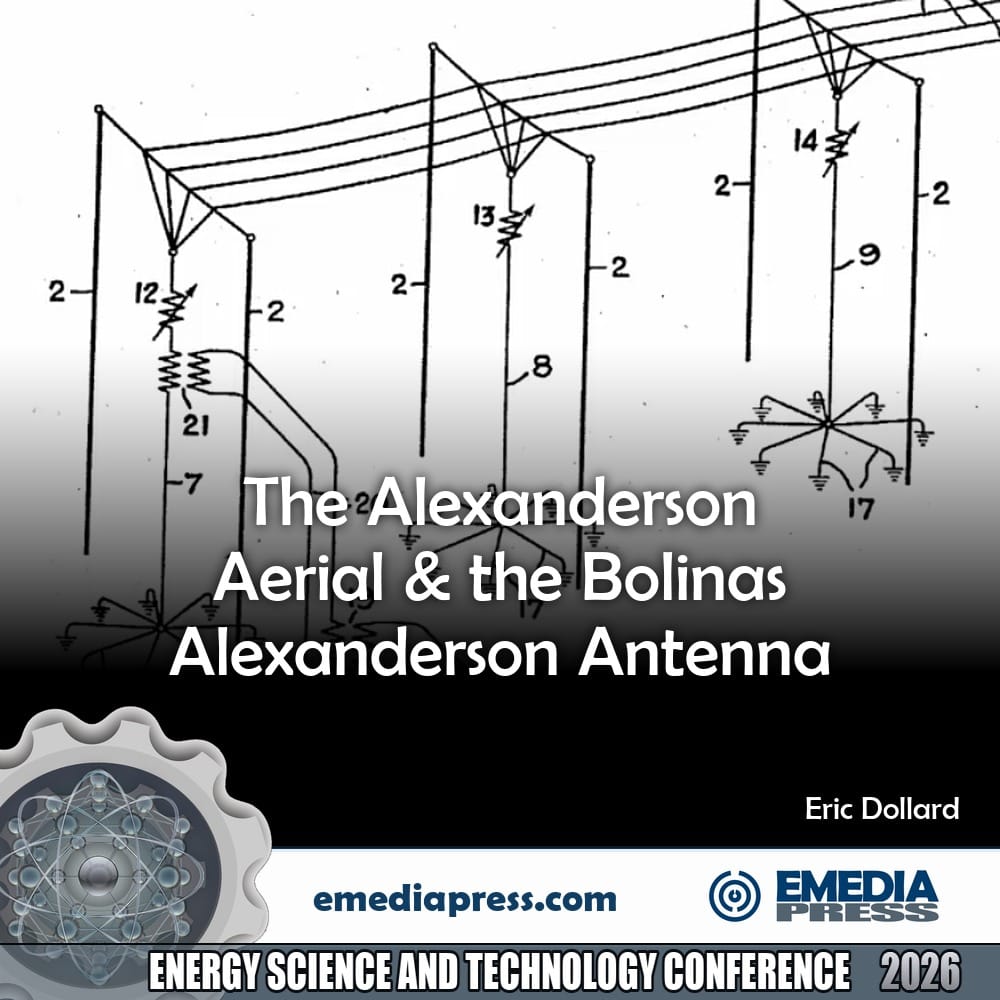
At 14, Eric Dollard walked into the RCA transmitting station on the cliffs at Bolinas, California. By 16 he had the keys. He held the original Marconi blueprints while he was still in high school, learned the station from men who had worked for Marconi, General Electric and RCA, and later inherited the station records and diagrams.
What had been built there was not what RCA taught him. His 223-minute presentation from the 2026 Energy Science and Technology Conference explains what the Alexanderson Aerial actually was, why it is not an ordinary antenna, and what he is building with it in mind at Tonopah, Nevada.
Get the Alexanderson Antenna, the full 223-minute presentation
The drawings, and what came out of the ground
Dollard did not stop at paper. He lived in the powerhouse and the antenna field and dug the Marconi, GE and RCA dumps along the cliffs for the hardware that had been thrown away: porcelain inserts from the series coil with the corona burns still on them, and an eight-saddle shunt-coil insulator he spent a week breaking out of Navy concrete. The pieces told him what the drawings left out, including series condensers nobody had drawn.
A structure that operates in unison
His conclusion, from the blueprints, the station records and the dirt, is that the phase of the current is invariant along the whole length of the Aerial. “There’s no delay and there’s no advance. Everything operates in unison.” He builds the case from the loading of transmission lines in the work of Steinmetz and Heaviside: lag networks and lead networks arranged so the advance of one cancels the delay of the other. When he ran the numbers, the electrostatic power flow was orders of magnitude larger than the electromagnetic. In his analysis the Aerial is electric, not electronic, and not an electromagnetic antenna at all.
A scale model makes it physical: 2,700 feet becomes 27 feet, 19 kilocycles becomes 1,900 kilocycles in the 160-meter amateur band, and the reactance stays at 1,800 ohms.
The Marconi aerial by the numbers
From the constants of the Marconi setup, Dollard works out the aerial that came before it: 3,000 feet long, 600 feet wide, 300 feet up, 44.77 kilocycles, 1,540 amperes at 100,000 volts, a magnification factor of 513. “It rang like a bell.” The RCA-207 water-cooled triodes that followed took 22 volts at 55 amps on the filament, and four of them made 50 kilowatts continuous. “It made all the lights dim in the town of Bolinas when you key one of these things.”
Ten years listening at Landers
Dollard built a receiving version at Landers: a 900-foot Alexanderson antenna under an 1,800-foot beverage antenna, ground rods driven into greasewood roots because the granite would not take them, the inside of the Earth on one speaker and the outside on the other. “And what I heard there and measured was absolutely stunning.” It taught him why Tesla built metallic roots instead of a radial ground, and why each loading network needs its own spot of ground. “Whatever is up in the air has got to be buried in the ground.” His summary of the whole idea: “This thing is a radio telescope to listen to the interior of Earth.”
The Tonopah line, pole by pole
The last part of the presentation leaves the equations and walks the right of way: a 54-pole line over about 2.1 miles, built to Bell System open-wire standards from hardware harvested out of the Mojave and the Great Basin. The aerial section strung so far runs 4,800 feet, from pole 49 to pole 26, with the Alexanderson pair in the center and the outer pairs transposed so they cannot talk to it. For now it runs as a simple capacitance aerial, like the Marconi aerial at Bolinas; the Alexanderson loading networks are the next stage.
Dollard shows the loading points, the 120-year-old pole on a 45-degree slope, the guying that stops one broken pole from pulling the whole antenna down, and the Bell carrier repeater cabinet in the ravine where the signal comes out at a level you can hear in a telephone receiver. “Everything you see here is basically a museum.” Still to come are the carrier pairs to the mine, its seismic transducers, and the public display he calls the musical seismograph. “I’m going to hang a sign on the door that says no software allowed past this point.”
What is inside the full 223 minutes
- Bolinas from the inside: the 1913 Marconi powerhouse, the Navy pushing Marconi out, and Steinmetz handing the antenna to Ernst Alexanderson.
- The lineage of the electric wireless, from Franklin’s kite through Loomis, Tesla, Hertz and Marconi.
- The units rebuilt from scratch in CGS, and the Steinmetz-Heaviside power equation in plain algebra.
- Loading, from the undersea telegraph cable to the Aerial, and the space scalar condition.
- The scale model, the Landers installation, and the Tonopah crossarm patterns.
- The Q&A, including the working Alexanderson station in Sweden and the analog instruments Dollard trusts.
You do not need to be an engineer. The opening is history and people, the mathematics is simple algebra with the units defined before they are used, and the last part is photographs and pole numbers. The video gives you the derivation and the Tonopah line in one sitting, from the one person who slept in the Bolinas powerhouse and is building the next one.
Get the Alexanderson Antenna, the full 223-minute presentation
More from the 2026 conference
Dollard’s other 2026 presentation, Gangrene Energy, is his master class on dirty electricity. Al Francoeur’s Onan and Dynamotor Tech is the bench report on a motor-generator that ran from April 17 to the solstice. For the background on Bolinas itself, see Wireless Giant of the Pacific.
EPD Laboratories, Inc. is a 501(c)(3) nonprofit carrying Eric Dollard’s work forward at its Tonopah, Nevada field site, where the line is being built. Donations are tax-deductible. Donate to EPD Laboratories.
Energy Times announces each 2026 conference release as it comes out. It is free, and you can leave any time. Get Energy Times.
Aaron Murakami
Energy Science and Technology Conference · emediapress.com