Posted on — Leave a comment

Why You Should Read When Stars Look Down by George W. Van Tassel: A Historical Lens on the Integratron and Lakhovsky’s Multiwave Oscillator

For those intrigued by the historical roots of alternative science and the iconic Integratron in Landers, California, When Stars Look Down by George W. Van Tassel is a must-read. Published in 1976, this book offers a fascinating glimpse into Van Tassel’s ambitious vision for the Integratron—a structure designed to rejuvenate human cells by taking the principles of the Lakhovsky Multiwave Oscillator (MWO) to a new level. As one of the earliest English-language accounts of the MWO, and with ties to electrical engineer Eric Dollard, the last notable figure to work on the Integratron’s restoration, this book is a vital historical resource. AMAZON PAPERBACK: WHEN STARS LOOK DOWN, it provides essential context for understanding the Integratron’s place in alternative science history without promoting unproven claims like UFOs or extraterrestrial contacts, which are included for their historical significance. Below, we explore the book’s themes, its connection to the Integratron and MWO, and why it’s a key read for historians and enthusiasts.

Disclaimer: This blog post discusses the historical and theoretical aspects of the Lakhovsky Multiwave Oscillator as presented in When Stars Look Down. The information is not intended to endorse or validate claims about the MWO we manufacture or any other devices. Instead, it highlights the historical importance of Van Tassel’s work in relation to one of the most enigmatic buildings in the world, the Integratron, and its place in alternative science history. Unproven claims, such as UFOs or extraterrestrial influences, are discussed solely for historical context and not as endorsements of their validity.

Overview of When Stars Look Down

When Stars Look Down is a collection of essays and articles by George W. Van Tassel (1910–1978), a former aerospace worker and founder of the Ministry of Universal Wisdom. Drawn from his Proceedings newsletter, the book explores electromagnetic energies, anti-gravity, and spiritual ideas, with some references to extraterrestrial contacts that reflect the era’s UFO fascination. While these unproven claims are not promoted here, they provide historical context for Van Tassel’s motivations behind the Integratron—a 55-foot-diameter, dome-shaped structure begun in 1957 and erected in 1959, intended to extend human lifespan through cellular rejuvenation.

Key themes include:

  • Electromagnetic Life Forces: Van Tassel views humans as “walking batteries,” powered by energies linking cells to broader forces (Chapters 5, 7, 19).
  • Integratron’s Purpose: Described as a modern “Tabernacle” akin to Moses’ biblical structure, the Integratron aims to recharge cells instantly using electromagnetic principles (Chapter 17, “The Integratron” article).
  • Historical Context of UFO Claims: Van Tassel’s assertions of extraterrestrial guidance in 1953 at Giant Rock, California, while unverified, shaped his vision for the Integratron (p. 188).
  • Critique of Mainstream Science: Van Tassel argues that economic interests suppress alternative technologies (Chapters 12, 14).

Available on Amazon, the book’s narrative offers a historical snapshot of mid-20th-century alternative science.

Why Read When Stars Look Down for the Integratron?

The Integratron, located in the Mojave Desert near Joshua Tree, is a global icon of alternative science, known for its acoustically perfect dome and current use as a “sound bath” venue by the Karl sisters since 2000. Listed on the National Register of Historic Places, it was designed as an electrostatic magnetic generator to rejuvenate cells, potentially extending lifespans (p. 175). Van Tassel envisioned it processing 10,000 people daily through a 270-degree arc (p. 146), an ambitious attempt to elevate the MWO’s principles to a new level.

When Stars Look Down is essential for understanding the Integratron because it:

  • Details the Vision: The book outlines the Integratron’s design, combining principles from Nikola Tesla, Georges Lakhovsky, and others, controlled by a “time function” for instant cellular effects (pp. 146, 173-174). It frames the Integratron as an evolution of the MWO, aiming for greater efficiency.
  • Provides Historical Context: While Van Tassel’s claims of extraterrestrial inspiration in 1953 are unproven, they reflect the cultural backdrop of the 1950s-1970s UFO movement and his motivations (p. 188).
  • Connects to Eric Dollard: The Integratron’s historical significance is amplified by Eric Dollard, the last engineer to work on it in the 1980s. Dollard, a Tesla enthusiast, spoke with Van Tassel’s son-in-law, Daniel Boone, who provided insights into the project. In a 2012 Energetic Forum post, Dollard noted, “By good fortune his son in law, Daniel Boone, who was present at the visitation by the E.T., was very helpful” (Energetic Forum Integratron Search). Dollard worked on components like the Di-Rod electrostatic generator but faced conflicts with Van Tassel’s second wife, Dorris. For more, watch his 2014 interview with Scott Hensler, reposted in 2025 (Integratron Interview), his latest 2025 interview on the Integratron’s background (Dollard’s Integratron Background Story), or an excerpt from his Four Quadrant Representation of Electricity (Integratron Excerpt). Dollard’s full presentation, dedicating a significant portion to the Integratron, is a must-see for technical insights (Four Quadrant Representation of Electricity).

The book is a primary source for the Integratron’s origins, making it vital for understanding its ambitious design and Dollard’s contributions.

The Lakhovsky Multiwave Oscillator: An Early English-Language Account

When Stars Look Down is one of the earliest English-language accounts of the Lakhovsky Multiwave Oscillator (MWO), a 1920s device by Georges Lakhovsky aimed at promoting health through electromagnetic frequencies. Referenced in Chapters 12, 17, and the “Integratron” article (pp. 108, 146, 173-174), the book details the MWO’s historical use and technical principles, making it a key resource for studying early alternative technologies.

  • Technical Insights: Van Tassel describes the MWO as generating a broad-spectrum electromagnetic field (10 cm to 400 meters, with harmonics up to 300 trillion vibrations per second), enabling cells and tissues to resonate at their natural frequencies for health benefits (p. 174). Readers can explore the book for detailed applications.
  • Historical Context: Used in French clinics in the 1920s and 1930s with no reported harmful effects, the MWO is documented in Lakhovsky’s The Secret of Life (1939) (p. 174). Van Tassel’s 1976 account predates many modern discussions in alternative science communities.
  • MWO and Integratron: Van Tassel saw the MWO’s side effect—cellular rejuvenation—as the Integratron’s primary purpose, achieved instantly through a “time function control” combining Lakhovsky’s principles with Tesla’s ionization and Barnothy’s magnetic fields (pp. 146, 174). He writes, “Where Georges Lakovsky created regeneration in the cell structure of his subjects, as a side effect of his basic principle, we use his side effect as our basic purpose” (p. 146).

This early documentation is crucial for tracing the MWO’s influence on projects like the Integratron, offering historical context without endorsing unproven claims.

The Integratron and MWO: A Pioneering Connection

The Integratron represents an ambitious attempt to take the MWO to a whole new level. Van Tassel viewed the MWO’s ability to promote cellular health as a foundation, but its weeks-long treatment periods were a limitation. The Integratron, built on a geomagnetic vortex with non-ferromagnetic materials, aims to instantly rejuvenate cells, drawing inspiration from Moses’ Tabernacle and the Great Pyramid (pp. 147-149). By integrating Lakhovsky’s multiple wave oscillation with other technologies, Van Tassel sought to create a revolutionary “energy machine” (p. 146).

This connection is significant because it positions the Integratron as an evolution of the MWO, blending early electromagnetic theories with a bold vision. The book’s explanation of this link provides a unique perspective on how alternative science sought to harness universal energies, making it essential for understanding the Integratron’s historical and theoretical roots.

Why You Should Read It

When Stars Look Down is a compelling read for:

  1. Historical Context: It documents Van Tassel’s vision during the 1950s-1970s UFO movement, providing context for the Integratron’s origins without promoting unproven extraterrestrial claims. It’s a primary source for Dollard’s work, detailed in his 2025 interview (Dollard’s Integratron Background Story).
  2. MWO Insights: As an early English account of the MWO, it offers technical and historical details, ideal for studying alternative technologies.
  3. Integratron’s Legacy: The book explains the Integratron’s design and purpose, crucial for understanding its connection to Dollard’s efforts, as explored in his Four Quadrant Representation of Electricity (Four Quadrant Representation of Electricity).
  4. Cultural Significance: For enthusiasts of alternative science history, it offers a firsthand narrative from a key figure, available on Amazon.

For further insights, explore Dollard’s posts on the Energetic Forum or his 2014 interview (Integratron Interview).

Conclusion

When Stars Look Down by George W. Van Tassel is a historical gem for those fascinated by the Integratron and the Lakhovsky Multiwave Oscillator. Its early account of the MWO and detailed vision for the Integratron—as an ambitious evolution of the MWO—make it essential reading for historians and enthusiasts, with Eric Dollard’s restoration efforts adding technical depth. While unproven UFO claims are part of its historical context, the book’s value lies in its documentation of alternative science’s roots. Dive into this captivating narrative, available on Amazon, to explore the Integratron’s legacy and its place in the history of unconventional technology.
Posted on — Leave a comment

Dollard’s Integratron Background Story

Here’s the latest video interview with Eric Dollard sharing how he became involved with the Integratron and other details most people haven’t heard about. This live call was on 2025-07-12.

Support EPD Laboratories, Inc. 501(c)3 – https://ericpdollard.com/donate

Posted on — Leave a comment

Integratron Interview of Eric Dollard by Scott Hensler

Here’s an interview of Eric Dollard by Scott Hensler from some years ago. Eric wants to bring this to everyone’s attention because shortly after this, we’ll release another video, which will be an exerpt from one of Eric’s presentations from the Energy Science & Technology Conference also relating to the Integretron.

What’s the Integratron? Listen to the interview!

It’s interesting to note that the Lakhovsky MWO was part of the inspiration behind George Van Tassel’s Integratron and Eric Dollard was the last real engineer who worked on it.

Support EPD Laboratories, Inc. 501(c)3 non profit, which is advancing the electrical sciences. https://ericpdollard.com/donate

Posted on — Leave a comment

2024-10-09 Aaron Murakami Interviewed by Karen Elkins of Science to Sage on the Lakhovsky Multiwave Oscillator

In this compelling interview with Karen Elkins, editor and founder of Science to Sage Magazine, Aaron Murakami shares incredible stories about his friendships with energy science pioneers like John Bedini, Eric Dollard, Peter Lindemann, and Paul Babcock, detailing how their work shaped his journey into alternative energy technologies. Aaron delves into how he got involved with the Lakhovsky Multiwave Oscillator (MWO) and offers an in-depth look at the device, explaining the critical differences between longitudinal and transverse waves, debunking the myth of scalar waves, and revealing how the MWO automatically tunes itself to its environment. He highlights Lakhovsky’s unbalanced vs. balanced operation, explaining the three intrinsic unbalanced features that most modern MWO units are missing—except for one—and provides a fascinating demonstration of the difference between balanced and unbalanced operation. He also shares insights into the origins of A & P Electronic Media, John Bedini’s battery chargers, and the history behind the Energy Science & Technology Conference, all while emphasizing that profits from the MWO go towards funding other innovative projects in Spokane, Washington.

Aaron takes viewers on a journey through advanced physics concepts, breaking down Einstein’s nonsensical views and redefining the true nature of space, inertia, and time. He explores extraluminal propagation, the structure of EMF, and what truly moves electron current. Aaron offers real definitions of energy and potential, showing how mainstream science has turned these concepts upside down, while explaining how we’re already tapping into the aether—the source of all potential. He also debunks the myth that energy can’t be created or destroyed and reveals how energy is destroyed between the coils of the Cosmic Induction Generator. Throughout the interview, he discusses inductive spikes vs. back EMF, burden in MWO rings, and the counterspace phenomenon. Aaron’s personal insights, including Eric Dollard’s relationship with Philo Farnsworth’s son, synchronicities that led him to these pioneers, and Eric Dollard’s golden ratio PCB antennae, are woven into the discussion, offering viewers an unmatched depth of knowledge.

Whether you’re interested in the Lakhovsky MWO, the Cosmic Induction Generator, or a fresh understanding of time, energy, and space, Aaron provides clear, practical explanations. He offers resources for deeper learning, including over 225 books and videos at https://eMediaPress.com, free downloads, and references to http://EnergeticForum.com and https://EnergyScienceForum.com for further exploration. This is a must-watch interview for anyone seeking to understand the hidden potentials of the universe and how Aaron’s work continues to push the boundaries of energy science. Don’t miss it! Science to Sage Magazine is available at https://sciencetosage.com

Posted on — Leave a comment

February 7, 2024 Live EPD Zoom Call Recording

This call goes into a lot of Griffin Brock’s earth signal reception system with an Alexanderson type of antennae elevated above his entire home and Adrian Marsh PhD covers more about the Golden Ratio discharge experiments including an astonishing “Golden Dragon” discharge.

Please donate to EPD Laboratories, Inc. 501(c)3 Non Profit at https://ericpdollard.com/donate

Posted on — Leave a comment

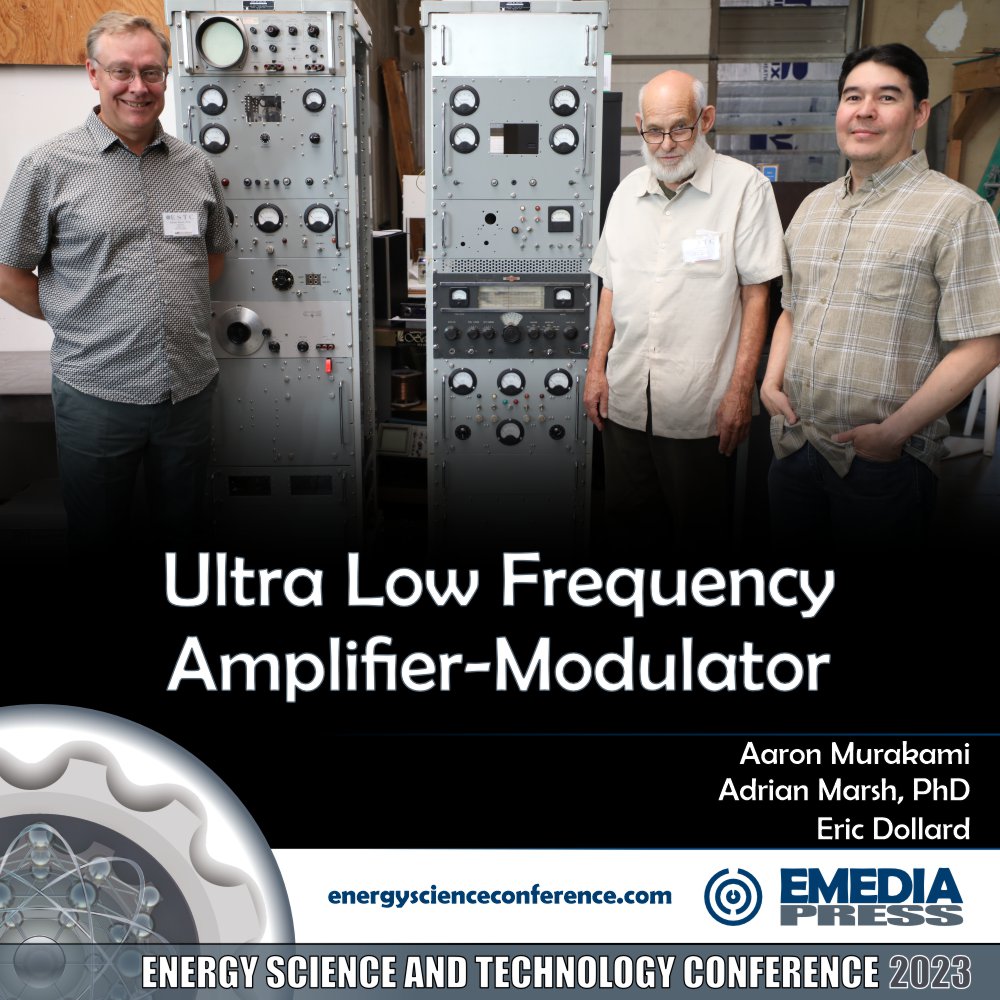
NEW RELEASE – 2023 ESTC Ultra Low Frequency Amplifier-Modulator – Eric Dollard, Adrian Marsh PhD, Aaron Murakami

Last year’s flame speaker was 100 watts, this year, it will be around 2000 watts. The audio modulator bay is 100% complete and the RF bay is well on its way. We have some makeshift modifications that we had time to complete for the conference. We’ll continue to completion after the conference. There will be multiple demonstrations with this universal, high frequency and high voltage test equipment. Watch the preview video below for a sample of what is demonstrated.

Posted on — Leave a comment

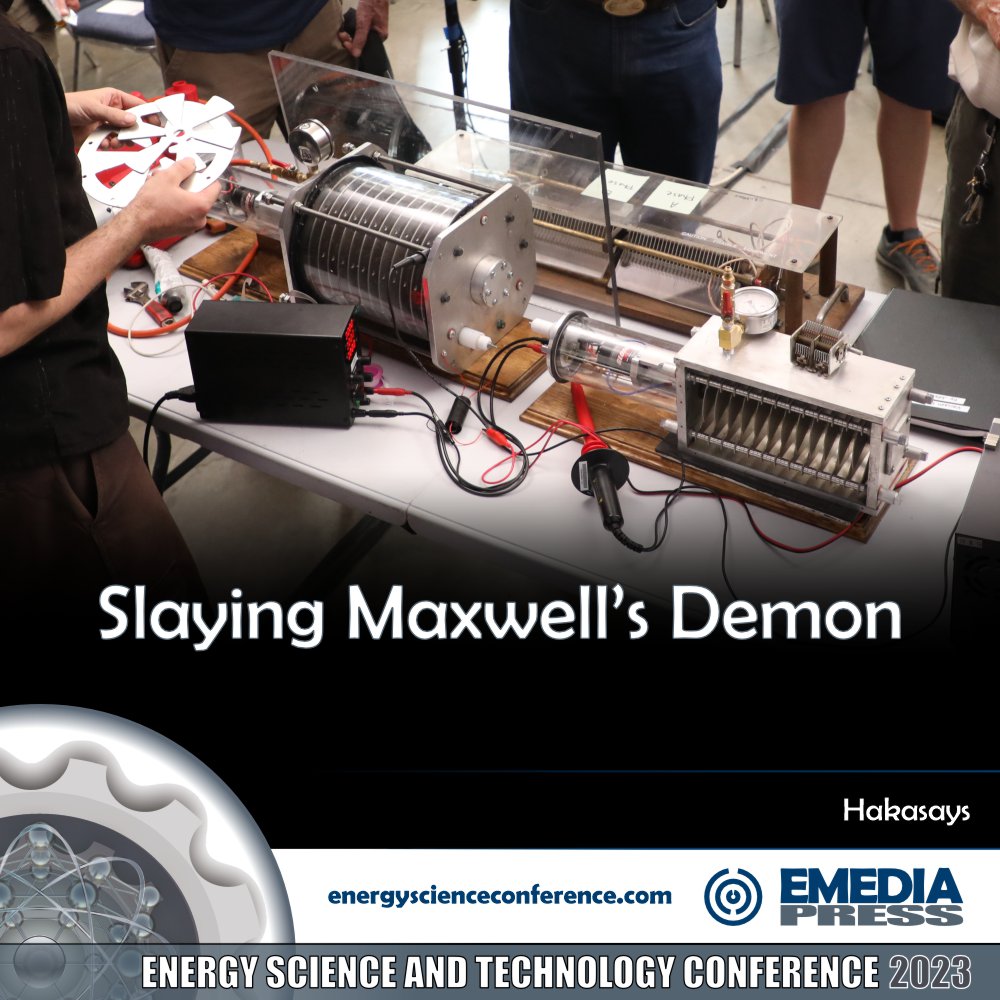
NEW RELEASE – 2023 ESTC Slaying Maxwell’s Demon – Hakasays

The focus in this presentation is to step back and take a “bird’s-eye-view” of both the established and the fringe science and find common themes/mechanics between them. How does Lorentz Special Relativity relate to electrical engineering, and is it compatible with the works of Eric Dollard, Heaviside, and others? How can we tell if a theory is accurate, and how might we design experiments to confirm or falsify a model or claim? Are there common threads between different claimed “overunity” devices? Parametric variation is a major theme of the talk, and the demonstration(s) will be a reflection of that. A much improved ‘Carson rotary electrostatic converter’ aka Trump motor is planned for demonstration as well as other models to demonstrate key principles of fringe tech.

Posted on — Leave a comment

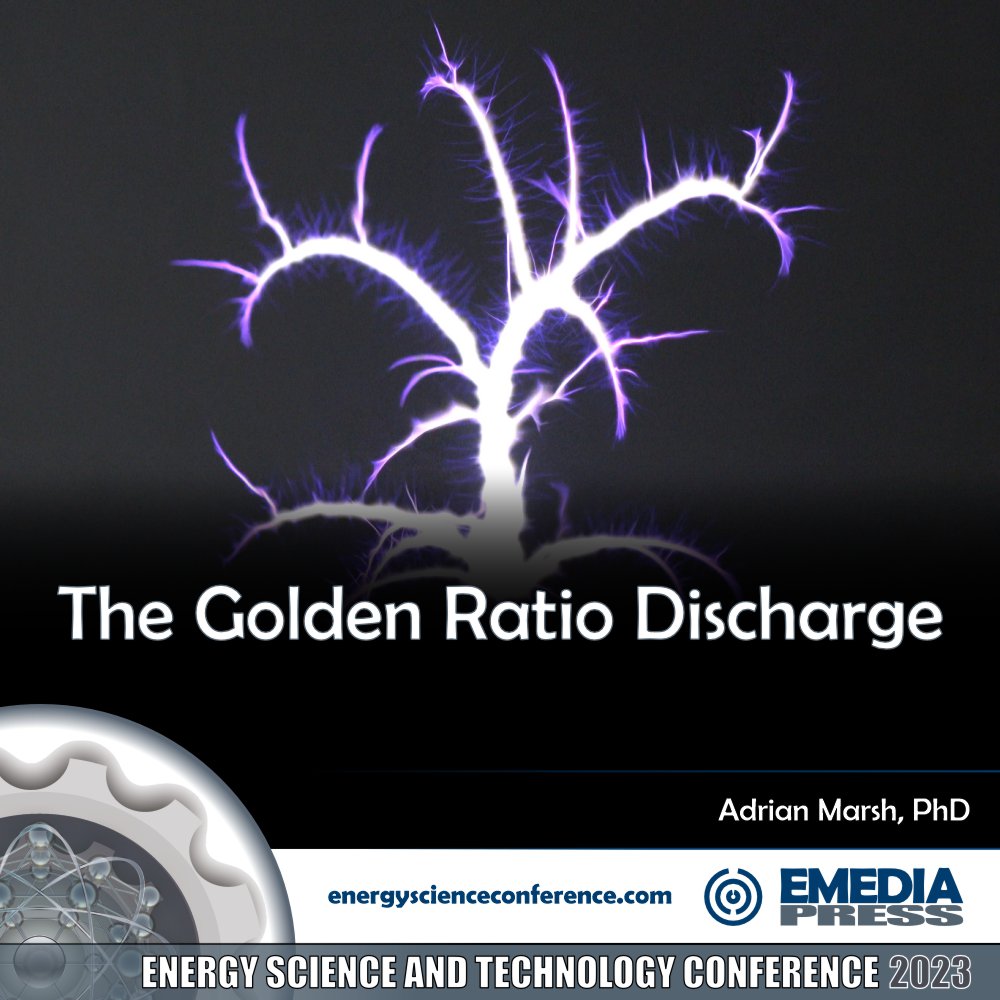
NEW RELEASE – 2023 ESTC – Adrian Marsh, PhD – The Golden Ratio Discharge

The Golden Ratio is one of the fundamental underlying principles in the Wheelwork of Nature, and is reflected within many forms in the natural world. The Golden Ratio Discharge reflects this fundamental principle in the field of electricity and energy, first discovered by Eric Dollard in 1978, and now rediscovered by Adrian Marsh, and demonstrated by using a specific arrangement of Tesla coil and generator. This presentation makes an in-depth exploration of this unique discharge, looking into its scientific, engineering, and philosophical/esoteric origins, and how to practically reveal this discharge in a Tesla coil system, as well as considering its importance as an example of a core underlying principle of nature revealed in the field of electricity and electro-magnetism.

A complete engineering apparatus and schematics are disclosed for the experimental Tesla coil system, along with comprehensive measurements of the power supply, generator, and Tesla coil characteristics in both the time and frequency domain. The presentation contains all the necessary design keys to replicate this remarkable experiment. Vibration, tuning, and resonance of the experiments are explored in detail, and how to transition the discharge form from the Golden Dragon, a fractal expanding with Golden Ratio proportions, to more conventional Sword streamers. The Golden Dragon discharge shows profound symmetry, temporal and spatial coherence, and a choreography that demonstrates in no uncertain terms the fundamental nature of this underlying principle of the natural world.

The inner nature of the Golden Ratio discharge is explored using high-speed photography up to 2000 times which shows the creation and extinction of each discharge streamer, and hidden within this the first conjectured emergence of ball-lightning, or the formation of a “micro-sun”, the precursor to an inclusive fusion process, observed before within specialised vacuum tubes, but never before manifested in free-space. The presentation concludes with a live demonstration of the optimal tuning of the experimental apparatus to generate the Golden Ratio discharge in the form of the Golden Dragon, and then through specific tuning and adjustment the transition to sword streamers at lower frequencies.
The Golden Ratio Discharge experiment in this presentation is shown to support Tesla’s profound statement, “… then it is a mere question of time when men will succeed in attaching their machinery to the very wheelwork of nature.”, and has the potential to reveal deeper insights, principles, and knowledge of the natural order.

Includes PDF of the Powerpoint presentation and two close-up videos of the Golden Ratio Discharge.

Posted on — Leave a comment

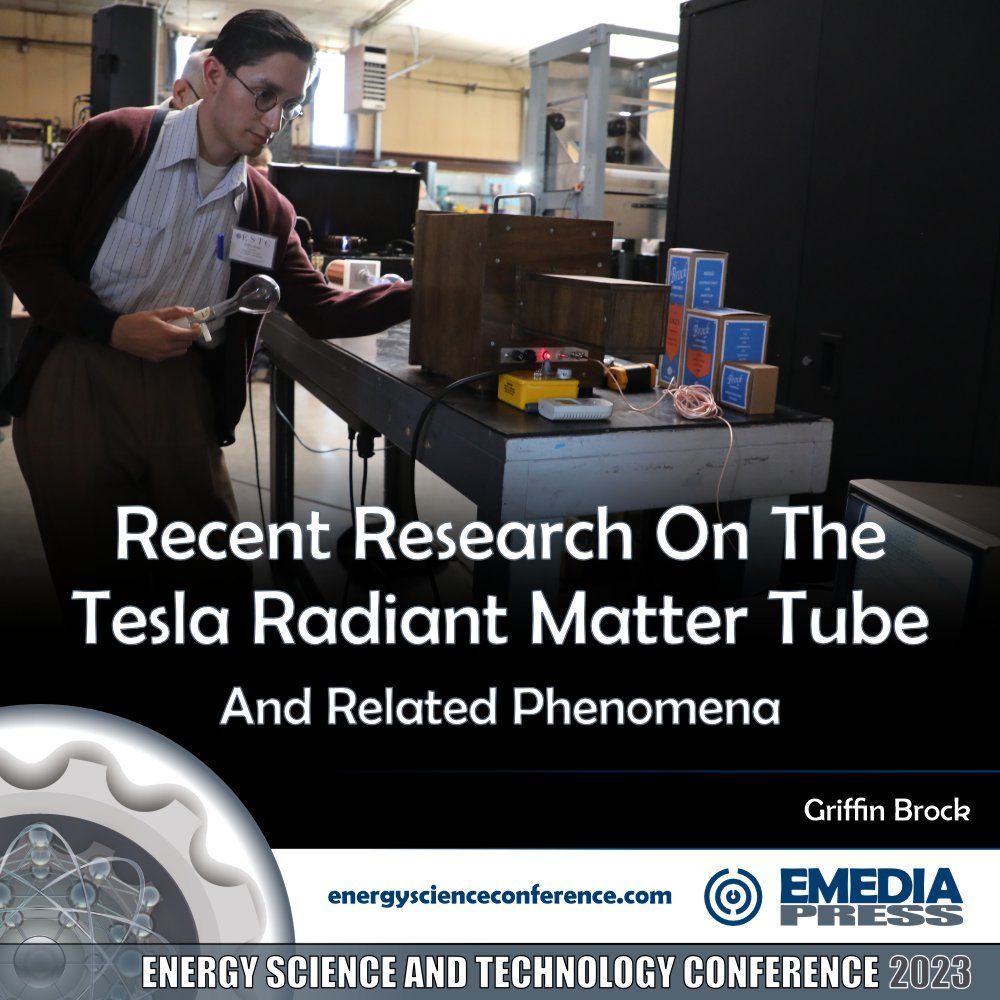
NEW RELEASE 2023 ESTC- Griffin Brock – Recent Research On The Tesla Radiant Matter Tube And Related Phenomena

This presentation by Griffin Brock demonstrates fundamental science – for the first time in 120 years, Tesla’s Shadowgraph tube has been perfected and demonstrated. This is one of the most important breakthroughs in the Tesla sciences that has emerged in a long time and we were fortunate to be able to witness this first hand at the 2023 ESTC!

At the close of the Nineteenth Century, research as conducted by Nikola Tesla became exceedingly directed towards high vacuum – high frequency vacuum tubes. Tesla produced a variety of single electrode lamps, some of which manufactured rather unique rays, dubbed as Shadowgraphs. As opposed to succeeding contemporaries including W. C. Röentgen, whom of which proclaimed a similar effect, Nikola Tesla ultimately discovered an exceptional form of ray, similar to conventional Röentgen Rays, while not possessing inherent characteristics. Tesla later dwelled upon these special single-electrode tubes, realizing their implication in radiant matter applications, as well as their electrostatic effects. This presentation will cover the replication and a rigorous scientific exploration into the realm of the Tesla Radiant Matter – Shadowgraph Tube. As well as the covering of perfected versions of the apparatus, not expounded upon since the 1890’s.

See the preview or get a copy here: